Biology:Ceriagrion aeruginosum
| Ceriagrion aeruginosum | |
|---|---|

| |
| Redtail in Cairns, Queensland | |
Scientific classification 
| |
| Kingdom: | Animalia |
| Phylum: | Arthropoda |
| Class: | Insecta |
| Order: | Odonata |
| Suborder: | Zygoptera |
| Family: | Coenagrionidae |
| Genus: | Ceriagrion |
| Species: | C. aeruginosum
|
| Binomial name | |
| Ceriagrion aeruginosum (Brauer, 1869)[2]
| |

| |
| Synonyms[3] | |
|
Agrion aeruginosum Brauer, 1869 Ceriagrion erubescens Selys, 1891 | |
Ceriagrion aeruginosum is a species of damselfly in the family Coenagrionidae.[4] Its common name is redtail.[5] It is found in Indonesia, the Moluccas, New Guinea, Australia and possibly the Solomon Islands.[5]
Natural habitats of Ceriagrion aeruginosum are freshwater swamps, ponds and slow moving streams. Adult males are medium-sized damselflies (wingspan 50mm, length 45mm), mostly red with their synthorax becoming pale green as they mature. In Australia, their distribution is in suitable habitat in the north-west and north-eastern part of the continent from about Broome to the south-eastern Queensland border.[5]
Ceriagrion aeruginosum has been assessed as least concern 3.1 in the IUCN Red List.
Etymology
The genus name Ceriagrion is derived from the Latin cerinus ("wax-coloured"), combined with Agrion, a genus name derived from the Greek ἄγριος (agrios, "wild"). Agrion was the name given in 1775 by Johan Christian Fabricius for all damselflies.[6]
The species name aeruginosum is derived from the Latin aeruginosus ("verdigris-coloured" or "rusty"), referring to the brownish colouring of the thorax, legs and top of the head.[6]
Gallery
-
 Mating pair
 -
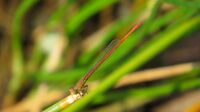 Male from above
 -
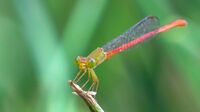 Male face
 -
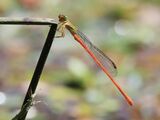 male, Cairns
 -
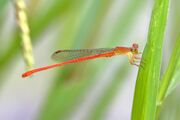 male, Cairns
 -
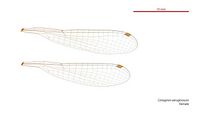 Female wings
 -
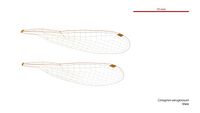 Male wings


.jpg)
.jpg)
See also
- List of Odonata species of Australia
References
- ↑ Kalkman, V.J. (2020). "Ceriagrion aeruginosum". IUCN Red List of Threatened Species 2020. doi:10.2305/IUCN.UK.2020-1.RLTS.T163918A83377729.en. https://www.iucnredlist.org/species/163918/83377729. Retrieved 19 November 2021.
- ↑ Brauer, F. (1869). "Beschreibung neuer Neuropteren aus dem Museum Godeffroy in Hamburg" (in German). Verhandlungen der Zoologisch-Botanischen Gesellschaft in Wien 19: 9–18 [13]. https://www.biodiversitylibrary.org/page/30239732.
- ↑ "World Odonata List". University of Puget Sound. https://www.pugetsound.edu/academics/academic-resources/slater-museum/biodiversity-resources/dragonflies/world-odonata-list2/.
- ↑ "Species Ceriagrion aeruginosum (Brauer, 1869)". Australian Biological Resources Study. 2012. https://biodiversity.org.au/afd/taxa/Ceriagrion_aeruginosum.
- ↑ 5.0 5.1 5.2 Theischinger, G; Hawking, J (2006). The Complete Field Guide to Dragonflies of Australia. Collingwood Vic.: CSIRO Publishing. p. 88. ISBN 978-0-64309-073-6.
- ↑ 6.0 6.1 Endersby, Ian; Fliedner, Heinrich (2015). The Naming of Australia's Dragonflies. Eltham, Victoria, Australia: Busybird Publishing. ISBN 9781925260625. https://www.researchgate.net/publication/283318421_The_Naming_of_Australia's_Dragonflies.
 |
Wikimedia Commons has media related to Ceriagrion aeruginosum. |
Wikidata ☰ Q3098281 entry
 |  |


