Biology:Chacoan mara
| Chacoan mara Temporal range: Pleistocene–recent
| |
|---|---|
,_Chacoan_mara,_Kleiner_Mara,_Tierpark_Berlin_Friedrichsfelde,_10.2012.jpg)
| |
Scientific classification 
| |
| Kingdom: | Animalia |
| Phylum: | Chordata |
| Class: | Mammalia |
| Order: | Rodentia |
| Family: | Caviidae |
| Genus: | Dolichotis |
| Species: | D. salinicola
|
| Binomial name | |
| Dolichotis salinicola Burmeister, 1876
| |
| File:Dolichotis salinicola distribution map.png | |
| Synonyms | |
|
Pediolagus salinicola | |
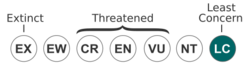
The Chacoan mara (Dolichotis salinicola) or Chacoan cavy is a relatively large South American rodent of the cavy family.[2] They are a close relative of the better known Patagonian mara. The Chacoan mara is the sole member of the genus Dolichotis.
Taxonomy
Until recently Pediolagus was considered synonymous with Dolichotis and the Chacoan mara was a member of that genus. However, a 2020 study by the American Society of Mammalogists found significant difference between the two mara species to warrant resurrecting Pediolagus.[3] Conversely, a 2021 study indicated that Pediolagus should be included in Dolichotis alongside the fossil species D. chapalmalense, D. major, and D. intermedia, and that the retention of Pediolagus would cause taxonomic issues and confusion for these fossil species.[4] The American Society of Mammalogists and IUCN continue to recognize this species as a member of Dolichotis.[1][5]
Habitat
The Chacoan mara lives in the South American Chaco, the dry thorny forests and grasslands of Argentina, Paraguay, and Bolivia. Maras dig a burrow to sleep in at night.
Ecology
The Chacoan mara eat grasses and other herbage. They will eat nearly any available vegetation. Specifically, they select forbs, grasses, succulents, and trees in the dry season and grasses in the wet season.[6] Annual forbs are eaten in the wet season as well.[7]
Despite the Chaocan cavy's close resemblance and coexistence to the Patagonian mara, they have a broader niche to allow coexistence with its relative.[8] This flexibility is reflected by its subfamily's high diversity,[9] recorded as early as the late Miocene epoch.[10]
Chacoan maras live in small groups of up to four animals.
References
- ↑ 1.0 1.1 Bernal, N. (2016). "Dolichotis salinicola". IUCN Red List of Threatened Species 2016. doi:10.2305/IUCN.UK.2016-2.RLTS.T6786A22190451.en. https://www.iucnredlist.org/species/6786/22190451. Retrieved 12 November 2021.
- ↑ Woods, C.A.; Kilpatrick, C.W. (2005). "Infraorder Hystricognathi". in Wilson, D.E.; Reeder, D.M. Mammal Species of the World: A Taxonomic and Geographic Reference (3rd ed.). Johns Hopkins University Press. p. 1555. ISBN 978-0-8018-8221-0. OCLC 62265494. http://www.departments.bucknell.edu/biology/resources/msw3/browse.asp?id=13400215.
- ↑ Campo, D.H. (2020). "Integrative taxonomy of extant maras supports the recognition of the genera Pediolagus and Dolichotis within the Dolichotinae (Rodentia, Caviidae)". Journal of Mammalogy 101 (3): 817–834. doi:10.1093/jmammal/gyaa038. https://academic.oup.com/jmammal/article/101/3/817/5836015.
- ↑ Madozzo‑Jaén, María Carolina; Pérez, María Encarnación; Deschamps, Cecilia Marcela (19 August 2021). "The Oldest Species of Dolichotis (Rodentia, Hystricognathi) from the Pliocene of Argentina: Redescription and Taxonomic Status of "Orthomyctera" chapalmalense". Journal of Mammalian Evolution 28 (3): 995–1013. doi:10.1007/s10914-021-09559-4.
- ↑ "Dolichotis salinicola Burmeister, 1876". American Society of Mammalogists. https://www.mammaldiversity.org/taxon/1001208.
- ↑ Chillo, Verónica; Rodríguez, Daniela; Ojeda, Ricardo A. (November 2010). "Niche partitioning and coexistence between two mammalian herbivores in the Dry Chaco of Argentina". Acta Oecologica 36 (6): 611–616. doi:10.1016/j.actao.2010.09.006. Bibcode: 2010AcO....36..611C.
- ↑ Rosati, V. R.; Bucher, E. H. (1 January 1992). "Seasonal diet of the Chacoan Cavy (Pediolagus salinicola) in the western Chaco, Argentina". Mammalia 56 (4): 567–574. doi:10.1515/mamm.1992.56.4.567.
- ↑ Rodriguez, D. (2010). "Niche partitioning and coexistence between two mammalian herbivores in the Dry Chaco of Argentina". Acta Oecologica 36 (6): 611–616. doi:10.1016/j.actao.2010.09.006. Bibcode: 2010AcO....36..611C.
- ↑ Madozzo-Jaén, M (2019). "Systematic and phylogeny of Prodolichotis prisca (Caviidae, Dolichotinae) from the Northwest of Argentina (late Miocene–early Pliocene): Advances in the knowledge of the evolutionary history of maras.". Comptes Rendus 18 (1): 33–50. doi:10.1016/j.crpv.2018.07.003. Bibcode: 2019CRPal..18...33M.
- ↑ Quintana, C (2005). "The caviomorph rodents from the San Andrés Formation, east-central Argentina, and global Late Pliocene climatic change.". Palaeogeography, Palaeoclimatology, Palaeoecology 219 (3–4): 303–320. doi:10.1016/j.palaeo.2005.01.003. Bibcode: 2005PPP...219..303V.
Template:Caviidae nav Wikidata ☰ Q195350 entry
 |  |


