Biology:Cordulephya bidens
| Tropical shutwing | |
|---|---|
| File:Female Tropical Shutwing, imported from iNaturalist photo 183358425.jpg | |
| Female | |
Scientific classification 
| |
| Kingdom: | Animalia |
| Phylum: | Arthropoda |
| Class: | Insecta |
| Order: | Odonata |
| Infraorder: | Anisoptera |
| Family: | Cordulephyidae |
| Genus: | Cordulephya |
| Species: | C. bidens
|
| Binomial name | |
| Cordulephya bidens Sjöstedt, 1917[2]
| |

| |
| Range in tropical North Queensland, Australia | |
Cordulephya bidens is a species of dragonfly in the family Austrocorduliidae,[3][4] commonly known as the tropical shutwing.[5] It inhabits rainforest streams in northern Queensland, Australia.[6][7]
Cordulephya bidens is a small to tiny, black or purplish-black dragonfly with yellowish markings. It rests with its wings folded above its body, similar to a damselfly.[5]
Etymology
The genus name Cordulephya combines Cordulia, a genus name derived from the Greek κορδύλη (kordylē, "club" or "cudgel"), with Greek φυή (phyē, "form", "stature" or "growth"), thus meaning "having the form of Cordulia".[8]
The species name bidens is Latin for "two-toothed" or "with two teeth", likely referring to the teeth on the male appendages.[2][8]
Gallery
-
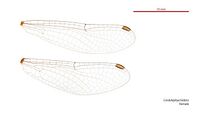 Female wings
 -
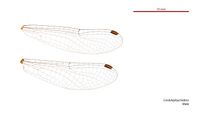 Male wings
.jpg)
.jpg)
See also
- List of Odonata species of Australia
References
- ↑ Dow, R.A. (2017). "Cordulephya bidens". IUCN Red List of Threatened Species 2017. doi:10.2305/IUCN.UK.2017-1.RLTS.T163575A14272490.en. https://www.iucnredlist.org/species/163575/14272490. Retrieved 19 November 2021.
- ↑ 2.0 2.1 Sjöstedt, Yngve (1917). "Results of Dr E. Mjöberg's Swedish scientific expeditions to Australia 1910–1913. 16. Odonaten." (in de). Arkiv för Zoologi 11 (11): 1–44 [7]. https://www.biodiversitylibrary.org/page/6739165.
- ↑ "Species Cordulephya bidens Sjöstedt, 1917". Australian Biological Resources Study. 2022. https://biodiversity.org.au/afd/taxa/Cordulephya_bidens.
- ↑ "World Odonata List". University of Puget Sound. https://www.pugetsound.edu/academics/academic-resources/slater-museum/biodiversity-resources/dragonflies/world-odonata-list2/.
- ↑ 5.0 5.1 Theischinger, Günther; Hawking, John (2021). The Complete Field Guide to Dragonflies of Australia (2nd ed.). Melbourne, Australia: CSIRO Publishing. pp. 406. ISBN 978-1-4863-1374-7.
- ↑ Theischinger, Gunther; Endersby, Ian (2009). Identification Guide to the Australian Odonata. Department of Environment, Climate Change and Water NSW. p. 209. ISBN 978-1-74232-475-3. http://www.environment.nsw.gov.au/resources/publications/09730AustOdonata.pdf.
- ↑ Watson, J.A.L.; Theischinger, G.; Abbey, H.M. (1991). The Australian Dragonflies: A Guide to the Identification, Distributions and Habitats of Australian Odonata. Melbourne: CSIRO. pp. 278. ISBN 0-643-05136-8.
- ↑ 8.0 8.1 Endersby, Ian; Fliedner, Heinrich (2015). The Naming of Australia's Dragonflies. Eltham, Victoria, Australia: Busybird Publishing. ISBN 9781925260625. https://www.researchgate.net/publication/283318421_The_Naming_of_Australia's_Dragonflies.
 |
Wikimedia Commons has media related to Cordulephya bidens. |
Wikidata ☰ Q2517247 entry
 |  |


