Biology:Diamond dove
| Diamond dove | |
|---|---|

| |
| Round Hill Nature Reserve, New South Wales, Australia. | |
Scientific classification 
| |
| Kingdom: | Animalia |
| Phylum: | Chordata |
| Class: | Aves |
| Order: | Columbiformes |
| Family: | Columbidae |
| Genus: | Geopelia |
| Species: | G. cuneata
|
| Binomial name | |
| Geopelia cuneata (Latham, 1801)
| |

| |
| distribution | |
The diamond dove (Geopelia cuneata) is a resident bird in Australia. The pigeon predominantly exists in areas near water but which are lightly arid or semi-arid in nature, being Central, West and Northern Australia. They are one of Australia's smallest pigeons along with the peaceful dove. They have been spotted occasionally in Southern Australia in parks and gardens when the centre of Australia is very dry.
Taxonomy and etymology
English ornithologist John Latham first described the diamond dove in 1801.[2] The common name "diamond" is a reference to the white speckles on its wings.[2]
Description
Regardless of its astoundingly small size (weighing only about 35 g), it has a great tolerance to high heat levels due to adaptations in body temperature, metabolism, respiration, water balance, and behaviour.[3]
Behaviour
The diamond dove is often seen on the ground, where it runs with a waddling gait. Its flight is strong, direct, and sometimes undulating.[4] The wings can make a whistling "frrr" noise when flying.
Conservation
Australia
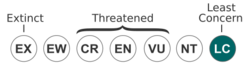
Diamond doves are not listed as threatened on the Australian Environment Protection and Biodiversity Conservation Act 1999.
State of Victoria, Australia
- The diamond dove is listed as threatened on the Victorian Flora and Fauna Guarantee Act (1988).[5] Under this Act, an Action Statement for the recovery and future management of this species has not been prepared.[6]
- On the 2007 advisory list of threatened vertebrate fauna in Victoria, the diamond dove is listed as near-threatened.[7]
India
In April 2025, a Diamond Dove was sighted in the Northeast Indian state of Assam sparking attention about its presence in this region. Scholars agreed that this is a result of human-mediated introduction as this species is extensively bred and traded at a global level.[8][9]
Gallery
-
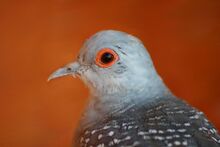 Close-up of a captive bird
 -
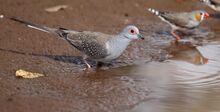 Next to a zebra finch at a waterhole, Northern Territory, Australia
 -
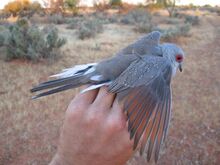 The rufous inner vanes of the primary feathers are clearly visible in this captive bird, Northern Territory, Australia


Citations
- ↑ BirdLife International (2016). "Geopelia cuneata". IUCN Red List of Threatened Species 2016. doi:10.2305/IUCN.UK.2016-3.RLTS.T22690705A93284384.en. https://www.iucnredlist.org/species/22690705/93284384. Retrieved 19 November 2021.
- ↑ 2.0 2.1 Fraser & Gray 2019, p. 37.
- ↑ Schleucher, E. (1993). "Life in Extreme Dryness and Heat: A Telemetric Study of the Behaviour of the Diamond Dove Geopelia cuneata in its Natural Habitat". Emu 93 (4): 251–258. doi:10.1071/MU9930251. Bibcode: 1993EmuAO..93..251S. https://www.researchgate.net/publication/248400219.
- ↑ Forshaw, Joseph (2015). Pigeons and Doves in Australia. Clayton South, VIC, Australia: Csiro Publishing. p. 199. ISBN 978-1-4863-0404-2. https://books.google.com/books?id=e74qBwAAQBAJ&pg=PA199.
- ↑ Department of Sustainability and Environment, Victoria
- ↑ Department of Sustainability and Environment, Victoria
- ↑ Victorian Department of Sustainability and Environment (2007). Advisory List of Threatened Vertebrate Fauna in Victoria - 2007. East Melbourne, Victoria: Department of Sustainability and Environment. p. 15. ISBN 978-1-74208-039-0.
- ↑ Bibhash Sarkar; Bijay Basfore; Leons Mathew Abraham; Anjana Singha Naorem (26 February 2026). "First record of the Diamond Dove Geopelia cuneata, an Australian endemic, in Sikhna Jwhwlao National Park, Assam, India". Journal of Threatened Taxa 18 (2). doi:10.11609/jott.10119.18.2.28438-28440. ISSN 0974-7907. https://threatenedtaxa.org/index.php/JoTT/article/view/10119/10680. Retrieved 4 March 2026.
- ↑ Goswami, Roopak (2 March 2026). "Australian Diamond Dove recorded in Assam for first time". https://eastmojo.com/assam/2026/03/02/australian-diamond-dove-recorded-in-assam-for-first-time/.
Sources
- Fraser, Ian; Gray, Jeannie (2019). Australian Bird Names: Origins and Meanings. Clayton South, Victoria: Csiro Publishing. ISBN 978-1-4863-1164-4.
- Pizzey and Knight, "Field Guide to the Birds of Australia", Angus & Robertson, ISBN 0-207-19691-5
External links
 |
Wikimedia Commons has media related to Diamond dove. |
 |
Wikispecies has information related to Geopelia cuneata |
Wikidata ☰ Q58904 entry
 |  |


