Biology:Diplacus nanus
| Diplacus nanus | |
|---|---|

| |
Scientific classification 
| |
| Kingdom: | Plantae |
| Clade: | Tracheophytes |
| Clade: | Angiosperms |
| Clade: | Eudicots |
| Clade: | Asterids |
| Order: | Lamiales |
| Family: | Phrymaceae |
| Genus: | Diplacus |
| Species: | D. nanus
|
| Binomial name | |
| Diplacus nanus (Hook. & Arn.) G.L.Nesom
| |
| Synonyms[2] | |
| |
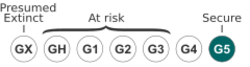
Diplacus nanus is a species of monkeyflower known by the common name dwarf purple monkeyflower. It is native to California and the Northwestern United States to Montana. It grows in moist habitat, often in bare or disturbed soils. It was formerly known as Mimulus nanus.[3][4][5][6]
Description
Diplacus nanus is a hairy annual herb growing at ground level or erect to 10 centimeters tall. The oppositely arranged purple-green leaves are oval or oblong and up to 2.5 centimeters long.
The tubular, wide-faced flower is usually magenta or purple[7] with two yellow stripes in the mouth, but is occasionally all yellow. The flower is up to 2 cm long.
Taxonomy
The species was first described as Mimulus nanus by William Jackson Hooker & George Arnott Walker-Arnott in 1839. In 2012 Guy L. Nesom placed the species in genus Diplacus as D. nanus.[2]
References
- ↑ NatureServe (31 July 2026). "Diplacus nanus" (in en). Arlington, Virginia. https://explorer.natureserve.org/Taxon/ELEMENT_GLOBAL.2.139668/.
- ↑ 2.0 2.1 "Diplacus nanus (Hook. & Arn.) G.L.Nesom" (in en). Royal Botanic Gardens, Kew. http://www.plantsoftheworldonline.org/taxon/77120016-1.
- ↑ Barker, W.R.; Nesom, G.L.; Beardsley, P.M.; Fraga, N.S. (2012), "A taxonomic conspectus of Phrymaceae: A narrowed circumscriptions for Mimulus, new and resurrected genera, and new names and combinations", Phytoneuron 2012–39: 1–60, http://www.phytoneuron.net/PhytoN-Phrymaceae.pdf
- ↑ Beardsley, P. M.; Yen, Alan; Olmstead, R. G. (2003). "AFLP Phylogeny of Mimulus Section Erythranthe and the Evolution of Hummingbird Pollination". Evolution 57 (6): 1397–1410. doi:10.1554/02-086. PMID 12894947.
- ↑ Beardsley, P. M.; Olmstead, R. G. (2002). "Redefining Phrymaceae: the placement of Mimulus, tribe Mimuleae, and Phryma". American Journal of Botany 89 (7): 1093–1102. doi:10.3732/ajb.89.7.1093. PMID 21665709.
- ↑ Beardsley, P. M.; Schoenig, Steve E.; Whittall, Justen B.; Olmstead, Richard G. (2004). "Patterns of Evolution in Western North American Mimulus (Phrymaceae)". American Journal of Botany 91 (3): 474–4890. doi:10.3732/ajb.91.3.474. PMID 21653403.
- ↑ Taylor, Ronald J. (1994) (in en). Sagebrush Country: A Wildflower Sanctuary (rev. ed.). Missoula, MT: Mountain Press Pub. Co. pp. 48. ISBN 0-87842-280-3. OCLC 25708726.
External links
- Jepson eFlora Treatment — Diplacus nanus
- USDA Plants Profile: Mimulus nanus (dwarf purple monkey flower)
- Mimulus nanus Photo gallery
Wikidata ☰ Q17746300 entry
 |  |


