Biology:Echium vulgare
| Viper's bugloss | |
|---|---|

| |
Scientific classification 
| |
| Kingdom: | Plantae |
| Clade: | Tracheophytes |
| Clade: | Angiosperms |
| Clade: | Eudicots |
| Clade: | Asterids |
| Order: | Boraginales |
| Family: | Boraginaceae |
| Genus: | Echium |
| Species: | E. vulgare
|
| Binomial name | |
| Echium vulgare | |
Echium vulgare, known as viper's bugloss and blueweed,[1] is a species of flowering plant in the borage family Boraginaceae. It is native to most of Europe and western and central Asia[2][3] and it occurs as an introduced species in north-eastern North America, south-western South America and the South and North Island of New Zealand.[1][4] If eaten, the plant is toxic to horses and cattle through the accumulation of pyrrolizidine alkaloids in the liver.[5][6]
The plant root was used in ancient times as a treatment for snake or viper bites.[7][8] According to the Doctrine of signatures, plants were thought to have traits (in this case a speckled stem reminiscent of snake skin, and flowers like an open viper's mouth) that mirror the ailment they treat.[9][10]
Description
It is a biennial or monocarpic perennial plant growing to 30–80 cm (12–31 in) tall, with rough, hairy, oblanceolate leaves.[11] The stems, which are red-flecked, resemble snake's skin and even the fruits are shaped like adders' heads.[12] The flowers start pink and turn vivid blue, and are 15–20 mm (0.59–0.79 in) in a branched spike, with all the stamens protruding. The pollen is blue[13] but the filaments of the stamens remain red, contrasting against the blue flowers. It flowers between May and September in the Northern Hemisphere. The Latin specific epithet vulgare means common.[7]
Distribution
It is native to Europe and temperate Asia. It has been introduced to Chile,[14] New Zealand[15] and North America, where it is naturalised in parts of the continent including Ontario and northern Michigan,[3] being listed as an invasive species in Washington.[16] It is found in dry, calcareous grassland and heaths, bare and waste places, along railways and roadsides and on coastal cliffs, sand dunes and shingle.[17]
Cultivation
E. vulgare is cultivated as an ornamental plant, and numerous cultivars have been developed. The cultivar 'Blue Bedder' has gained the Royal Horticultural Society's Award of Garden Merit.[18][19]
Gallery
-
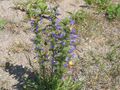 Being pollinated by skipper butterflies
 -
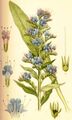 Illustration
 -
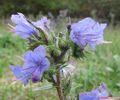 Closeup of flower
 -
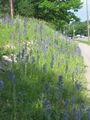 Colonizing the banks of a Montreal city highway
 -
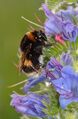 White-tailed bumblebee
 -
 Extensive occurrence near Waldems-Wüstems in the Taunus


See also
- Monofloral honey
- North American nectar sources
References
- ↑ 1.0 1.1 Dickinson, T.; Metsger, D.; Bull, J.; & Dickinson, R. (2004) ROM Field Guide to Wildflowers of Ontario. Toronto:Royal Ontario Museum, p. 203.
- ↑ Flora Europaea: Echium vulgare
- ↑ 3.0 3.1 {{citation | mode = cs1 | title = Echium vulgare | work = Germplasm Resources Information Network (GRIN) | url = | publisher = [[Organization:Agricultural Research ServAgricultural Research Service (ARS), United States Department of Agriculture (USDA) | access-date = 17 December 2017 }}
- ↑ "Echium vulgare L.". Plants of the World Online. Royal Botanic Garden, Kew. https://powo.science.kew.org/taxon/urn:lsid:ipni.org:names:115950-1.
- ↑ "Guide to Poisonous Plants – College of Veterinary Medicine and Biomedical Sciences". Colorado State University. https://csuvth.colostate.edu/poisonous_plants/Plants/Details/38.
- ↑ Klemow, Kenneth M.; Clements, David R.; Threadgill, Paul F.; Cavers, Paul B. (1 January 2002). "The biology of Canadian weeds. 116. Echium vulgare L.". Canadian Journal of Plant Science 82 (1): 235–248. doi:10.4141/P01-058.
- ↑ 7.0 7.1 "Echium vulgare - Plant Finder". Missouri Botanical Garden. http://www.missouribotanicalgarden.org/PlantFinder/PlantFinderDetails.aspx?taxonid=277970.
- ↑ Coles, William (1657). Adam in Eden, or Nature's Paradise. The History of Plants, Herbs, Flowers, with their several, . . names, whether Greek, Latin, or English, and . . . vertues. London. pp. 187.
- ↑ "Doctrine of Signatures". Science Museum. http://www.sciencemuseum.org.uk/broughttolife/techniques/doctrine.aspx.
- ↑ "Viper's Bugloss" (in en-GB). 2020-06-28. https://congletonbhpg.co.uk/our-plants/vipers-bugloss/.
- ↑ Graves, Melissa; Mangold, Jane; Jacobs, Jim. "Biology, Ecology and Management of Blueweed". Montana State University. http://store.msuextension.org/publications/AgandNaturalResources/EB0195.pdf.
- ↑ "Echium vulgare - Viper's Bugloss". https://www.first-nature.com/flowers/echium-vulgare.php.
- ↑ Dorothy Hodges (1952). The pollen loads of the honeybee. Bee Research Association Ltd., London.
- ↑ "Description and images of Echium vulgare (Hierba azul, Viborera, Ortiguilla), a native Chilean plant, provided by the supplier of native exotic Chilean seeds, Chileflora.com". http://www.chileflora.com/Florachilena/FloraEnglish/HighResPages/EH0022.htm.
- ↑ "Echium vulgare" (in en). https://www.nzpcn.org.nz/flora/species/echium-vulgare/.
- ↑ "Common viper's bugloss: Echium vulgare (Lamiales: Boraginaceae): Invasive Plant Atlas of the United States". Invasive Plant Atlas of the United States. http://www.invasiveplantatlas.org/subject.html?sub=5564.
- ↑ Fitter, R. & A. (1974). The Wild Flowers of Britain and Northern Europe. Collins.
- ↑ "RHS Plantfinder - Echium vulgare 'Blue Bedder'". https://www.rhs.org.uk/Plants/139228/i-Echium-vulgare-i-Blue-Bedder/Details.
- ↑ "AGM Plants - Ornamental". Royal Horticultural Society. July 2017. p. 35. https://www.rhs.org.uk/plants/pdfs/agm-lists/agm-ornamentals.pdf.
- Blanchan, Neltje (2005). Wild Flowers Worth Knowing.. Project Gutenberg Literary Archive Foundation.
Wikidata ☰ Q157722 entry
 |  |


