Biology:Gardenia brighamii
| Gardenia brighamii | |
|---|---|

| |
Scientific classification 
| |
| Kingdom: | Plantae |
| Clade: | Tracheophytes |
| Clade: | Angiosperms |
| Clade: | Eudicots |
| Clade: | Asterids |
| Order: | Gentianales |
| Family: | Rubiaceae |
| Genus: | Gardenia |
| Species: | G. brighamii
|
| Binomial name | |
| Gardenia brighamii H.Mann[2]
| |

Gardenia brighamii is a species of flowering plant in the coffee family, Rubiaceae.[3][4] It is sometimes referred to by the common names nānū, naʻu, or forest gardenia, and is endemic to Hawaii.[5]
Description
Gardenia brighamii is a small tree, reaching a height of 5 m (16 ft).[5] The glossy, dark green leaves[6] are ovate, 2.2–10.5 cm (0.87–4.13 in) long and 1.5–5.5 cm (0.59–2.17 in) wide. The petals of the solitary, white flowers are fused at the base to form a tube 15–20 mm (0.59–0.79 in) in length and have six lobes.
Gallery
-
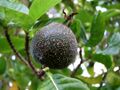 Fruits
 -
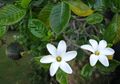 Flowers
 -
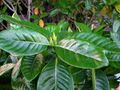 Leaves
 -
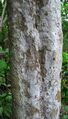 Bark
Bark -
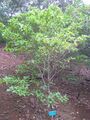 Plant
Plant
.jpg)
.jpg)
.jpg)
.jpg)

Habitat and range
Forest gardenia inhabits tropical dry forests at elevations of 350–520 m (1,150–1,710 ft). It previously could be found on all main islands, but today populations only exist on Maui, Molokaʻi, Oʻahu, and Lānaʻi, and the Big Island.[5]
Conservation
The total population of G. brighamii is between 15 and 19 trees. There are only two plants in the wild on Oʻahu and one on the Big Island.[7] Major threats to the survival of this species include loss of dry forest habitat and the establishment of invasive species, such as fountain grass (Pennisetum setaceum).[5]
Uses
Native Hawaiians made kua kuku (kapa anvils)[5] and pou (house posts) from the wood of nānū.[7] A yellow kapa dye was derived from the fruit pulp.[8] The white, fragrant flowers are used in lei. Today, it is grown as an ornamental plant on the islands.[7]
References
 |
Wikispecies has information related to Gardenia brighamii |
- ↑ Bruegmann, M.M.; Caraway, V. (2003). "Gardenia brighamii". IUCN Red List of Threatened Species 2003. doi:10.2305/IUCN.UK.2003.RLTS.T30927A9593228.en. https://www.iucnredlist.org/species/30927/9593228. Retrieved 17 November 2021.
- ↑ {{citation | mode = cs1 | title = Gardenia brighamii | work = Germplasm Resources Information Network (GRIN) | url = | publisher = [[Organization:Agricultural Research ServAgricultural Research Service (ARS), United States Department of Agriculture (USDA) | access-date = 2011-01-10 }}
- ↑ "Gardenia brighamii H.Mann". Royal Botanic Gardens, Kew. http://powo.science.kew.org/taxon/urn:lsid:ipni.org:names:750931-1.
- ↑ "Gardenia brighamii H.Mann". Species 2000: Leiden, the Netherlands. https://www.catalogueoflife.org/data/taxon/6JX54.
- ↑ 5.0 5.1 5.2 5.3 5.4 "Gardenia brighamii (Rubiaceae)". Meet the Plants. National Tropical Botanical Garden. http://www.ntbg.org/plants/plant_details.php?plantid=5346.
- ↑ "Gardenia brighamii". CPC National Collection Plant Profile. Center for Plant Conservation. 2010-03-04. http://www.centerforplantconservation.org/collection/cpc_viewprofile.asp?CPCNum=1994.
- ↑ 7.0 7.1 7.2 Barboza, Rick (2006-09-08). "Rare plant's fragrance has hint of coconut". Honolulu Star-bulletin 11 (251). http://archives.starbulletin.com/2006/09/08/features/garden.html.
- ↑ "nanu, nau". Hawaii Ethnobotany Online Database. Bernice P. Bishop Museum. http://www2.bishopmuseum.org/ethnobotanydb/resultsdetailed.asp?search=nanu.
External links
- "Gardenia brighamii". Hawaiian Native Plant Propagation Database. University of Hawaiʻi at Mānoa. http://www2.hawaii.edu/~eherring/hawnprop/gar-brig.htm.
Wikidata ☰ Q2245771 entry
 |  |


