Biology:Hymenocarina
Hymenocarina is an order of extinct marine arthropods known from the Cambrian. They possess bivalved carapaces, typically with exposed posteriors. Members of the group are morphologically diverse and had a variety of ecologies, including filter feeders and predators. Recent research has generally considered them to be stem or crown group members of Mandibulata, due to the presence of mandibles in well-preserved species.
Description
Hymenocarines are characterized by the combination of the following characters: bivalved, convex carapace covering cephalothoracic (combined head and thorax) region; cephalothorax bearing multisegmented antennae (though as an exception antennae are absent in Odaraia[1]) and rounded mandibles and likely maxillae, post maxillae limbs with spiny, subdivided basis and endopods (lower, leg-like braches of limbs) with well-developed terminal claws; absence of appendages between antennae and mandibles; median sclerite and lobate protrusions located between compound eyes; and posterior tagma (abdomen) with ring-like segments with the posterior of the body ending with pair of well-developed caudal rami (often in the form of tail flukes).[2][3]
The group was very diverse in shape, with some forms like Waptia somewhat resembling shrimp,[3] and others like Odaraia having a large carapace and trifurcate tail.[4] The appendages showing various degrees of specialization across the group, ranging from the feathery gills of Waptia[3] to the robust pincers (chelae) of Tokummia.[2] They also had a wide range of sizes with some like Fibulacaris reaching a length of up to 2 cm (0.79 in) long,[5] while largest Balhuticaris reached 24.5 cm (9.6 in) long.[6] Hymenocarines are thought to have been ecologically diverse, with various forms occupying scavenging, predatory, deposit feeding and suspension feeding niches.[6]
-
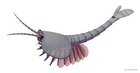 Life restoration of Waptia
 -
 Life restoration of Canadaspis laevigata
 -

-
 Only 2 cm-long Fibulacaris is suggested to have swum upside down
 -
 Large-sized Balhuticaris shows extreme multisegmentation with over 100 segments
 -

-
 Unlike other taxa, eyes of possible hymenocarine Erjiecaris were probably placed over carapace
 -
 The carapace of possible hymenocarine Pseudoarctolepis had wing-like projections
 -
 Life restoration of Odaraia, which had a trifurcate tail and probably habitually swam upside down
 -
 Life restoration of Tuzoia, a large hymenocarine


Taxonomy
Based on the interpretation of simple head region that possess only a few segments and appendages, hymenocarine taxa were thought to be part of the upper stem-group euarthropods in early and mid 2010s.[7][8][9][10][11][12][13][14] They later became widely accepted as mandibulates (the group that contains insects, crustaceans, centipedes and millipedes, among others) after the discovery of their mandible-bearing mouthparts in late 2010s.[2][3][15][16] Since then, most phylogenetic analysis suggest hymenocarines represent part of the mandibulate stem-group,[2][17][3][18][19][20][21][22] with some results suggest a rather crownward position such as stem-pancrustaceans,[3][23][24][22] stem-myriapods,[3] stem-hexapods[20] or somewhere in-between the former taxa.[25]
Several subgroups within the order are recognised, including Waptiidae[3] and Protocarididae.[2] The internal relationships of Hymenocarina are unstable, and it is unclear whether the group is monophyletic or paraphyletic.[26][6]
List of families and genera
- Canadaspis
- Clypecaris
- ?Dioxycaris
- Ercaicunia
- ?Erjiecaris
- ?Forfexicaris
- ?Occacaris
- ?Ovalicephalus
- Perspicaris
- Plenocaris
- ?Pseudoarctolepis
- ?Yunnanocaris
- Xiazhuangocaris
- ?Cassicaris
- Pectocaris
- Odaraiidae
- Balhuticaris
- Odaraia
- Jugatacaris
- Nereocaris
- Fibulacaris
- Pakucaris
- ?Vermontcaris
- Tuzoiidae
- Tuzoia
- Duplapex
- Protocarididae
- Tokummia
- Branchiocaris
- Protocaris
- Loricicaris
- Waptiidae
- Waptia
- Pauloterminus
- Synophalos?
- Chuandianella? (lacks mandibles, may not be a hymenocarine)
Cambrian bivalved arthropods are now recognised to be a polyphyletic group, with other groups of bivalved arthropods such as the Isoxyida, Bradoriida and Phosphatocopina only distantly related to Hymenocarina.[21][27][28][29] Chuandianella a bivalved arthropod morphologically similar to Waptia and long thought to be closely related[3][25] was reinterpreted as a non-hymenocarine euarthropod based on a restudy published in 2022, which found that it definitely lacked mandibles, characteristic of true hymenocarines.[27]
Cladogram after O'Flynn et al, 2023. showing possible placement of Hymenocarina within Mandibulata:[30]
| Total group Arthropoda |
| |||||||||||||||||||||||||||||||||||||||||||||||||||||||||||||||||||||||||||||||||||||||||||||||||||
Cladogram of Hymenocarina, following Izquierdo-López and Caron, (2024):[1]
| ||||||||||||||||||||||||||||||||||||||||||||||||||||||||||||||||||||||||||||||||||||||||||||||||||||||||||||||||||||||
References
- ↑ 1.0 1.1 Izquierdo-López, Alejandro; Caron, Jean-Bernard (August 2024). "The Cambrian Odaraia alata and the colonization of nektonic suspension-feeding niches by early mandibulates" (in en). Proceedings of the Royal Society B: Biological Sciences 291 (2027). doi:10.1098/rspb.2024.0622. ISSN 1471-2954. PMID 39043240. PMC 11463219. https://royalsocietypublishing.org/doi/10.1098/rspb.2024.0622.
- ↑ 2.0 2.1 2.2 2.3 2.4 Aria, Cédric; Caron, Jean-Bernard (2017-04-26). "Burgess Shale fossils illustrate the origin of the mandibulate body plan". Nature 545 (7652): 89–92. doi:10.1038/nature22080. ISSN 0028-0836. PMID 28445464. Bibcode: 2017Natur.545...89A.
- ↑ 3.0 3.1 3.2 3.3 3.4 3.5 3.6 3.7 3.8 Vannier, Jean; Aria, Cédric; Taylor, Rod S.; Caron, Jean-Bernard (2018). "Waptia fieldensis Walcott, a mandibulate arthropod from the middle Cambrian Burgess Shale". Royal Society Open Science 5 (6). doi:10.1098/rsos.172206. PMID 30110460. Bibcode: 2018RSOS....572206V.
- ↑ Briggs, D. E. G. (1981). "The Arthropod Odaraia alata Walcott, Middle Cambrian, Burgess Shale, British Columbia". Philosophical Transactions of the Royal Society of London. Series B, Biological Sciences 291 (1056): 541–582. doi:10.1098/rstb.1981.0007. Bibcode: 1981RSPTB.291..541B.
- ↑ Izquierdo-López, Alejandro; Caron, Jean-Bernard (2019). "A possible case of inverted lifestyle in a new bivalved arthropod from the Burgess Shale". Royal Society Open Science 6 (11). doi:10.1098/rsos.191350. PMID 31827867. Bibcode: 2019RSOS....691350I.
- ↑ 6.0 6.1 6.2 Izquierdo-López, Alejandro; Caron, Jean-Bernard (2022-07-15). "Extreme multisegmentation in a giant bivalved arthropod from the Cambrian Burgess Shale" (in English). iScience 25 (7). doi:10.1016/j.isci.2022.104675. ISSN 2589-0042. PMID 35845166. Bibcode: 2022iSci...25j4675I.
- ↑ Legg, David A.; Sutton, Mark D.; Edgecombe, Gregory D.; Caron, Jean-Bernard (2012-12-07). "Cambrian bivalved arthropod reveals origin of arthrodization". Proceedings of the Royal Society B: Biological Sciences 279 (1748): 4699–4704. doi:10.1098/rspb.2012.1958. PMID 23055069.
- ↑ Legg, David (2013). "Multi-Segmented Arthropods from the Middle Cambrian of British Columbia (Canada)" (in en). Journal of Paleontology 87 (3): 493–501. doi:10.1666/12-112.1. ISSN 0022-3360. Bibcode: 2013JPal...87..493L. https://www.cambridge.org/core/journals/journal-of-paleontology/article/abs/multisegmented-arthropods-from-the-middle-cambrian-of-british-columbia-canada/9CA5AE5D58832452EDA388ED438774CB.
- ↑ Legg, David A.; Vannier, Jean (2013-09-16). "The affinities of the cosmopolitan arthropod Isoxys and its implications for the origin of arthropods". Lethaia 46 (4): 540–550. doi:10.1111/let.12032. ISSN 0024-1164. Bibcode: 2013Letha..46..540L.
- ↑ Legg, David A.; Sutton, Mark D.; Edgecombe, Gregory D. (2013-09-30). "Arthropod fossil data increase congruence of morphological and molecular phylogenies" (in en). Nature Communications 4 (1): 2485. doi:10.1038/ncomms3485. ISSN 2041-1723. PMID 24077329. Bibcode: 2013NatCo...4.2485L. https://www.researchgate.net/publication/257205419.
- ↑ Ortega-Hernández, Javier (2014-12-21). "Making sense of 'lower' and 'upper' stem-group Euarthropoda, with comments on the strict use of the name Arthropoda von Siebold, 1848" (in en). Biological Reviews 91 (1): 255–273. doi:10.1111/brv.12168. PMID 25528950.
- ↑ Ortega-Hernández, Javier; Janssen, Ralf; Budd, Graham E. (2017-05-01). "Origin and evolution of the panarthropod head – A palaeobiological and developmental perspective" (in en). Arthropod Structure & Development 46 (3, Evolution of Segmentation): 354–379. doi:10.1016/j.asd.2016.10.011. ISSN 1467-8039. PMID 27989966. Bibcode: 2017ArtSD..46..354O.
- ↑ Yang, Jie; Ortega-Hernández, Javier; Legg, David A.; Lan, Tian; Hou, Jin-bo; Zhang, Xi-guang (2018-02-01). "Early Cambrian fuxianhuiids from China reveal origin of the gnathobasic protopodite in euarthropods" (in en). Nature Communications 9 (1): 470. doi:10.1038/s41467-017-02754-z. ISSN 2041-1723. PMID 29391458. Bibcode: 2018NatCo...9..470Y.
- ↑ Daley, Allison C.; Antcliffe, Jonathan B.; Drage, Harriet B.; Pates, Stephen (2018-05-22). "Early fossil record of Euarthropoda and the Cambrian Explosion" (in en). Proceedings of the National Academy of Sciences 115 (21): 5323–5331. doi:10.1073/pnas.1719962115. ISSN 0027-8424. PMID 29784780. Bibcode: 2018PNAS..115.5323D.
- ↑ Giribet, Gonzalo; Edgecombe, Gregory D. (2019-06-17). "The Phylogeny and Evolutionary History of Arthropods" (in English). Current Biology 29 (12): R592–R602. doi:10.1016/j.cub.2019.04.057. ISSN 0960-9822. PMID 31211983. Bibcode: 2019CBio...29.R592G.
- ↑ Edgecombe, Gregory D. (2020-11-02). "Arthropod Origins: Integrating Paleontological and Molecular Evidence". Annual Review of Ecology, Evolution, and Systematics 51 (1): 1–25. doi:10.1146/annurev-ecolsys-011720-124437. ISSN 1543-592X. https://www.annualreviews.org/doi/10.1146/annurev-ecolsys-011720-124437.
- ↑ Aria, Cédric; Caron, Jean-Bernard (2017-12-21). "Mandibulate convergence in an armoured Cambrian stem chelicerate". BMC Evolutionary Biology 17 (1): 261. doi:10.1186/s12862-017-1088-7. ISSN 1471-2148. PMID 29262772. Bibcode: 2017BMCEE..17..261A.
- ↑ Zeng, Han; Zhao, Fangchen; Niu, Kecheng; Zhu, Maoyan; Huang, Diying (2020-12-03). "An early Cambrian euarthropod with radiodont-like raptorial appendages". Nature 588 (7836): 101–105. doi:10.1038/s41586-020-2883-7. PMID 33149303. Bibcode: 2020Natur.588..101Z. https://www.researchgate.net/publication/345317560.
- ↑ Aria, Cédric; Zhao, Fangchen; Zhu, Maoyan (2021-09-01). "Fuxianhuiids are mandibulates and share affinities with total-group Myriapoda" (in en). Journal of the Geological Society 178 (5). doi:10.1144/jgs2020-246. ISSN 0016-7649. Bibcode: 2021JGSoc.178..246A. https://jgs.lyellcollection.org/content/178/5/jgs2020-246.
- ↑ 20.0 20.1 Anderson, Evan P.; Schiffbauer, James D.; Jacquet, Sarah M.; Lamsdell, James C.; Kluessendorf, Joanne; Mikulic, Donald G. (2021-04-19). "Stranger than a scorpion: a reassessment of Parioscorpio venator, a problematic arthropod from the Llandoverian Waukesha Lagerstätte". Palaeontology 64 (3): 429–474. doi:10.1111/pala.12534. ISSN 0031-0239. Bibcode: 2021Palgy..64..429A. https://onlinelibrary.wiley.com/doi/abs/10.1111/pala.12534.
- ↑ 21.0 21.1 Izquierdo-López, Alejandro; Caron, Jean-Bernard (2021-06-15). "A Burgess Shale mandibulate arthropod with a pygidium: a case of convergent evolution". Papers in Palaeontology 7 (4): 1877–1894. doi:10.1002/spp2.1366. ISSN 2056-2799. Bibcode: 2021PPal....7.1877I. https://onlinelibrary.wiley.com/doi/abs/10.1002/spp2.1366.
- ↑ 22.0 22.1 O'Flynn, Robert; Williams, Mark; Yu, Mengxiao; Harvey, Thomas; Liu, Yu (2022-02-11). "A new euarthropod with large frontal appendages from the early Cambrian Chengjiang biota". Palaeontologia Electronica 25: a6. doi:10.26879/1167. https://www.researchgate.net/publication/358519106.
- ↑ Aria, Cédric; Caron, Jean-Bernard (2019). "A middle Cambrian arthropod with chelicerae and proto-book gills" (in en). Nature 573 (7775): 586–589. doi:10.1038/s41586-019-1525-4. ISSN 1476-4687. PMID 31511691. Bibcode: 2019Natur.573..586A. https://www.nature.com/articles/s41586-019-1525-4.
- ↑ Aria, Cédric; Zhao, Fangchen; Zeng, Han; Guo, Jin; Zhu, Maoyan (2020-01-08). "Fossils from South China redefine the ancestral euarthropod body plan". BMC Evolutionary Biology 20 (1): 4. doi:10.1186/s12862-019-1560-7. ISSN 1471-2148. PMID 31914921. Bibcode: 2020BMCEE..20....4A.
- ↑ 25.0 25.1 Ou, Qiang; Vannier, Jean; Yang, Xianfeng; Chen, Aiiln; Huijuan, Mai; Shu, Degan; Han, Jian; Fu, Dongjing et al. (2020-04-29). "Evolutionary trade-off in reproduction of Cambrian arthropods". Science Advances 6 (18): 3376–3405. doi:10.1126/sciadv.aaz3376. PMID 32426476. PMC 7190318. Bibcode: 2020SciA....6.3376O. https://www.researchgate.net/publication/341071940.
- ↑ Izquierdo-López, Alejandro; Caron, Jean-Bernard (December 2022). "The problematic Cambrian arthropod Tuzoia and the origin of mandibulates revisited" (in en). Royal Society Open Science 9 (12). doi:10.1098/rsos.220933. ISSN 2054-5703. PMID 36483757. Bibcode: 2022RSOS....920933I.
- ↑ 27.0 27.1 Zhai, Dayou; Williams, Mark; Siveter, David J.; Siveter, Derek J.; Harvey, Thomas H. P.; Sansom, Robert S.; Mai, Huijuan; Zhou, Runqing et al. (2022-02-22). "Chuandianella ovata: An early Cambrian stem euarthropod with feather-like appendages" (in English). Palaeontologia Electronica 25 (1): 1–22. doi:10.26879/1172. ISSN 1094-8074. https://palaeo-electronica.org/content/2022/3557-chuandianella-ovata.
- ↑ Izquierdo-López, Alejandro; Caron, Jean-Bernard (2019). "A possible case of inverted lifestyle in a new bivalved arthropod from the Burgess Shale". Royal Society Open Science 6 (11). doi:10.1098/rsos.191350. PMID 31827867. Bibcode: 2019RSOS....691350I.
- ↑ Zeng, Han; Zhao, Fang-Chen; Yin, Zong-Jun; Zhu, Mao-Yan (September 2021). "A new early Cambrian bivalved euarthropod from Yunnan, China and general interspecific morphological and size variations in Cambrian hymenocarines" (in en). Palaeoworld 30 (3): 387–397. doi:10.1016/j.palwor.2020.09.002. https://linkinghub.elsevier.com/retrieve/pii/S1871174X20300755.
- ↑ O'Flynn, Robert J.; Liu, Yu; Hou, Xianguang; Mai, Huijuan; Yu, Mengxiao; Zhuang, Songling; Williams, Mark; Guo, Jin et al. (August 2023). "The early Cambrian Kylinxia zhangi and evolution of the arthropod head". Current Biology 33 (18): 4006–4013.e2. doi:10.1016/j.cub.2023.08.022. ISSN 0960-9822. PMID 37643622. Bibcode: 2023CBio...33E4006O.
Wikidata ☰ Q96381504 entry
 |  |


