Biology:Kadenicarpus pseudomacrochele
| Kadenicarpus pseudomacrochele | |
|---|---|

| |
Scientific classification 
| |
| Kingdom: | Plantae |
| Clade: | Tracheophytes |
| Clade: | Angiosperms |
| Clade: | Eudicots |
| Order: | Caryophyllales |
| Family: | Cactaceae |
| Subfamily: | Cactoideae |
| Genus: | Kadenicarpus |
| Species: | K. pseudomacrochele
|
| Binomial name | |
| Kadenicarpus pseudomacrochele (Backeb.) Doweld[3]
| |
| Synonyms[3] | |
| |
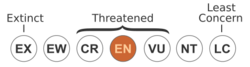
Kadenicarpus pseudomacrochele, synonym Turbinicarpus pseudomacrochele, is a species of plant in the family Cactaceae.[3]
It is an endangered species, threatened by habitat loss.
Description
Kadenicarpus pseudomacrochele grows mostly singly with light green to darker blue-green, spherical to spherical-cylindrical bodies that occasionally sprout and has a large fleshy turnip root. The bodies, which are woolly at the top, reach heights of 2 to 4 cm (0.79 to 1.57 in) and diameters of 2.5 to 3.4 cm (0.98 to 1.34 in). Their rounded cusps become narrower towards their tip and are 3 to 5 mm (0.12 to 0.20 in) high. There are 5 to 8 yellowish-brown thorns that turn gray with age and cannot be differentiated into marginal and central thorns. They are bristle-like, twisted, mostly stick out and are 15 to 30 mm (0.59 to 1.18 in) long.
The white to reddish purple or yellowish green or magenta flowers are 2.5 to 3.2 cm (0.98 to 1.26 in) long and 2 to 3.5 cm (0.79 to 1.38 in) in diameter. The green, almost spherical fruits are 4 to 6 mm (0.16 to 0.24 in) long.[4]
Subspecies
Accepted subspecies:[3]
| Image | Scientific name | Distribution |
|---|---|---|
| 120px | Kadenicarpus pseudomacrochele subsp. pseudomacrochele | NE. Mexico |
| 120px | Kadenicarpus pseudomacrochele subsp. krainzianus (Gerhart Frank) Vázquez-Sánchez | Mexico (Querétaro, Hidalgo) |
| 120px | Kadenicarpus pseudomacrochele subsp. minimus (G.Frank) Vázquez-Sánchez | Mexico (Hidalgo) |
Distribution
It is endemic to Hidalgo and Querétaro states of Mexico. Its natural habitat is hot deserts.
Taxonomy
The first description as Strombocactus pseudomacrochele was made in 1935 by Curt Backeberg.[5] The specific epithet pseudomacrochele is derived from the Greek word pseudo for 'false' and the similarity to the species Turbinicarpus macrochele. Alexander Borissovitch Doweld placed the species in the genus Kadenicarpus in 1998.[6] Further nomenclature synonym are Turbinicarpus pseudomacrochele (Backeb.) Buxb. & Backeb. (1937), Toumeya pseudomacrochele (Backeb.) W.T.Marshall (1946), Neolloydia pseudomacrochele (Backeb.) E.F.Anderson (1986) and Pediocactus pseudomacrochele (Backeb.) Halda (1998).
Constituents
In terms of total alkaloid content, Kadenicarpus pseudomacrochele contains 49.6% hordenine, 2.5% mescaline, 2.4% anhalonidine, and 0.4% pellotine.[7] For comparison, Lophophora williamsii (peyote) contains 30% mescaline, 17% pellotine, 14% anhalonidine, and 8% hordenine, among other alkaloids.[7]
References
- ↑ Gómez-Hinostrosa, C.; Sánchez, E.; Guadalupe Martínez, J. (2013). "Turbinicarpus pseudomacrochele". IUCN Red List of Threatened Species 2013. doi:10.2305/IUCN.UK.2013-1.RLTS.T40983A2949357.en. https://www.iucnredlist.org/species/40983/2949357. Retrieved 16 November 2021.
- ↑ "Appendices | CITES". https://cites.org/eng/app/appendices.php.
- ↑ 3.0 3.1 3.2 3.3 "Kadenicarpus pseudomacrochele (Backeb.) Doweld". Plants of the World Online. Royal Botanic Gardens, Kew. https://powo.science.kew.org/taxon/urn:lsid:ipni.org:names:1008390-1.
- ↑ Anderson, Edward F.; Eggli, Urs (2005) (in de). Das grosse Kakteen-Lexikon. Stuttgart (Hohenheim): Ulmer. pp. 632–633. ISBN 3-8001-4573-1.
- ↑ "Au Cactus Francophone" (in fr). https://www.cactuspro.com/lecture/Backeberg-Curt/Blatter-fur-Kakteenforschung/page-146.de.html.
- ↑ Korotkova, Nadja; Aquino, David; Arias, Salvador; Eggli, Urs; Franck, Alan; Gómez-Hinostrosa, Carlos; Guerrero, Pablo C.; Hernández, Héctor M. et al. (2021-08-31). "Cactaceae at Caryophyllales.org – a dynamic online species-level taxonomic backbone for the family". Willdenowia 51 (2). doi:10.3372/wi.51.51208. ISSN 0511-9618.
- ↑ 7.0 7.1 Ali, Ehsan; Azhar, Muhammad Farooq; Laila, Ume (23 January 2025). "False Peyote (Lophophora diffusa (Croizat) Bravo Cactaceae)". Comprehensive Guide to Hallucinogenic Plants. Boca Raton: CRC Press. p. 37–41. doi:10.1201/9781003460336-7. ISBN 978-1-003-46033-6. https://www.taylorfrancis.com/books/9781003460336/chapters/10.1201/9781003460336-7. Retrieved 27 June 2026.
External links
 Data related to Kadenicarpus pseudomacrochele at Wikispecies

Wikidata ☰ {{{from}}} entry
 |  |


