Biology:Koelreuteria paniculata
| Koelreuteria paniculata | |
|---|---|
_Koelreuteria_paniculata_-Leaves_and_inflorescences_-_Palais_Niel.jpg)
| |
| Foliage and flowers of Koelreuteria paniculata var. apiculata | |
Scientific classification 
| |
| Kingdom: | Plantae |
| Clade: | Tracheophytes |
| Clade: | Angiosperms |
| Clade: | Eudicots |
| Clade: | Rosids |
| Order: | Sapindales |
| Family: | Sapindaceae |
| Genus: | Koelreuteria |
| Species: | K. paniculata
|
| Binomial name | |
| Koelreuteria paniculata Laxm.
| |
| Synonyms[2] | |
|
List
| |


Koelreuteria paniculata is a species of flowering plant in the family Sapindaceae, native to China, Korea, and Outer Manchuria in both Russia and Mongolia. Naturalized in Japan since at least the 1200s,[3] it was introduced to Europe in 1747 and North America in 1763, and has become a popular landscape tree worldwide.[4][5] Common names include goldenrain tree,[6][7] pride of India,[8] China tree,[9] and the varnish tree.[7]
Description
It is a small to medium-sized deciduous tree growing to 7 m (23 ft) tall, with a broad, dome-shaped crown. The leaves are pinnate, 15–40 cm (6–16 in) long, rarely to 50 cm (20 in), with 7–15 leaflets 3–8 cm long, with a deeply serrated margin; the larger leaflets at the midpoint of the leaf are sometimes themselves pinnate but the leaves are not consistently fully bipinnate as in the related Koelreuteria bipinnata.[3]
The flowers are yellow, with four petals, growing in large terminal panicles 20–40 cm (8–16 in) long.[10] The fruit is a three-part inflated bladderlike pod, 3–6 cm long and 2–4 cm broad, that is green, then ripening from orange to pink in autumn. It contains several dark brown to black seeds 5–8 mm diameter.[5]
Taxonomy
Publication
The species was first published in 1772, in the 1771 edition of Novi commentarii academiae scientiarum imperialis Petropolitanae, attributed to Erik Laxmann.[2][11]
Varieties
Several varieties have been described:
- K. paniculata var. paniculata. Northern China and Korea. Leaves single-pinnate.
- K. paniculata var. apiculata (Rehder & E.H.Wilson) Rehder (syn. K. apiculata).[12] Western China (Sichuan), intergrading with var. paniculata in central China. Leaves with larger leaflets commonly bipinnate.
- K. paniculata var. fastigiata. Small growing columnar form originated in 1888.[13]
- K. paniculata var. variegata. a form with variegated foliage.[13]
But none of them are accepted.[2]
Cultivation
K. paniculata has been cultivated since ancient times. In the Zhou dynasty it was one of the five official memorial trees (alongside P. tabuliformis, P. orientalis, S. japonicum and certain poplars), being planted next to the tombs of scholars.[14]
It is popularly grown as an ornamental tree in temperate regions all across the world because of the aesthetic appeal of its flowers, leaves and seed pods. Several cultivars have been selected for garden planting, including 'Fastigiata' with a narrow crown, and 'September Gold', flowering in late summer.
In the UK the cultivar 'Coral Sun' has gained the Royal Horticultural Society's Award of Garden Merit.[15][16]
In some areas, notably the eastern United States (and particularly in Florida), it is considered an invasive species.[17]
Gallery
-
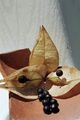 Fruits
 -
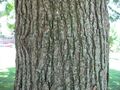 Bark
Bark -
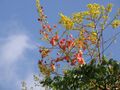 Flowers and legumens in the top of a tree in São Paulo Brazil
 -
 Koelreuteria paniculata infructescence, Butler County, Kansas
 -
 Koelreuteria paniculata infructescence and leaves, Harvey County, Kansas


Notes
- ↑ Ye, J.; Yu, S.; Botanic Gardens Conservation International (BGCI); IUCN SSC Global Tree Specialist Group (2019). "Koelreuteria paniculata". IUCN Red List of Threatened Species 2019.
- ↑ 2.0 2.1 2.2 "Koelreuteria paniculata Laxm." (in en). Royal Botanic Gardens, Kew. http://www.plantsoftheworldonline.org/taxon/783426-1. Retrieved 8 February 2024.
- ↑ 3.0 3.1 Meyer, F.G. (April 1976). "A Revision of the Genus Koelreuteria (Sapindaceae)". Journal of the Arnold Arboretum 57 (2): 129-141,146-153. doi:10.5962/p.185862. https://archive.org/details/biostor-177359.
- ↑ "Golden Rain Tree Koelreuteria paniculata". http://www.monrovia.com/plant-catalog/plants/2426/golden-rain-tree/.
- ↑ 5.0 5.1 "Goldenraintree Tree on the Tree Guide at arborday.org". https://www.arborday.org/trees/treeguide/TreeDetail.cfm?ItemID=841.
- ↑ "PLANTS Profile for Koelreuteria paniculata (goldenrain tree)". Natural Resources Conservation Service. United States Department of Agriculture. https://plants.usda.gov/java/profile?symbol=KOPA.
- ↑ 7.0 7.1 UConn Plant Database
- ↑ RHS A-Z encyclopedia of garden plants. United Kingdom: Dorling Kindersley. 2008. pp. 1136. ISBN 978-1-4053-3296-5.
- ↑ goldenrain tree.Encyclopædia Britannica Online. Encyclopædia Britannica. Retrieved 2008-07-12.
- ↑ "Golden rain tree: Staatliche Schlösser und Gärten Baden-Württemberg" (in en). https://www.botanischer-garten-karlsruhe.de/en/visitor-experience/hidden-treasures/golden-rain-tree.
- ↑ Laxmann, E. (1772). "KOELREVTERIA PANICVLATA, NOVVM PLANTARVM GENVS.". Novi Commentari Academiae Scientiarum Imperialis Petropolitanae 16: 561–564. https://archive.org/details/novicommentariac16impe.
- ↑ Sargent, Charles (1916). Plantae Wilsonianae: An enumeration of the woody plants collected in western China for the Arnold Arboretum of Harvard University during the years 1907, 1908, and 1910 by E. H. Wilson.. Cambridge (Mass): University Press. pp. 191–193.
- ↑ 13.0 13.1 More, David (2003). Cassell's trees of Britain & Northern Europe. John White. London: Cassell. p. 711. ISBN 0-304-36192-5. OCLC 47232390.
- ↑ Li, Hui-Lin (1974) (in en). The Origin and Cultivation of Shade and Ornamental Trees. Pennsylvania, United States: University of Pennsylvania Press. pp. 20-22,44,191,201,218. ISBN 0-8122-1070-0.
- ↑ "RHS Plantfinder - Koelreuteria paniculata 'Coral Sun'". https://www.rhs.org.uk/Plants/177985/i-Koelreuteria-paniculata-i-Coral-Sun-sup-(PBR)-sup/Details.
- ↑ "AGM Plants - Ornamental". Royal Horticultural Society. July 2017. p. 57. https://www.rhs.org.uk/plants/pdfs/agm-lists/agm-ornamentals.pdf.
- ↑ City of Jacksonville Department of Parks, Recreation and Community Services (2021). "2021 Tree Hill Nature Center Management Plan". https://floridadep.gov/sites/default/files/20210902_Tree_Hill_Nature_Preserve_MP.pdf.
References
- Plants for a Future: Koelreuteria paniculata
- Koelreuteria paniculata images at bioimages.vanderbilt.edu
External links
 |
Wikimedia Commons has media related to Koelreuteria paniculata. |
- Dosmann, Michael S., Whitlow, Thomas H., and Ho-Duck, Kang. "The (un)Natural and Cultural History of Korean Goldenrain Tree." Arnoldia 64 (1) (2006).
- Santamour, Frank S.and Spongberg, Stephen A. "'Rose Lantern': A New Cultivar of Koelreuteria paniculata, the Golden-Rain Tree." Arnoldia 56 (2) (1996).
Wikidata ☰ Q844835 entry
 |  |


