Biology:Larix decidua
| European larch | |
|---|---|
_Val_d%27Anniviers._Europese_larix_(Larix_decidua)_01.JPG)
| |
| European larch in l'A Bran, (1798 m) Val d'Annivier | |
Scientific classification 
| |
| Kingdom: | Plantae |
| Clade: | Tracheophytes |
| Clade: | Gymnospermae |
| Division: | Pinophyta |
| Class: | Pinopsida |
| Order: | Pinales |
| Family: | Pinaceae |
| Genus: | Larix |
| Species: | L. decidua
|
| Binomial name | |
| Larix decidua Mill.
| |

| |
| Continuous range (var. decidua)
Continuous range ✖ Isolated population (var. carpatica) | |
| Synonyms[3] | |
|
List
| |


Larix decidua, the European larch, is a species of larch native to the mountains of central Europe, in the Alps and Carpathian Mountains, with small disjunct lowland populations in northern Poland. Its life span has been confirmed to be close to 1000 years,[4] with ages of around 2000 years likely.[5]
Description
Larix decidua is a medium-size to large deciduous coniferous tree reaching 25–45 metres (82–148 ft) tall, with a trunk up to 1.5 metres (5 ft) diameter (exceptionally, to 53.8 metres (176 ft 6 in)[6] and 11.20 m girth (3.56 m diameter[7]). The crown is conic when young, becoming broad and often irregular with age; the main branches are level to upswept, with the side branches often pendulous. The shoots are dimorphic, with growth divided into long shoots (typically 10–50 cm (4–20 in) long) and bearing several buds, and short shoots only 1–2 mm long with only a single bud. The leaves are needle-like, light green, 2–4 centimetres (3⁄4–1 5⁄8 in) long which turn bright yellow before they fall in the autumn, leaving the pale yellow-buff shoots bare until the next spring. The cones are erect, ovoid-conic, 2–6 centimetres (3⁄4–2 3⁄8 in) long, with 10-90 erect or slightly incurved (not reflexed) seed scales; they are bright pinkish-red at pollination, then green variably flushed red to purplish when immature, and turn brown and opening to release the seeds when mature, 4–6 months after pollination. The old cones commonly remain on the tree for many years, turning dull grey-black. It is very cold tolerant, able to survive winter temperatures down to at least −50 °C (−58 °F), and is among the tree line trees in the Alps, reaching 2,400 m (7,900 ft) altitude, though most abundant from 1,000–2,000 m (3,300–6,600 ft). It only grows on well-drained soils, avoiding waterlogged ground and is not shade tolerant. It is closely related to Siberian larch Larix sibirica and similar in morphology; the two are best distinguished by the dense pubescence on the cone scales of L. sibirica, compared to the glabrous or only thinly pubescent cone scales of L. decidua.[8]
Subtaxa
The following varieties are accepted by Plants of the World Online:[3]
- Larix decidua var. decidua – European larch or Alpine larch. Most of the range, except as below. Cones 2.5–6 cm; shoots yellow-buff.
- Larix decidua var. carpatica Domin – Carpathian larch. In the Carpathian Mountains. Differs little from nominate var. decidua.
- Larix decidua var. polonica (Racib. ex Wóycicki) Ostenf. & Syrach – Polish larch. Disjunct in lowland northern and central Poland. Cones 2–3 cm; shoots very pale yellow-buff, almost white.
The Polish larch, being disjunct and growing in a different lowland habitat with a more continental rather than montane sub-oceanic climate, is widely treated at the higher rank of subspecies rather than variety, Larix decidua subsp. polonica (Racib. ex Wóycicki) Domin.[9][10][11][8] The Russian botanist Evgenij Bobrov considered it to be an ancient natural hybrid between European larch and Siberian larch L. sibirica,[12] but this has been shown to be incorrect, with it derived from only L. decidua.[13]
Ecology
.jpg)
Cultivation

Larix decidua is widely cultivated as an ornamental tree for planting in gardens and parks. It was first cultivated in Britain in or shortly before 1629.[14] John Evelyn encouraged its wider planting and use.[15] Three successive Dukes of Atholl planted it widely[16] and the fourth Duke wrote "Observations on Larch" in 1807 further encouraged its cultivation, which he practiced on a large scale.[17] One of the larches planted by the second Duke of Atholl at Dunkeld in 1737 is still standing,[18] as are two slightly older specimens planted in 1725 at Kailzie, near Peebles in southern Scotland.[19][20]
European larch is now widely naturalised in northern Europe, including Britain,[21] Scandinavia, and in Germany north of its native range. It is also widely cultivated in southern Canada and the northeastern United States, and is naturalised in Maine, Michigan, New York, Pennsylvania, Connecticut, New Hampshire, Vermont, and Rhode Island. In the northern Appalachian Mountains it is often used for the reforestation of surface mines.[22] European larch can grow on drier soils and tolerate warmer climates than tamarack (Larix laricina) or Siberian larch (Larix sibirica), being better suited to non-boreal climates.[23]
Hybrids
European larch readily hybridises with Japanese larch L. kaempferi when the two are planted together; the hybrid, named Dunkeld larch or hybrid larch (Larix × marschlinsii Coaz, syn. L. × eurolepis), is extensively used in forestry, and is also naturalised in Britain, Ireland, and elsewhere.[14][24] It is faster-growing than either parent, and more resistant to larch canker Lachnellula willkommii.[14][25] Hybrids with several other larches have been made, but are rare;[9][14] the hybrid with Larix laricina has also been named, as Larix × pendula (Solander) Salisbury.[14]
Bonsai
The European larch is a popular bonsai species, with many unique specimens available in European circles, and is popularly used in bonsai forest groups.[26]
Invasive species
Uses
The wood is tough and durable, but also flexible in thin strips, and is particularly valued for yacht building; wood used for this, known as 'boatskin larch',[14][27] must be free of knots, and can only be obtained from old trees that were pruned when young to remove side branches. Small larch poles are widely used for rustic fencing. Because of its fast juvenile growth and its pioneer character, larch has found numerous applications in forestry and agroforestry. It is used as a 'preparatory species' to afforest open land, abandoned farmland or disturbed land, and as a 'nurse species' prior to the introduction of more demanding species.[28]
Gallery
-
 Larix decidua subsp. decidua at Aletschwald, Switzerland
 -
 Larix decidua subsp. polonica at Gajówka, Kraków, Poland
 -
 In winter, without leaves, Guarda, Graubünden, Switzerland
 -
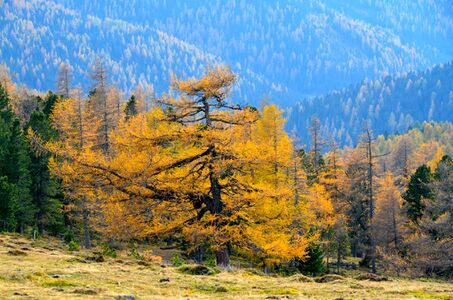 Larch in Albeck, district Feldkirchen, Carinthia, Austria
 -
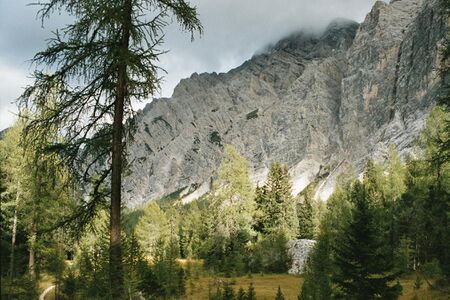 South Tyrol, Wengen-La Val-La Valle
 -
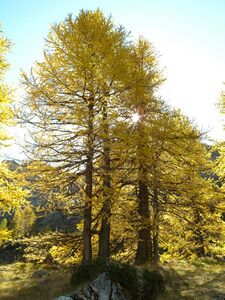 Parc régional du Queyras, Embrun, Hautes-Alpes, France
 -
 Autumnal forest with larches, spruces and arolla pines at Seebachern
 -
 Bark, with a wound from a broken branch.
 -
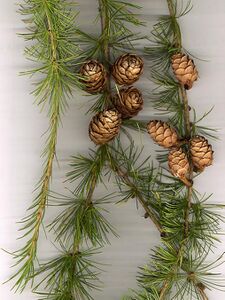 European larch foliage and cones
 -
 Developing seed cone in detail
 -
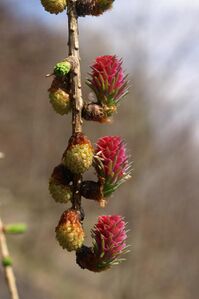 Young seed cones (red) and pollen cones (yellow)
 -
 Young female cone
 -
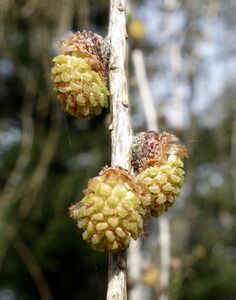 Male cones
 -
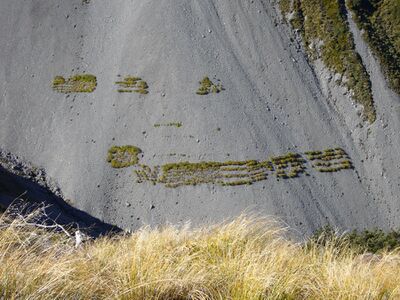 European larch planted for erosion control on a scree slope in Canterbury, New Zealand
 -
 Close-up of leaves


.jpg)


._Wond_van_een_afgebroken_tak._Europese_larix_(Larix_decidua)_02.jpg)


References
- ↑ Farjon, A. (2017). "Larix decidua". IUCN Red List of Threatened Species 2017. doi:10.2305/IUCN.UK.2017-2.RLTS.T42309A83969267.en. https://www.iucnredlist.org/species/42309/83969267. Retrieved 19 November 2021.
- ↑ NatureServe. "Larix decidua" (in en). Arlington, Virginia. https://explorer.natureserve.org/Taxon/ELEMENT_GLOBAL.2.130387/.
- ↑ 3.0 3.1 "Larix decidua Mill.". Board of Trustees of the Royal Botanic Gardens, Kew. 2017. http://powo.science.kew.org/taxon/urn:lsid:ipni.org:names:262420-1.
- ↑ "Larix decidua - The Gymnosperm Database". http://www.conifers.org/pi/Larix_decidua.php.
- ↑ "European Larch 'Santa Gertrude 1' in a forest, Val d'Ultimo, Trentino-Alto Adige, Italy". 2001-07-15. https://www.monumentaltrees.com/en/ita/trentinoaltoadige/ultimo/12812_forest/25954/.
- ↑ "European Larch close to Richthof, Schlitz, Hesse, Germany". 2013-01-10. https://www.monumentaltrees.com/en/deu/hesse/vogelsbergkreis/4524_richthof/10650/.
- ↑ "European Larch close to the cheese farm in Prairion, Vallese, Switzerland". 2012-07-22. https://www.monumentaltrees.com/en/che/vallese/iserables/4323_cheesefarm/.
- ↑ 8.0 8.1 Rushforth, Keith (1999). Trees of Britain and Europe. London: Collins. pp. 777–785. ISBN 0-00-220013-9.
- ↑ 9.0 9.1 Vidaković, Mirko (1991). Conifers (English ed.). Croatia: Grafički Zavod Hrvatske. pp. 255–281.
- ↑ "Larix decidua". https://europlusmed.org/cdm_dataportal/taxon/532ff1b0-6cfa-41f5-81d9-ecf7433a67ba.
- ↑ Litkowiec, Monika; Lewandowski, Andrzej; Burczyk, Jarosław (2018-12-20). "Genetic status of Polish larch (Larix decidua subsp. polonica (Racib. Domin)) from Chełmowa Mountain: implications for gene conservation". Dendrobiology 80: 101–111. doi:10.12657/denbio.080.010. ISSN 1641-1307.
- ↑ Bobrov, E. G. (1972). "Synopsis Specierum Generis Larix Mill.". Novitates Systematicae Plantarum Vascularum 9: 4–15.
- ↑ Lewandowski, A. (1997). "Genetic relationships between European and Siberian larch, Larix spp. (Pinaceae), studied by allozymes. Is the Polish larch a hybrid between these two species?". Plant Systematics and Evolution (Springer) 204 (1/2): 65–73. doi:10.1007/BF00982532. ISSN 0378-2697. Bibcode: 1997PSyEv.204...65L.
- ↑ 14.0 14.1 14.2 14.3 14.4 14.5 Mitchell, Alan (1972). "Conifers in the British Isles: a descriptive handbook". pp. 130–134. https://cdn.forestresearch.gov.uk/1972/03/fcbk033.pdf.
- ↑ The Gardener's Dictionary, Vol.1, Philip Miller, 1835
- ↑ A History of British Forest-trees: Indigenous and Introduced, Prideaux John Selby, 1842
- ↑ The Philosophical Magazine and Journal, Vol. 53, 1819
- ↑ "European Larch Dunkeld Cathedral, Dunkeld, Scotland, United Kingdom". 2024-06-02. https://www.monumentaltrees.com/en/gbr/scotland/perthandkinross/7377_dunkeldcathedral/64836/.
- ↑ "European Larch in the garden of Kailzie, Peebles, Scotland, United Kingdom (1)". 2023-09-14. https://www.monumentaltrees.com/en/gbr/scotland/roxburgh/33694_kailzie/62173/.
- ↑ "European Larch in the garden of Kailzie, Peebles, Scotland, United Kingdom (2)". 2023-09-14. https://www.monumentaltrees.com/en/gbr/scotland/roxburgh/33694_kailzie/62172/.
- ↑ "European Larch Larix decidua". https://plantatlas2020.org/atlas/2cd4p9h.1as.
- ↑ "Larix decidua". US Forest Service. http://www.fs.fed.us/database/feis/plants/tree/lardec/all.html.
- ↑ Perry, Leonard. "Larches Large and Small". University of Vermont Extension. http://pss.uvm.edu/ppp/articles/larches.html.
- ↑ "Hybrid Larch Larix × marschlinsii". https://plantatlas2020.org/atlas/2cd4p9h.9dn.
- ↑ "The advantages of hybrid over European and Japanese larch". https://larchresearch.com/wp-content/uploads/2015/11/The-advantages-of-hybrid-over-European-and-Japanese-larch-Coillete-1998.pdf.
- ↑ D'Cruz, Mark. "Ma-Ke Bonsai Care Guide for Larix decidua". Ma-Ke Bonsai. http://makebonsai.com/guide/bonsailink.asp?quicklink=5002&name=Larix_decidua.
- ↑ King, Joshua (2017-07-24). "Deeside timber firm teams up with north-east boat festival for unique restoration project". https://www.pressandjournal.co.uk/fp/news/aberdeen-aberdeenshire/1294342/deeside-timber-firm-teams-up-with-north-east-boat-festival-for-unique-restoration-project/.
- ↑ Matras, Jan; Pâques, Luc E. (2008). European Larch, Larix decidua. Technical guidelines for genetic conservation and use. European Forest Genetic Resources Programme. http://www.euforgen.org/fileadmin//templates/euforgen.org/upload/Publications/Technical_guidelines/1324_European_larch__Larix_decidua_.pdf. Retrieved 2016-10-05.
External links
- Larix decidua. Information, genetic conservation units and related resources. European Forest Genetic Resources Programme (EUFORGEN)
Wikidata ☰ Q146048 entry
 |  |


