Biology:Lathrocordulia garrisoni
| Queensland swiftwing | |
|---|---|
Scientific classification 
| |
| Kingdom: | Animalia |
| Phylum: | Arthropoda |
| Class: | Insecta |
| Order: | Odonata |
| Infraorder: | Anisoptera |
| Family: | Austrocorduliidae |
| Genus: | Lathrocordulia |
| Species: | L. garrisoni
|
| Binomial name | |
| Lathrocordulia garrisoni Theischinger & Watson, 1991[2]
| |

| |
| Distribution in north-eastern Australia | |
Lathrocordulia garrisoni is a species of dragonfly in the family Austrocorduliidae.[3][4][5] It is also known as the Queensland swiftwing.[6] It is a medium-sized, bronze to black dragonfly without pale markings.[6] It is endemic to north-eastern Australia, where its natural habitat is subtropical or tropical moist montane forests.[6]
Etymology
The genus name Lathrocordulia combines the Greek λαθραῖος (lathraios, "hidden", "secret" or "furtive") with Cordulia, a genus name derived from the Greek κορδύλη (kordylē, "club" or "cudgel"). The name may refer to the uncertain or obscure relationship of the genus to other corduliid dragonflies.[7]
In 1991, Günther Theischinger and Tony Watson named this species garrisoni, an eponym honouring Rosser Garrison, who collected the original specimen.[2][8][9]
Gallery
-
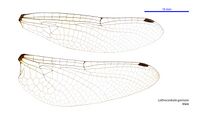 Male wings
.jpg)
See also
- List of Odonata species of Australia
References
- ↑ Dow, R.A. (2017). "Lathrocordulia garrisoni". IUCN Red List of Threatened Species 2017. doi:10.2305/IUCN.UK.2017-1.RLTS.T59735A14274472.en. https://www.iucnredlist.org/species/59735/14274472. Retrieved 29 September 2024.
- ↑ 2.0 2.1 Theischinger, G.; Watson, J.A.L. (1991). The Australian Dragonflies. Melbourne: CSIRO. pp. 21–51 [48]. ISBN 0-643-05136-8. http://www.publish.csiro.au/book/6594/.
- ↑ "Species Lathrocordulia garrisoni Theischinger & Watson, 1991". Australian Biological Resources Study. 2022. https://biodiversity.org.au/afd/taxa/Lathrocordulia_garrisoni.
- ↑ "World Odonata List". University of Puget Sound. https://www.pugetsound.edu/academics/academic-resources/slater-museum/biodiversity-resources/dragonflies/world-odonata-list2/.
- ↑ Goodman, Aaron; Abbott, John C.; Bybee, Seth M.; Ehlert, Juliana; Frandsen, Paul B.; Guralnick, Rob; Kalkman, Vincent J.; Newton, Lacie et al. (2025-10-09). "Systematic and taxonomic revision of emerald and tigertail dragonflies (Anisoptera: Synthemistidae and Corduliidae)". Systematic Entomology. doi:10.1111/syen.70000.
- ↑ 6.0 6.1 6.2 Theischinger, Günther; Hawking, John (2021). The Complete Field Guide to Dragonflies of Australia (2nd ed.). Melbourne, Australia: CSIRO Publishing. pp. 406. ISBN 978-1-4863-1374-7.
- ↑ Endersby, Ian (2012). "Etymology of the Dragonflies (Insecta: Odonata) named by R.J. Tillyard, F.R.S.". Proceedings of the Linnean Society of New South Wales 134: 1-16. https://openjournals.library.sydney.edu.au/LIN/article/view/5941.
- ↑ Endersby, I. (2012). "Watson and Theischinger: the etymology of the dragonfly (Insecta: Odonata) names which they published". Journal and Proceedings of the Royal Society of New South Wales 145 (443 & 444): 34–53 [41]. doi:10.5962/p.146542. ISSN 0035-9173. https://www.biodiversitylibrary.org/page/46371079.
- ↑ Hämäläinen, Matti (9 February 2016). "Catalogue of individuals commemorated in the scientific names of extant dragonflies, including lists of all available eponymous species-group and genus-group names – Revised edition". International Dragonfly Fund Report 92: 1–132. ISSN 1435-3393. https://dragonflyfund.org/wp-content/uploads/2024/06/IDF_Report_92_Haemaelaeinen_2016.pdf.
 |
Wikimedia Commons has media related to Lathrocordulia garrisoni. |
Wikidata ☰ Q1938056 entry
 |  |


