Biology:Little grebe
| Little grebe | |
|---|---|

| |

| |
| Two adults in breeding plumage, below with feathers pressed against the body, for low buoyancy | |
Scientific classification 
| |
| Kingdom: | Animalia |
| Phylum: | Chordata |
| Class: | Aves |
| Order: | Podicipediformes |
| Family: | Podicipedidae |
| Genus: | Tachybaptus |
| Species: | T. ruficollis
|
| Binomial name | |
| Tachybaptus ruficollis (Pallas, 1764)
| |

| |
Breeding
Year-round
Non-breeding
Vagrant (seasonality uncertain)
| |
| Synonyms | |
|
Podiceps ruficollis | |

The little grebe (Tachybaptus ruficollis), also known as the dabchick, is a member of the grebe family of water birds. The genus name is from Ancient Greek takhus "fast" and bapto "to sink under". The specific ruficollis is from Latin rufus "red" and Modern Latin -collis, "-necked", itself derived from Latin collum "neck".[2]
At 23 to 29 centimetres (9 to 11 1⁄2 inches) in length it is the smallest European, Asian, and African member of its family. It is commonly found in open bodies of water across most of its range.
Taxonomy
The little grebe was formally described in a sales catalogue by the German naturalist Peter Simon Pallas in 1764 under the binomial name Colymbus ruficollis.[3][4] The type locality is the Netherlands.[5] The specific epithet is Modern Latin meaning "red-necked", from Latin rufus meaning "red", "ruddy" or "rufous" and Modern Latin -collis meaning "-necked".[6] The little grebe is now one of five species placed in the genus Tachybaptus that was introduced in 1789 by German naturalist Johann Friedrich Gmelin.
Subspecies
Ten subspecies are currently accepted, four widespread, and six with restricted ranges; they are separated principally by size, eye colour, which varies from dark to light from west to east, to red in the southeast, and extent of white on the secondary feathers of the wing, which varies from none in temperate northern regions, to extensive white in tropical regions.[7][8][9]
| Summer | Winter | Scientific name | Distribution | Notes (flank colour refers to breeding plumage) |
|---|---|---|---|---|
| 120px Brussels, Belgium |
120px Lac de Tunis, Tunisia |
T. r. ruficollis Pallas, 1764 | nominate, Europe to western Asia, south to northern Africa; northeast European birds migratory, others resident. | Eye dark brown; flanks brown; secondaries with no or minimal white. |
| 120px Bharatpur, Rajasthan, India |
120px Coimbatore, Tamil Nadu, India |
T. r. albescens (Blanford, 1877) | Southern and central Asia from Turkmenistan to southern Kazakhstan, south to Sri Lanka, and east through Pakistan, India, Nepal, Bhutan and Bangladesh to Myanmar; central Asian birds migratory, south Asian birds resident. | Eye orange to yellow; bill short; secondaries with extensive white. |
| 120px Al Jahra, Kuwait |
120px Kuwait |
T. r. iraquensis (Ticehurst, 1923) | Tigris–Euphrates river system in southeastern Iraq, southwestern Iran, and Kuwait; resident. | Eye dark brown; bill short; flanks brown; secondaries with extensive white. |
| 120px Marievale, Gauteng, South Africa |
120px Marievale, Gauteng, South Africa |
T. r. capensis (Salvadori, 1884) | Sub-Saharan Africa, Madagascar, Comoros. | Eye reddish brown; flanks brown; secondaries with extensive white. |
| 120px Sakai, Osaka, Japan |
120px Kihoku, Mie Prefecture, Japan |
T. r. poggei (Reichenow, 1902) | Eastern Asia, in Indochina, China, Korea, Taiwan, Japan, and the south Kuril Islands. | Eye pale yellow to white; bill long; flanks brown; secondaries with no or minimal white. |
| 120px | T. r. philippensis (Bonnaterre, 1790) | Northern Philippines (Luzon and nearby islands), Borneo. | Eye pale yellow to white; bill long; flanks dark brown; secondaries with white. | |
| T. r. cotabato (Rand, 1948) | Southern Philippines (Mindanao). | Eye pale yellow to white; bill long; secondaries with white. | ||
| T. r. vulcanorum (Rensch, B, 1929) | Java to Tanimbar Islands | Eye red; flanks blackish | ||
| 120px | T. r. tricolor (Gray, GR, 1861) | Sulawesi to New Guinea and Lesser Sunda Islands | Eye red; flanks blackish | |
| T. r. collaris (Mayr, E, 1945) | northeastern New Guinea to Bougainville Island (northern Solomon Islands | Eye red; flanks blackish |
The last three subspecies in the above table, T. r. vulcanorum, T. r. tricolor and T. r. collaris, have sometimes been treated as a separate species, the tricoloured grebe;[10] it differs only slightly, notably in the red eyes, and blackish flanks and underparts.[11]
Description
The little grebe is a small water bird with a pointed bill. The adult is unmistakable in summer, predominantly dark above with its rich, rufous colour neck, cheeks and flanks, and bright yellow gape. The rufous is replaced by a dirty brownish grey in non-breeding and juvenile birds.
Juvenile birds have a yellow bill with a small black tip, and black and white streaks on the cheeks and sides of the neck as seen below. This yellow bill darkens as the juveniles age, eventually turning black in adulthood.
In winter, its size, buff plumage, with a darker back and cap, and "powder puff" rear end enable easy identification of this species. The little grebe's breeding call, given singly or in duet, is a trilled repeated weet-weet-weet or wee-wee-wee which sounds like a horse whinnying.
Distribution
This bird breeds in small colonies in heavily vegetated areas of freshwater lakes across Europe, much of Asia down to New Guinea, and most of Africa. Most birds move to more open or coastal waters in winter, but it is only migratory in those parts of its range where the waters freeze. Outside of breeding season, it moves into more open water, occasionally even appearing on the coast in small bays.[1]
Behaviour
The little grebe is an excellent swimmer and diver and pursues its fish and aquatic invertebrate prey underwater. It uses the vegetation skilfully as a hiding place.
Like all grebes, it nests at the water's edge, since its legs are set very far back and it cannot walk well. Usually four to seven eggs are laid. When the adult bird leaves the nest it usually takes care to cover the eggs with weeds. This makes it less likely to be detected by predators.[12] The young leave the nest and can swim soon after hatching, and chicks are often carried on the backs of the swimming adults.[13] In India, the species breeds during the rainy season.[14]
Gallery
-
 T. r. ruficollis in Spain; no white in the wing
 -
 T. r. poggei in Japan; no white in the wing
 -
 T. r. albescens in India; extensive white in the wing
 -
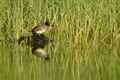 Nest at edge of lake in Jodhpur, Rajasthan, India
 -
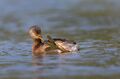 Grebe displaying its webbed feet
 -
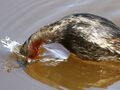 Diving at Delta del Llobregat, Barcelona
 -
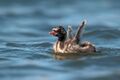 Chick
Chick -
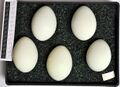 Eggs, Collection Museum Wiesbaden


.jpg)


References
- ↑ 1.0 1.1 BirdLife International (2025). "Tachybaptus ruficollis". IUCN Red List of Threatened Species 2025. doi:10.2305/IUCN.UK.2025-2.RLTS.T22696545A281865439.en. https://www.iucnredlist.org/species/22696545/281865439.
- ↑ Jobling, James A (2010). The Helm Dictionary of Scientific Bird Names. London: Christopher Helm. pp. 341, 377. ISBN 978-1-4081-2501-4. https://archive.org/details/Helm_Dictionary_of_Scientific_Bird_Names_by_James_A._Jobling.
- ↑ Pallas, Peter Simon; Vosmaer, Arnout (1764) (in Dutch, French, Latin). Beredeneerde catalogus van eene, by uitstek fraaye en weergaalooze verzameling, zoo van inlandsche als uitheemsche vogelen, viervoetige en gekorvene dieren: Adumbratiunculae. s'Gravenhage [The Hague]: Pieter van Os, boekverkoper op de plaats. p. 6, No. 281. https://www.biodiversitylibrary.org/page/56365385. Published anonymously. For the authors see: Rookmaaker, L.C.; Pieters, F.F.J.M. (2000). "Birds in the sales catalogue of Adriaan Vroeg (1764) described by Pallas and Vosmaer". Contributions to Zoology 69 (4): 271–277. doi:10.1163/18759866-06904005. http://www.repository.naturalis.nl/document/571856.
- ↑ Sherborn, C. Davies (1905). "The new species of birds in Vroeg's catalogue, 1764". Smithsonian Miscellaneous Collections 47: 332–341 [339 No. 281]. https://www.biodiversitylibrary.org/page/8812106. Includes a transcript of the 1764 text.
- ↑ Mayr, Ernst; Cottrell, G. William (1979). Check-list of Birds of the World. 1 (2nd ed.). Cambridge, Massachusetts: Museum of Comparative Zoology. p. 143. https://www.biodiversitylibrary.org/page/16108783.
- ↑ Jobling, James A.. "ruficollis". The Key to Scientific Names. Cornell Lab of Ornithology. https://birdsoftheworld.org/bow/key-to-scientific-names/search?q=ruficollis.
- ↑ Ogilvie, Malcolm; Rose, Chris (2003). Grebes of the World. Bruce Coleman. ISBN 978-1-872842-03-5.
- ↑ Mlíkovský, J. (2010). "Systematic notes on Asian birds: 74. A preliminary review of the grebes, Family Podicipedidae". British Ornithologists' Club Occasional Publication 5: 125–131. https://www.biodiversitylibrary.org/page/59129969.
- ↑ AviList Core Team (2025). "AviList: The Global Avian Checklist, v2025". doi:10.2173/avilist.v2025. http://www.avilist.org/checklist/v2025/.
- ↑ Gill, Frank; Donsker, David; Rasmussen, Pamela, eds (February 2025). "Grebes, flamingos". IOC World Bird List Version 15.1. International Ornithologists' Union. https://www.worldbirdnames.org/new/bow/grebes/. Retrieved 11 May 2026.
- ↑ del Hoyo, Josep (2020). All the birds of the world. Barcelona: Lynx Edicions. p. 81. ISBN 978-84-16728-37-4.
- ↑ Prokop, Pavel; Trnka, Alfréd (2011). "Why do grebes cover their nests? Laboratory and field tests of two alternative hypotheses". Journal of Ethology 29: 17–22. doi:10.1007/s10164-010-0214-4. http://www.zoo.sav.sk/prokop/articles/Prokop-Trnka-JEthol-2011.pdf.
- ↑ Finn, Frank (1905). "Notes on the nesting of the Indian Dabchick". Bird Notes 4: 10–17. https://archive.org/stream/birdnotes05fore#page/n17/mode/2up.
- ↑ Dalgliesh, Gordon (1906). "Notes on the Indian Podicipedidae". The Avicultural Magazine 5 (2): 65–72. https://archive.org/stream/aviculturalm519061907avic#page/n97/mode/2up.
Wikidata ☰ Q25421 entry
 |  |


