Biology:Macrochloa tenacissima
| Macrochloa tenacissima | |
|---|---|

| |
Scientific classification 
| |
| Kingdom: | Plantae |
| Clade: | Tracheophytes |
| Clade: | Angiosperms |
| Clade: | Monocots |
| Clade: | Commelinids |
| Order: | Poales |
| Family: | Poaceae |
| Subfamily: | Pooideae |
| Genus: | Macrochloa |
| Species: | M. tenacissima
|
| Binomial name | |
| Macrochloa tenacissima (L.) Kunth
| |
| Synonyms[2] | |
| |
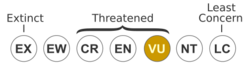
Macrochloa tenacissima, synonym Stipa tenacissima, (esparto, esparto grass, halfah grass, alfa grass, or needle grass) is a perennial grass of northwestern Africa and the southern part of the Iberian Peninsula.[1] Phylogenetic and morphological evidence indicated that the species did not belong in Stipa,[3][4][5] and recent sources treat the species as Macrochloa tenacissima as a result.[2][6][7]
Distribution
Macrochloa tenacissima is native to the Iberian Peninsula, the Balearic Islands, and western north Africa (Morocco, Algeria, Tunisia and Libya).[2] It grows in dry, rocky and base rich soils, forming a steppe-like grassland. It has been managed by people for centuries.[1]
Uses
Macrochloa tenacissima produces a fiber product called esparto which is used for crafts, such as cords, basketry, and espadrilles as well as for making paper.[1]
See also
- Lygeum spartum, another species of grass also used as esparto
References
- ↑ 1.0 1.1 1.2 1.3 Carapeto, A.; Véla, E. (2018). "Stipa tenacissima". IUCN Red List of Threatened Species 2018. doi:10.2305/IUCN.UK.2018-1.RLTS.T57471077A125468612.en. https://www.iucnredlist.org/species/57471077/125468612. Retrieved 22 August 2021.
- ↑ 2.0 2.1 2.2 "Macrochloa tenacissima (L.) Kunth". Royal Botanic Gardens, Kew. https://powo.science.kew.org/taxon/urn:lsid:ipni.org:names:407732-1..
- ↑ Vázquez, F.M.; Barkworth, M.E. (2004). "Resurrection and emendation of Macrochloa (Gramineae: Stipeae)". Botanical Journal of the Linnean Society 144 (4): 483–495.
- ↑ Romaschenko, K.; Peterson, P.M.; Soreng, R.J.; Garcia-Jacas, N.; Susanna, A. (2010). "Phylogenetics of Stipeae (Poaceae: Pooideae) Based on Plastid and Nuclear DNA Sequences". in Seberg, Ole; Petersen, G.; Barfod, A.S. et al.. Diversity, phylogeny, and evolution in the monocotyledons. Aarhus Universitetsforlag. pp. 511-537.
- ↑ Romaschenko, K.; Peterson, P.M.; Soreng, R.J.; Garcia-Jacas, N.; Futorna, O.; Susanna, A.. "Systematics and evolution of the needle grasses (Poaceae: Pooideae: Stipeae) based on analysis of multiple chloroplast loci, ITS, and lemma micromorphology". Taxon 61 (1): 18–44. doi:10.1002/tax.611002.
- ↑ Valdés, B.; Scholz, H.; Raab-Straube, E.; Parolly, G. (2009). "Poaceae (pro parte majore)". https://europlusmed.org/cdm_dataportal/taxon/ad19c16d-8d72-4432-a84e-2086e635e4d3.
- ↑ Krawczyk, K.; Mazdziarz, M.; Paukszto, Ł.; Nobis, M.; Sawicki, J. (2025). "Phylogenetic reconstruction and species delimitation in Stipeae with special reference to Stipa (Poaceae, Pooideae) using mitochondrial genomes". Cladistics. doi:10.1111/cla.12618.
External links
- Stipa tenacissima Spanish information
- McQuarrie, Gavin (1995). European influence and tribal society in Tunisia during the nineteenth century: the origins and impact of the trade in esparto grass 1870–1940 (PDF) (PhD thesis). University of Durham. hdl:10068/460367.
Wikidata ☰ Q831011 entry
 |  |


