Biology:Malaika longipes
| Malaika longipes | |
|---|---|
| Close-up of a brown spider wth white hairs, on a web | |
| close-up of a brown spider wth white hairs, on a web | |
Scientific classification 
| |
| Kingdom: | Animalia |
| Phylum: | Arthropoda |
| Subphylum: | Chelicerata |
| Class: | Arachnida |
| Order: | Araneae |
| Infraorder: | Araneomorphae |
| Family: | Phyxelididae |
| Genus: | Malaika |
| Species: | M. longipes
|
| Binomial name | |
| Malaika longipes (Purcell, 1904)[2]
| |
| Synonyms | |
| |
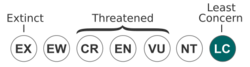
Malaika longipes is a species of spider in the family Phyxelididae.[3] It is endemic to South Africa and is commonly known as the Table Mountain malaika hackled band spider.[4]
Distribution
Malaika longipes is endemic to the Western Cape province of South Africa, with a distribution centered around the Cape Peninsula. Notable locations include Constantia, Kalk Bay Caves, Muizenberg, Simon's Town, and numerous locations within Table Mountain National Park including Bats Caves, Constantia Berg Caves, Devil's Peak, Skeleton Gorge, Kirstenbosch National Botanical Garden, Newlands Forest, Wynberg Caves, Cecilia Spilhaus, Constantia Nek, Orange Kloof, and Tokai.[4]
Habitat and ecology
The species is a ground retreat-web cryptic spider that lives in damp and dark places. It has been found mostly in moister ravines on the slopes of Table Mountain, in indigenous forest, as well as Fynbos. The species has been recorded from primary and indigenous forest, as well as the Wynberg Caves in Table Mountain and Kalk Bay Caves. It occurs at elevations from 6 to 279 m above sea level.[4]
Description
 | This section is empty. You can help by adding to it. (September 2025) |
Conservation
Malaika longipes is listed as Rare due to its restricted distribution. The species occurs within one of South Africa's large protected areas, the Table Mountain National Park, and is unlikely to face future threats. There are no significant threats to the species.[4]
Taxonomy
The species was originally described by Purcell in 1904 as Auximus longipes from Devil's Peak in Table Mountain National Park. It was subsequently described as Haemilla grindleyi by Lawrence in 1964 and transferred to Phyxelida by Brignoli in 1983 before being placed in its current genus and synonymized by Griswold in 1990. Malaika longipes is the type species of the genus Malaika.[4][3]
References
- ↑ "Table Mountain Malaika Hackled Band Spider". IUCN. https://www.iucnredlist.org/species/176427554/189448173.
- ↑ Purcell, W.F. (1904). "Descriptions of new genera and species of South African spiders". Transactions of the South African Philosophical Society 15: 132. doi:10.1080/21560382.1904.9526438.
- ↑ 3.0 3.1 "Malaika longipes (Purcell, 1904)". World Spider Catalog. https://wsc.nmbe.ch/species/27104. Retrieved 24 September 2025.
- ↑ 4.0 4.1 4.2 4.3 4.4 Dippenaar-Schoeman, A.S.; Haddad, C.R.; Foord, S.H.; Lotz, L.N. (2021). The Phyxelididae of South Africa. Version 1. South African National Survey of Arachnida Photo Identification Guide. pp. 9. doi:10.5281/zenodo.6813843. https://doi.org/10.5281/zenodo.6813843. Retrieved 24 September 2025.
 This article incorporates text available under the CC BY 4.0 license.
External links
- {{Inaturalist taxon}} template missing ID and not present in Wikidata.
Wikidata ☰ Q2028874 entry
 |  |


