Biology:Olea capensis
| Black ironwood | |
|---|---|

| |
| In Cape Town | |
Scientific classification 
| |
| Kingdom: | Plantae |
| Clade: | Tracheophytes |
| Clade: | Angiosperms |
| Clade: | Eudicots |
| Clade: | Asterids |
| Order: | Lamiales |
| Family: | Oleaceae |
| Genus: | Olea |
| Species: | O. capensis
|
| Binomial name | |
| Olea capensis | |

| |
| approximate range | |
| Synonyms[3] | |
| |
Olea capensis, the black ironwood,[4] is an African tree species in the olive family Oleaceae. It is widespread in sub-Saharan Africa: from the east in Somalia, Ethiopia and Sudan, south to the tip of South Africa, and west to Cameroon, Sierra Leone and the islands of the Gulf of Guinea, as well as Madagascar and the Comoros.[2] It occurs in bush, littoral scrub and evergreen forest.[5]
Other common names in English include ironwood, ironwood olive, East African olive and Elgon olive.[5]
Description
The black ironwood is a bushy shrub, or a small to medium-sized tree, up to 10 metres (33 ft) in height, occasionally reaching 40 metres (130 ft).[5]
- Bark: light grey, becoming dark grey and vertically fissured with age; a characteristic blackish gum is exuded from bark wounds.
- Leaves: light to dark green and glossy above and paler green below; petiole often purplish, 0.3–1.7 cm long; lanceolate-oblong to almost circular, 3–10 x 1.5–5 cm.
- Flowers: white or cream and sweetly scented, small and in many flowered axillary or terminal heads, bisexual, 3–15 cm long.
- Fruit: when ripe they are somewhat succulent purplish drupes; ovoid up to 2 x 1 cm.
Subspecies
The species has been divided into 3 subspecies:[5]
- Olea capensis subsp. macrocarpa: flowers in lax heads, fruits oblong to elliptic.
- Olea capensis subsp. capensis: flowers in dense heads, leaves very variable, apex often rounded, and fruits almost spherical to oblong elliptic.
- Olea capensis subsp. enervis: leaves usually broadly elliptic, apex tapering.
Uses
Food
Olea capensis has masses of sweetly scented bisexual flowers that produce large edible fruits.[6][7]
Timber
The wood of the tree is very hard, fine grained, and heavy, and although difficult to work, it is widely used for art and artifacts and is an excellent turnery wood.[7] Guinness World Records lists this tree as the world's heaviest wood, with a specific gravity of 1.49, similar to that of anthracite or dry earth.[8] This causes the wood to sink in water, unlike other wood materials. It is also one of the world's hardest woods according to the Janka hardness test.[9]
Gardens
Olea capensis is cultivated as an ornamental tree in parks and gardens.[6]
Gallery
-
 O. c. subsp. macrocarpa, large forest specimen
 -
 Flowers
 -
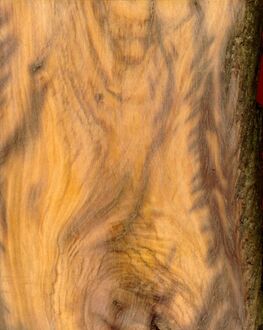 Timber
 -
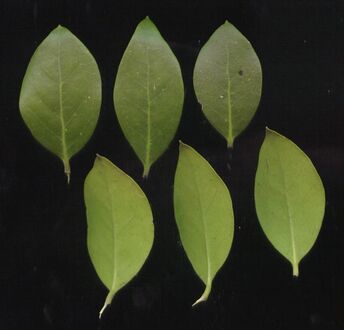 Leaves
 -
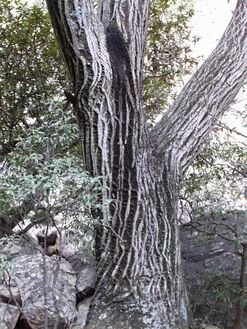 Trunk and bark of O. c. subsp. enervis


References
- ↑ Botanic Gardens Conservation International (BGCI); IUCN SSC Global Tree Specialist Group (2020). "Olea capensis". IUCN Red List of Threatened Species 2020. doi:10.2305/IUCN.UK.2020-2.RLTS.T61919282A146444162.en. https://www.iucnredlist.org/species/61919282/146444162. Retrieved 19 November 2021.
- ↑ 2.0 2.1 "Olea capensis". World Checklist of Selected Plant Families (WCSP). Royal Botanic Gardens, Kew. http://wcsp.science.kew.org/namedetail.do?name_id=355136.
- ↑ "Olea laurifolia". World Checklist of Selected Plant Families (WCSP). Royal Botanic Gardens, Kew. http://wcsp.science.kew.org/namedetail.do?name_id=355200.
- ↑ {{citation | mode = cs1 | title = Olea capensis | work = Germplasm Resources Information Network (GRIN) | url = https://npgsweb.ars-grin.gov/gringlobal/taxonomydetail.aspx?405245 | publisher = [[Organization:Agricultural Research ServAgricultural Research Service (ARS), United States Department of Agriculture (USDA) | access-date = 4 August 2017 }}
- ↑ 5.0 5.1 5.2 5.3 "Olea capensis". World Agroforestry Centre. http://www.worldagroforestry.org/treedb/AFTPDFS/Olea_capensis.PDF.
- ↑ 6.0 6.1 "IRC - Natives for Your Neighborhood". https://www.regionalconservation.org/beta/nfyn/plantdetail.asp?tx=Krugferr.
- ↑ 7.0 7.1 "Olea capensis - Useful Tropical Plants". https://tropical.theferns.info/viewtropical.php?id=Olea+capensis.
- ↑ "Solids and Metals - Specific Gravities". https://www.engineeringtoolbox.com/specific-gravity-solids-metals-d_293.html.
- ↑ "Black Ironwood | The Wood Database (Hardwood)" (in en-US). https://www.wood-database.com/black-ironwood/.
External links
- "Olea capensis". Ecocrop FAO. http://ecocrop.fao.org/ecocrop/srv/en/cropView?id=8059.
- "Olea capensis subsp. capensis". Aluka. http://www.aluka.org/action/showCompilationPage?doi=10.5555/AL.AP.COMPILATION.PLANT-NAME-SPECIES.OLEA.CAPENSIS.
- "Olea capensis subsp. capensis". Fernkloof Nature Reserve. http://fernkloof.com/species.mv?159.
Wikidata ☰ Q568254 entry
 |  |


