Biology:Pachliopta hector
| Crimson rose | |
|---|---|
_in_Hyderabad,_AP_W_IMG_7819.jpg)
| |
| Male in Hyderabad, India | |
_underside.jpg)
| |
| In Kerala, India | |
Scientific classification 
| |
| Kingdom: | Animalia |
| Phylum: | Arthropoda |
| Class: | Insecta |
| Order: | Lepidoptera |
| Family: | Papilionidae |
| Genus: | Pachliopta |
| Species: | P. hector
|
| Binomial name | |
| Pachliopta hector | |
| Synonyms | |
|
Atrophaneura hector | |

_in_Hyderabad,_AP_W_IMG_7849.jpg)
Pachliopta hector, the crimson rose,[3][4] is a large swallowtail butterfly belonging to the genus Pachliopta (roses) of the red-bodied swallowtails.[3][4]
Range
It is found in Pakistan, India, Sri Lanka, Maldives and possibly the coast of western Myanmar.[3][4][5]
In India, it is found in the Western Ghats, southern India (Tamil Nadu, Kerala), eastern India (West Bengal and Odisha). It is a straggler in the Andaman Islands.[3][4][6]
Status
It is generally common and not known to be threatened. It is common all along the Western Ghats up to Maharashtra but rare in Gujarat.{{citation needed|date=October 2014} India.[citation needed]
Description
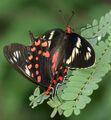
The male's upperside is black. Forewing with a broad white interrupted band from the subcostal nervure opposite the origin of veins 10 and 11, extended obliquely to the tornus, and a second short pre-apical similar band; both bands composed of detached irregularly indented broad streaks in the interspaces. Hindwing with a distal posteriorly strongly curved series of seven crimson spots followed by a subterminal series of crimson lunules. Cilia black alternated with white. Underside: forewing dull brownish black, hindwing black; markings as on the upperside, but the crimson spots and crescent-shaped markings on the hindwing larger. Antennae, thorax and abdomen above at base, black; head and rest of the abdomen bright crimson; beneath: iho palpi, the sides of the thorax and abdomen crimson.[7][8]
The female is similar, the discal series of spots and subterminal lunules much duller, pale crimson irrorated (sprinkled) with black scales; in some specimens the anterior spots and lunules almost white barely tinged with crimson; abdomen above with the black colour extended further towards the apex.[7][8]
No geographic races have been described.[7][8]
Habitat
Habits
Aposematism and mimicry
Migration
In the Entomologist's Monthly Magazine, 1880, p. 276, Mr. R. S. Eaton notes that in Bombay this butterfly roosted in great numbers together, however Charles Thomas Bingham notes that in the Western Ghats between Vengurla and Belgaum, where the butterfly occurred in some numbers and had the habit of roosting in company on twigs of some thorny shrub, but never saw more than "a score or so together".[7]
Life cycle
-
 Mating
 -
 Egg
Egg -
 Egg
Egg -
 Hatching
 -
 Caterpillar
 -
 Caterpillar
 -
 Chrysalis
 -
 Freshly emerged specimen
 -
 Newly Emerged
_mating_in_Hyderabad,_AP_W_IMG_9124.jpg)


Eggs
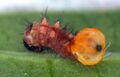
Similar to those of the common rose, the eggs hatch in seven days.[7][8]
Caterpillars
The caterpillars of the crimson rose are similar to those of the common rose butterflies, but are purplish black or blackish brown with a little bit of red, pink and orange colors on there wings. They have a black head and orange osmeterium. Their bodies are fat, with orange-red tubercles and a prominent yellowish-white band transversely placed on segments six to eight. The caterpillar has five instars. The caterpillars are known to display cannibalistic behaviour.[7][8]
Pupa
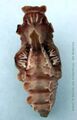
The pupa is pinkish brown with darker expanded wing cases. The wing-like expansions on the abdomen are distinctive.[7][8]
Food plants
The larvae of the species breed on various species of Aristolochia including Aristolochia indica, Aristolochia bracteolata, and Thottea siliquosa. The species is unpalatable as they sequester chemical compounds in their larval stages including aristolochic acid from the host plants.[9]
Nectar resources
- Adathoda zeylonica January–March
- Albizzia lebbeck March–June
- Anacardium occidentale December–March
- Antigonon leptopus year-long
- Bougainvillea spectabilis year-long
- Caesalpinia pulcherrima year-long
- Capparis spinosa December–February
- Carissa carandus year-long (April–July)
- Catharanthus roseus year-long
- Citheroxylum subserratum April–June
- Clerodendrum infortunatum February–April
- Duranta repens June–December
- Hibiscus rosa-sinensis year-long
- Hyptis suaveolens September–January
- Jasminum angustifolium June–August
- Lantana camara year-long
- Muntingia calabura year-long
- Nerium odorum year-long
- Premna latifolia March–August
- Sida acuta August–December
- Sida cordifolia August–December
- Stachytarpheta indica June–September
- Wrightia tinctoria April–June
- Zizyphus oenoplia August–December and March–June
Etymology
Cited references
- ↑ Fernando, E.; Jangid, A.K.; Alwis, C.; Chowdhury, S.; Jayasinghe, H.D.; Kehimkar, I.; Kunte, K.; Rajapakshe, S.S. et al. (2020). "Pachliopta hector". IUCN Red List of Threatened Species 2020. doi:10.2305/IUCN.UK.2020-2.RLTS.T121972074A170543045.en. https://www.iucnredlist.org/species/121972074/170543045. Retrieved 26 February 2026.
- ↑ "Papilionidae – revised GloBIS/GART species checklist (2nd draft)". Entomological Data Information System. Staatliches Museum für Naturkunde Stuttgart, Germany. 28 July 2005. http://www.insects-online.de/frames/papilio.htm.
- ↑ 3.0 3.1 3.2 3.3 Varshney, R.K.; Smetacek, Peter (2015). A Synoptic Catalogue of the Butterflies of India. New Delhi: Butterfly Research Centre, Bhimtal & Indinov Publishing, New Delhi. pp. 1–2. doi:10.13140/RG.2.1.3966.2164. ISBN 978-81-929826-4-9. https://www.researchgate.net/publication/287980260.
- ↑ 4.0 4.1 4.2 4.3 Savela, Markku. "Atrophaneura hector (Linnaeus, 1758)". https://www.nic.funet.fi/pub/sci/bio/life/insecta/lepidoptera/ditrysia/papilionoidea/papilionidae/papilioninae/atrophaneura/#hector.
- ↑ Salman Baloch, Zafeer Ahmed Shaikh, Sadiq Baloch, Zohaib Ahmed (September 2024). "Pakistan's First Crimson Rose on Big Butterfly Month's Inaugural Day". https://www.researchgate.net/publication/384635825_Pakistan's_First_Crimson_Rose_on_Big_Butterfly_Month's_Inaugural_Day.
- ↑ Cotton, Adam; Fric, Zdenek Faltynek; Smith, Colin; Smetacek, Peter (March 2013). "Subspecies Catalogue of the Butterflies of India (Papilionidae): A Synopsis". Bionotes 15 (1): 5–8.
- ↑ 7.0 7.1 7.2 7.3 7.4 7.5 7.6
 This article incorporates text from a publication now in the public domain: Bingham, C.T. (1907). The Fauna of British India, Including Ceylon and Burma. II (1st ed.). London: Taylor and Francis, Ltd.. pp. 19–20. https://archive.org/stream/butterflies02bingiala#page/18/mode/2up/.
- ↑ 8.0 8.1 8.2 8.3 8.4 8.5 Moore, Frederic (1901–1903). Lepidoptera Indica. Vol. V. 5. London: Lovell Reeve and Co.. pp. 173–175. https://www.biodiversitylibrary.org/item/103496#page/185/mode/1up.
- ↑ Sime K.R., Feeny, P.P. and Haribal, M.M. (2000) Sequestration of aristolochic acids by the pipevine swallowtail, Battus philenor (L.): evidence and ecological implications. Chemoecology 10:169–178 "Archived copy". http://daane.uckac.edu/People/Sime%20Feeny%20Haribal%202000.pdf.

References
- Collins, N. Mark; Morris, Michael G. (1985). Threatened Swallowtail Butterflies of the World: The IUCN Red Data Book. Gland & Cambridge: IUCN. ISBN 978-2-88032-603-6. https://www.biodiversitylibrary.org/item/98674#page/7/mode/1up.
- Evans, W.H. (1932). The Identification of Indian Butterflies (2nd ed.). Mumbai, India: Bombay Natural History Society.
- Gaonkar, Harish (1996). Butterflies of the Western Ghats, India (including Sri Lanka) - A Biodiversity Assessment of a Threatened Mountain System. Bangalore, India: Centre for Ecological Sciences.
- Gay, Thomas; Kehimkar, Isaac David; Punetha, Jagdish Chandra (1992). Common Butterflies of India. Nature Guides. Bombay, India: World Wide Fund for Nature-India by Oxford University Press. ISBN 978-0195631647.
- Kunte, Krushnamegh (2000). Butterflies of Peninsular India. India, A Lifescape. Hyderabad, India: Universities Press. ISBN 978-8173713545. https://books.google.com/books?id=cuPPjOMcu_4C.
- Wynter-Blyth, Mark Alexander (1957). Butterflies of the Indian Region. Bombay, India: Bombay Natural History Society. OCLC 842858821. https://books.google.com/books?id=yEkgAQAAMAAJ.
External links
 |
Wikispecies has information related to Pachliopta hector |
Template:Red-bodied swallowtail Wikidata ☰ Q1768113 entry
 |  |


