Notocactus arechavaletae var. aureus Notocactus arechavaletae var. horstii
Notocactus arechavaletae var. nanus Notocactus campestrensis
Notocactus glaucinus Notocactus glaucinus var. depressus
Notocactus globularis Notocactus incomptus
Notocactus miniatispinus Notocactus minusculus
Notocactus neo-ottoianus var. stenogonus Notocactus neo-ottoianus var. tortuosus
Notocactus ottonis var. albispinus Notocactus ottonis f. elegans
Notocactus ottonis f. globularis Notocactus ottonis subsp. horstii
(Hofacker & K.Herm) N.Gerloff & Neduchal Backeb.
(F.Ritter) N.Gerloff Vích
(F.Ritter) Vích (Link & Otto) Herter
(Werderm.) Borg (F.Ritter) Hofacker
(F.Ritter) Doweld Parodia paraguayensis
Parodia ottonis var. tortuosa Parodia nothominuscula subsp. gravior
Parodia glaucina Opuntia ottonis
(Arechav.) Herter Notocactus tenuispinus f. cristatus
Notocactus spegazzinii var. rubescens Notocactus spegazzinii var. limiticola
Notocactus spegazzinii var. buenekeri (F.Ritter) Vích
Notocactus spegazzinii var. alacriportanus Notocactus securituberculatus var. miniatispinus
Notocactus ruoffii Notocactus oxycostatus var. schuldtii
N.Gerloff Notocactus oxycostatus f. miniatispinus
Notocactus ottonis var. schuldtii Notocactus ottonis var. nigrispinus
Notocactus ottonis var. janousekianus Notocactus ottonis var. acutangularis
Notocactus laetivirens f. densispinus Notocactus eurypleurus
Parodia ottonis, also known as Indian head cactus, is a species of flowering plant in the family Cactaceae.[2][3] This cactus species is found in Argentina, Brazil, Paraguay and Uruguay. There are two recognized subspecies.[1] The epithet ottonis honors the German botanist Christoph Friedrich Otto.
The plant at first grows individually and later forms groups. The light to dark green or blue-green spherical shoots are often tapered towards the base. They reach diameters of 3 to 15 centimeters. The six to 16 distinct ribs are rounded or sharp-edged. There are usually only a few areoles on each rib . The bristle-like thorns that spring from them are straight, curved or twisted. The one to four central spines are brownish, reddish brown or yellowish and have a length of 0.8 to 4 centimeters. The four to 15 spines are whitish to yellowish or brownish and 0.5 to 3 centimeters long.[4]
The usually yellow flowers, rarely orange-red or red, reach lengths of 5 to 6 centimeters and would appear in late summer. Its flower tube is covered with brownish wool and bristles. The scars are dark red. The thick-walled egg-shaped to short cylindrical fruits tear open. They have diameters from 0.9 to 1.3 centimeters. The fruits contain, often very numerous, bell-shaped, glossy black seeds, which are strongly humped.[5]
Range
Parodia ottonis is common in southern Brazil, southern Paraguay, Uruguay, and northeastern Argentina.[6]
Taxonomy
The first description as Cactus ottonis by Johann Georg Christian Lehmann was published in 1827. Nigel Paul Taylor presented the type 1987 in the genus Parodia . Other nomenclatural synonyms are Echinocactus ottonis (Lehm.) Link & Otto (1830), Malacocarpus ottonis (Lehm.) Britton & Rose (1922), Notocactus ottonis (Lehm.) A.Berger ( 1929) and Peronocactus ottonis (Lehm.)[7]



 A flowering specimen
 Botanical illustration
 Flower closeup
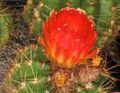 Side view of flower


