Biology:Peperomia blepharipus
| Peperomia blepharipus | |
|---|---|

| |
Scientific classification 
| |
| Kingdom: | Plantae |
| Clade: | Tracheophytes |
| Clade: | Angiosperms |
| Clade: | Magnoliids |
| Order: | Piperales |
| Family: | Piperaceae |
| Genus: | Peperomia |
| Species: | P. blepharipus
|
| Binomial name | |
| Peperomia blepharipus Trel.
| |
Peperomia blepharipus is a species of epiphyte in the genus Peperomia that is endemic in Peru.[1][2] It grows on wet tropical biomes.[1] Its conservation status is Threatened.[3]
Description
The type specimen were collected near Yurimaguas, Peru, at an altitude of 135 meters (443 ft).[4]
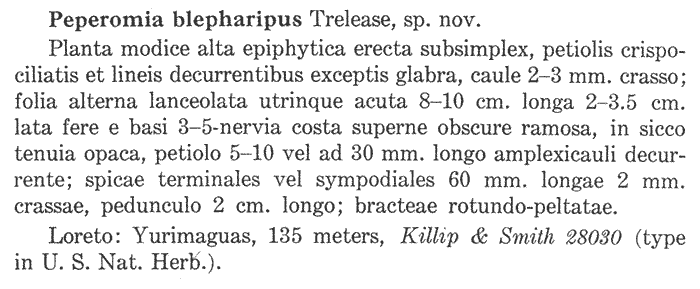
Peperomia blepharipus is a moderately tall, erect, epiphytic herb with a mostly unbranched stem, 2–3 mm thick. It is largely hairless except for the distinctive crisp-ciliate hairs on its petioles and their decurrent (extending down the stem) lines. The alternate leaves are lanceolate and pointed at both ends, measuring Template:Convert abbreviated long and Template:Convert abbreviated wide. They are 3–5-nerved from near the base, with the midrib obscurely branched above. When dry, the leaves are thin and opaque. The petioles are clasping and decurrent, varying in length from 5–10 mm on most leaves to as long as Template:Convert abbreviated on others. The spikes are terminal or sympodial, reaching Template:Convert abbreviated in length and 2 mm in thickness, and are borne on a peduncle about Template:Convert abbreviated long. The floral bracts are round-peltate.[4]
Taxonomy and naming
It was described in 1936 by William Trelease in Publications of the Field Museum of Natural History, Botanical Series 13 (es), from specimens collected by Ellsworth Paine Killip & Dorothea Eliza Smith.[5] It got its name from the description of the type specimen.[4]
Subtaxa
Following subtaxa are accepted.[2][5]
- Peperomia blepharipus var. binispica Trel.
- Peperomia blepharipus var. iquitosensis Trel.
Distribution and habitat
It is endemic in Peru.[2] It grows on a epiphyte environment and is a herb.[1][4] It grows on wet tropical biomes.[1]
Conservation
This species is assessed as Threatened, in a preliminary report.[3]
References
- ↑ 1.0 1.1 1.2 1.3 "Peperomia blepharipus Trel.". Royal Botanic Gardens, Kew. http://powo.science.kew.org/taxon/urn:lsid:ipni.org:names:188365-2.
- ↑ 2.0 2.1 2.2 "Peperomia blepharipus Trel.". Species. GBIF. http://www.gbif.org/species/7305440.
- ↑ 3.0 3.1 Bachman, Steven P.; Brown, Matilda J. M.; Leão, Tarciso C. C.; Lughadha, Eimear Nic; Walker, Barnaby E. (2024). "Extinction risk predictions for the world's flowering plants to support their conservation". New Phytologist 242 (2): 797–808. doi:10.1111/nph.19592. PMID 38437880. https://nph.onlinelibrary.wiley.com/doi/full/10.1111/nph.19592.
- ↑ 4.0 4.1 4.2 4.3 Trelease, William. ":Publications of the Field Museum of Natural History, Botanical Series 13(357): 25. 1936.". Publ. Field Mus. Nat. Hist., Bot. Ser. 13(357): 25. http://www.peperomia.net/photos/blepharipus-txt.gif.
- ↑ 5.0 5.1 "Peperomia blepharipus Trel.". http://legacy.tropicos.org/Name/25001168.
Wikidata ☰ Q15607233 entry
 |  |