Biology:Peperomia cuprea
| Peperomia cuprea | |
|---|---|
| File:Peperomia cuprea.jpg | |
Scientific classification 
| |
| Kingdom: | Plantae |
| Clade: | Tracheophytes |
| Clade: | Angiosperms |
| Clade: | Magnoliids |
| Order: | Piperales |
| Family: | Piperaceae |
| Genus: | Peperomia |
| Species: | P. cuprea
|
| Binomial name | |
| Peperomia cuprea Trel.
| |
Peperomia cuprea is a species of epiphyte in the genus Peperomia that is endemic in Peru.[1][2] It grows on wet tropical biomes.[1] Its conservation status is Threatened.[3]
Description
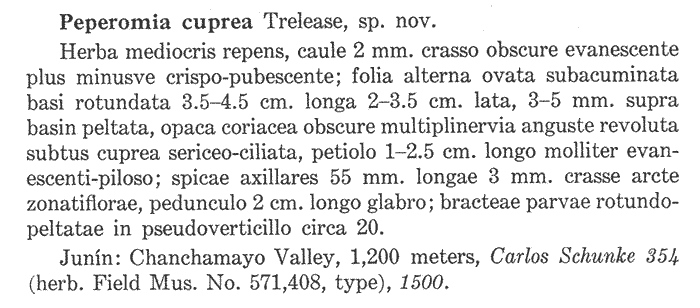
The type specimen were collected near Chanchamayo Valley, Peru, at an altitude of 1,200 meters (3,900 ft).[4]
Peperomia cuprea is a medium-sized, creeping herb with a stem about 2 mm thick that bears an obscure, evanescent, more or less crisp pubescence. The alternate leaves are ovate, somewhat acuminate, with a rounded base, and are peltate (attached 3–5 mm above the base). They measure 3.5–4.5 cm long and 2–3.5 cm wide, and are opaque, leathery, with obscure multiple pinnate nerves and a narrowly revolute margin. The underside is a distinctive copper color and has silky-ciliate hairs. The petiole is 1–2.5 cm long with a soft, evanescent pubescence. The axillary spikes are 55 mm long and 3 mm thick, with tightly arranged flowers in zones, and are borne on a 2 cm, glabrous peduncle. The small, round-peltate bracts are arranged in pseudowhorls of about 20.[4]
Taxonomy and naming
It was described in 1936 by William Trelease in Publications of the Field Museum of Natural History, Botanical Series 13 (es), from specimens collected by Carlos Schunke.[5] It got its epithet from the Latin cuprea, referring to the copper-colored undersides of the leaves that distinguish this species.[4]
Subtaxa
Following subtaxa are accepted.[2][5]
- Peperomia cuprea var. cordulifolia Trel.
Distribution and habitat
It is endemic in Peru.[2] It grows on a epiphyte environment and is a herb.[1][4] It grows on wet tropical biomes.[1]
Conservation
This species is assessed as Threatened, in a preliminary report.[3]
References
- ↑ 1.0 1.1 1.2 1.3 "Peperomia cuprea Trel.". Royal Botanic Gardens, Kew. http://powo.science.kew.org/taxon/urn:lsid:ipni.org:names:188579-2.
- ↑ 2.0 2.1 2.2 "Peperomia cuprea Trel.". Species. GBIF. http://www.gbif.org/species/7305946.
- ↑ 3.0 3.1 Bachman, Steven P.; Brown, Matilda J. M.; Leão, Tarciso C. C.; Lughadha, Eimear Nic; Walker, Barnaby E. (2024). "Extinction risk predictions for the world's flowering plants to support their conservation". New Phytologist 242 (2): 797–808. doi:10.1111/nph.19592. PMID 38437880. https://nph.onlinelibrary.wiley.com/doi/full/10.1111/nph.19592.
- ↑ 4.0 4.1 4.2 4.3 Trelease, William. "Publications of the Field Museum of Natural History, Botanical Series 13(357): 35. 1936.". Publ. Field Mus. Nat. Hist., Bot. Ser. 13(357): 35. http://www.peperomia.net/photos/cuprea-txt.gif.
- ↑ 5.0 5.1 "Peperomia cuprea Trel.". http://legacy.tropicos.org/Name/25001201.
Wikidata ☰ Q15606536 entry
 |  |