Biology:Peperomia deceptrix
| Peperomia deceptrix | |
|---|---|

| |
Scientific classification 
| |
| Kingdom: | Plantae |
| Clade: | Tracheophytes |
| Clade: | Angiosperms |
| Clade: | Magnoliids |
| Order: | Piperales |
| Family: | Piperaceae |
| Genus: | Peperomia |
| Species: | P. deceptrix
|
| Binomial name | |
| Peperomia deceptrix Trel.
| |
Peperomia deceptrix is a species of epiphyte in the genus Peperomia that is endemic in Peru.[1][2] It grows on wet tropical biomes.[1] Its conservation status is Threatened.[3]
Description
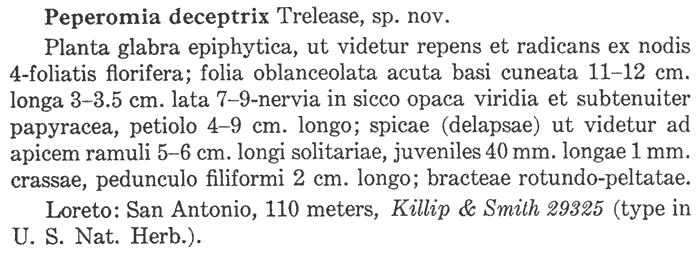
The type specimen were collected near San Antonio, Peru, at an altitude of 110 meters (360 ft).[4]
Peperomia deceptrix is a glabrous, epiphytic plant, apparently creeping and rooting, flowering from nodes with 4 leaves. The leaves are oblanceolate, acute, with a cuneate base, measuring Template:Convert abbreviated long and Template:Convert abbreviated wide. They are 7–9-nerved and, when dry, are opaque green and somewhat thinly papery in texture. The petiole is Template:Convert abbreviated long. The spikes appear to be solitary at the apex of a Template:Convert abbreviated long branchlet. Young spikes are Template:Convert abbreviated long and 1 mm thick, borne on a filiform peduncle Template:Convert abbreviated long.[4]
Taxonomy and naming
It was described in 1936 by William Trelease in Publications of the Field Museum of Natural History, Botanical Series 13 (es), from specimens collected by Ellsworth Paine Killip & Dorothea Eliza Smith.[5] It got its epithet from the Latin wikt:decipio, referring to the plant's appearance that can be misleading or easily confused with another species. [4]
Distribution and habitat
It is endemic in Peru.[2] It grows on a epiphyte environment and is a herb.[1][4] It grows on wet tropical biomes.[1]
Conservation
This species is assessed as Threatened, in a preliminary report.[3]
References
- ↑ 1.0 1.1 1.2 1.3 "Peperomia deceptrix Trel.". Royal Botanic Gardens, Kew. http://powo.science.kew.org/taxon/urn:lsid:ipni.org:names:188602-2.
- ↑ 2.0 2.1 "Peperomia deceptrix Trel.". Species. GBIF. http://www.gbif.org/species/4189944.
- ↑ 3.0 3.1 Bachman, Steven P.; Brown, Matilda J. M.; Leão, Tarciso C. C.; Lughadha, Eimear Nic; Walker, Barnaby E. (2024). "Extinction risk predictions for the world's flowering plants to support their conservation". New Phytologist 242 (2): 797–808. doi:10.1111/nph.19592. PMID 38437880. https://nph.onlinelibrary.wiley.com/doi/full/10.1111/nph.19592.
- ↑ 4.0 4.1 4.2 4.3 Trelease, William. "Publications of the Field Museum of Natural History, Botanical Series 13(357): 38. 1936.". Publ. Field Mus. Nat. Hist., Bot. Ser. 13(357): 38. http://www.peperomia.net/photos/deceptrix-txt.gif.
- ↑ "Peperomia deceptrix Trel.". http://legacy.tropicos.org/Name/25001211.
Wikidata ☰ Q15604990 entry
 |  |