Biology:Peperomia parva
| Peperomia parva | |
|---|---|

| |
Scientific classification 
| |
| Kingdom: | Plantae |
| Clade: | Tracheophytes |
| Clade: | Angiosperms |
| Clade: | Magnoliids |
| Order: | Piperales |
| Family: | Piperaceae |
| Genus: | Peperomia |
| Species: | P. parva
|
| Binomial name | |
| Peperomia parva Trel.
| |
Peperomia parva is a species of terrestrial or epiphytic herb in the genus Peperomia that is native to Peru.[1][2] It grows on wet tropical biomes.[1] Its conservation status has been evaluated as threatened.[3]
Description
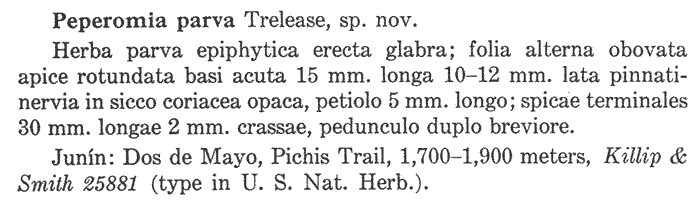
The type specimen were collected at Pichis Trail, Peru at an altitude of 1700-1900 meters above sea level.[4]
Peperomia parva is a small, epiphytic, erect, glabrous herb. The alternate leaves are obovate, with a rounded apex and an acute base, measuring 15 mm long and 10–12 mm wide. They are pinnately nerved and, when dry, are leathery and opaque. The petiole is 5 mm long. The terminal spikes are 30 mm long and 2 mm thick, with a peduncle half as long (15 mm).[4]
Taxonomy and naming
It was described in 1936 by William Trelease in Publications of the Field Museum of Natural History, Botanical Series 13 (es), from specimens collected by Ellsworth Paine Killip & Albert Charles Smith.[5]
The epithet is derived from the Latin for "small," directly referring to the diminutive size of this epiphytic species.[4]
Distribution and habitat
It is native to Peru.[2] It grows as a terrestrial or epiphytic herb.[1] It grows on wet tropical biomes.[1]
Conservation
This species has been assessed as threatened in a preliminary report.[3]
References
- ↑ 1.0 1.1 1.2 1.3 "Peperomia parva Trel.". Royal Botanic Gardens, Kew. http://powo.science.kew.org/taxon/urn:lsid:ipni.org:names:189315-2.
- ↑ 2.0 2.1 "Peperomia parva Trel.". Species. GBIF. http://www.gbif.org/species/4188320.
- ↑ 3.0 3.1 Bachman, Steven P.; Brown, Matilda J. M.; Leão, Tarciso C. C.; Lughadha, Eimear Nic; Walker, Barnaby E. (2024). "Extinction risk predictions for the world's flowering plants to support their conservation". New Phytologist 242 (2): 797–808. doi:10.1111/nph.19592. PMID 38437880. https://nph.onlinelibrary.wiley.com/doi/full/10.1111/nph.19592.
- ↑ 4.0 4.1 4.2 Trelease, William. "Publications of the Field Museum of Natural History, Botanical Series 13(2): XX. 1936.". Publ. Field Mus. Nat. Hist., Bot. Ser. 13(2): XX. http://www.peperomia.net/photos/parva-txt.gif.
- ↑ "Peperomia parva Trel.". http://legacy.tropicos.org/Name/25001362.
Wikidata ☰ Q15606429 entry
 |  |