Biology:Pinus henryi
| Pinus henryi | |
|---|---|

| |
Scientific classification 
| |
| Kingdom: | Plantae |
| Clade: | Tracheophytes |
| Clade: | Gymnospermae |
| Division: | Pinophyta |
| Class: | Pinopsida |
| Order: | Pinales |
| Family: | Pinaceae |
| Genus: | Pinus |
| Subgenus: | P. subg. Pinus |
| Section: | P. sect. Pinus |
| Subsection: | P. subsect. Pinus |
| Species: | P. henryi
|
| Binomial name | |
| Pinus henryi Mast.
| |
| Synonyms[2] | |
| |
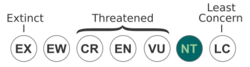
Pinus henryi, or Henry's pine, is a species of conifer in the family Pinaceae.[1][2][3]
Description
Pinus henryi is a monoecious evergreen tree, reaching up to 30 metres (98 feet) tall and 100 centimetres (39 inches) diameter at breast height, typically with a single straight trunk. The bark on mature P. henryi is scaly, fissured, and broken into large irregular plates, which are gray-brown in color and flaky. The twigs are thick, with new shoots appearing reddish-brown in color. The needles are 7–12 cm (3–4 1⁄2 in) long and in fascicles of 2, persisting for 2–3 years before falling off. Pollen cones appear in clusters at the base of new shoots, and are only 2 cm long. Seed cones are thin and woody, and bear a short stout spine.[4]
-
 A mature cone on P. henryi at the Arnold Arboretum
.jpg)
Distribution
Pinus henryi is typically considered to be endemic to China,[5] found in the Chongqing, Hubei, Hunan, Shaanxi, and Sichuan provinces. Some sources also place it in the Vietnamese provinces of Ha Giang and Bac Kan. P. henryi occurs in subtropical mountains, typically at elevations of 1,100–2,000 m (3,600–6,600 ft), primarily on dry, sunny slopes.[4]
References
- ↑ 1.0 1.1 Farjon, A. (2013). "Pinus henryi". IUCN Red List of Threatened Species 2013. doi:10.2305/IUCN.UK.2013-1.RLTS.T37555A2866837.en. https://www.iucnredlist.org/species/37555/2866837. Retrieved 11 November 2021.
- ↑ 2.0 2.1 "Pinus henryi Mast.". Royal Botanic Gardens, Kew. http://powo.science.kew.org/taxon/urn:lsid:ipni.org:names:262990-1.
- ↑ "Pinus henryi Mast.". Species 2000: Leiden, the Netherlands. https://www.catalogueoflife.org/data/taxon/4J289.
- ↑ 4.0 4.1 "Pinus henryi (巴山松 Henry's pine) description - The Gymnosperm Database". https://www.conifers.org/pi/Pinus_henryi.php.
- ↑ "Pinus henryi-Henry's Pine_EOL". http://eol.org/pages/990860/details.
External links
 Data related to Pinus henryi at Wikispecies

Wikidata ☰ Q2744072 entry
 |  |


