Biology:Rhadinosticta banksi
| Rhadinosticta banksi | |
|---|---|

| |
| Northern wiretail | |
Scientific classification 
| |
| Kingdom: | Animalia |
| Phylum: | Arthropoda |
| Class: | Insecta |
| Order: | Odonata |
| Suborder: | Zygoptera |
| Family: | Isostictidae |
| Genus: | Rhadinosticta |
| Species: | R. banksi
|
| Binomial name | |
| Rhadinosticta banksi | |

| |
| Synonyms[4] | |
| |
Rhadinosticta banksi is an Australian species of damselfly in the family Isostictidae,[5] commonly known as the northern wiretail.[6]
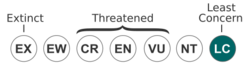
Northern wiretail prefers fresh water streams and pools. The adult is a small to medium-sized damselfly with a length of 35 to 40mm, with the hindwing 20 to 25mm. They are dull in colour with a bluish thorax and may have pruinescence toward the end of the abdomen. In Australia, the distribution is in suitable habitat from Broome, Western Australia, across the north of the continent to the southern Queensland border.[6] The taxon has been assessed in the IUCN Red List as least concern.[1]
Taxonomy
Rhadinosticta handschini, described by Lieftinck in 1933,[3] has recently been made a synonym of Rhadinosticta banksi.[6][4]
Etymology
The genus name Rhadinosticta is derived from the Greek ῥαδινός (rhadinos, "slender") and στικτός (stiktos, "spotted" or "marked"). The suffix -sticta is commonly used in names of taxa within the subfamily Isostictinae.[7]
The species name banksi is named for Banks Island in Torres Strait, where the original specimens of this species were collected.[2][8]
Gallery
-
 Male in Cairns, Queensland
 -
 Female, right hand side
 -
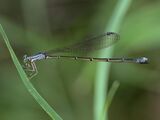 Female left hand side
 -
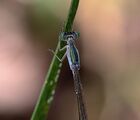 Female from above
 -
 Female wings
 -
 Male wings

_4087.jpg)


.jpg)
.jpg)
References
- ↑ 1.0 1.1 Hawking, J. (2021). "Rhadinosticta banksi". IUCN Red List of Threatened Species 2021. doi:10.2305/IUCN.UK.2021-1.RLTS.T163581A174385095.en. https://www.iucnredlist.org/species/163581/174385095. Retrieved 20 November 2021.
- ↑ 2.0 2.1 Tillyard, R.J. (1913). "On some new and rare Australian Agrionidae (Odonata)". Proceedings of the Linnean Society of New South Wales 37 (1912): 404–479 [433]. doi:10.5962/bhl.part.22352. Bibcode: 1913PLSNS..37..404T. https://www.biodiversitylibrary.org/page/2903665.
- ↑ 3.0 3.1 Lieftinck, M.A. (1933). "Odonaten aus Nordaustralien" (in German). Revue suisse de Zoologie 40: 409–439 [417]. doi:10.5962/bhl.part.117662. https://www.biodiversitylibrary.org/page/43726522.
- ↑ 4.0 4.1 "World Odonata List". University of Puget Sound. https://www.pugetsound.edu/academics/academic-resources/slater-museum/biodiversity-resources/dragonflies/world-odonata-list2/.
- ↑ "Species Rhadinosticta banksi (Tillyard, 1913)". Australian Biological Resources Study. 2012. https://biodiversity.org.au/afd/taxa/Rhadinosticta_banksi.
- ↑ 6.0 6.1 6.2 Theischinger, Günther; Hawking, John (2021). The Complete Field Guide to Dragonflies of Australia (2nd ed.). Melbourne, Australia: CSIRO Publishing. ISBN 9781486313747.
- ↑ Endersby, I. (2012). "Watson and Theischinger: the etymology of the dragonfly (Insecta: Odonata) names which they published". Journal and Proceedings of the Royal Society of New South Wales 145 (443 & 444): 34–53 [47]. doi:10.5962/p.146542. ISSN 0035-9173. https://www.biodiversitylibrary.org/page/46371079.
- ↑ Endersby, Ian (2012). "Etymology of the Dragonflies (Insecta: Odonata) named by R.J. Tillyard, F.R.S.". Proceedings of the Linnean Society of New South Wales 134: 1-16. https://openjournals.library.sydney.edu.au/LIN/article/view/5941.
 |
Wikimedia Commons has media related to Rhadinosticta banksi. |
Wikidata ☰ Q9309994 entry
 |  |


