Biology:Rhyothemis graphiptera
| Rhyothemis graphiptera | |
|---|---|

| |
| Male, Cairns, Queensland, Australia | |
Scientific classification 
| |
| Kingdom: | Animalia |
| Phylum: | Arthropoda |
| Class: | Insecta |
| Order: | Odonata |
| Infraorder: | Anisoptera |
| Family: | Libellulidae |
| Genus: | Rhyothemis |
| Species: | R. graphiptera
|
| Binomial name | |
| Rhyothemis graphiptera (Rambur, 1842)[2]
| |

| |
| Synonyms[3] | |
| |

Rhyothemis graphiptera, known as the graphic flutterer[4] or banded flutterer, is a species of dragonfly of the family Libellulidae.[5][3] It is found across northern Australia, the Moluccas, New Guinea and New Caledonia. Rhyothemis extends from Africa to the western Pacific.[6]
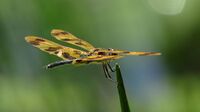
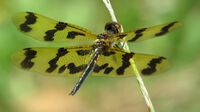
The flight of the genus Rhyothemis is usually fluttering. Rhyothemis graphiptera, a medium-sized dragonfly (wingspan 70mm, length 35mm), inhabits lagoons, lakes, ponds and swamps. The abdomen is dark and the wings are brownish-yellow with dark mottled markings.[4] The taxon has been assessed for the IUCN Red List as being of least concern, and is noted in the Catalog of Life.[7]
Etymology
The genus name Rhyothemis is derived from the Greek ῥέω (rheō, "to flow") and -themis, from Greek Θέμις (Themis), the goddess of divine law, order and justice. In early odonate taxonomy, names ending in -themis were widely used for dragonflies. The name may refer to the irregularly banded and coloured wings of species in the genus, resembling flow banding in rhyolite.[8]
The species name graphiptera is derived from the Greek γραφή (graphē, "drawing" or "painting") and –πτερος (pteros, "winged"), referring to the coloured wing markings.[2][8]
Gallery
-
 Male showing independent movement of forewings and hindwings
 -
 Male holding wings flat
 -
 Female showing wing pattern
 -
 Female head on
 -
 4. Rhyothemis graphiptera from Australian Insects 1907.
 -
 Female wings
 -
 Male wings
.jpg)
.jpg)
.jpg)
.jpg)
_(7268226282).jpg)
.jpg)
.jpg)
See also
- List of Odonata species of Australia
References
- ↑ Dow, R.A. (2017). "Rhyothemis graphiptera". IUCN Red List of Threatened Species 2017. doi:10.2305/IUCN.UK.2017-1.RLTS.T83370076A83383928.en. https://www.iucnredlist.org/species/83370076/83383928. Retrieved 19 November 2021.
- ↑ 2.0 2.1 Rambur, Jules (1842) (in fr). Histoire naturelle des insectes. Névroptères. Paris: Librairie Encyclopédique de Roret. pp. 534 [45]. http://gallica.bnf.fr/ark:/12148/bpt6k61025298/f67.image.
- ↑ 3.0 3.1 "World Odonata List". University of Puget Sound. https://www.pugetsound.edu/academics/academic-resources/slater-museum/biodiversity-resources/dragonflies/world-odonata-list2/.
- ↑ 4.0 4.1 Theischinger, Gunther; Hawking, John (2006). The Complete Field Guide to Dragonflies of Australia. Collingwood Vic.: CSIRO. p. 286. ISBN 0-643-09073-8.
- ↑ "Species Rhyothemis graphiptera (Rambur, 1842)". Australian Biological Resources Study. 2012. https://biodiversity.org.au/afd/taxa/Rhyothemis_graphiptera.
- ↑ Watson, J.A.L.; Theischinger, G.; Abbey, H.M. (1991). The Australian Dragonflies: A Guide to the Identification, Distributions and Habitats of Australian Odonata. Melbourne: CSIRO. pp. 278. ISBN 0-643-05136-8.
- ↑ "Rhyothemis graphiptera". http://www.catalogueoflife.org/col/details/species/id/9696588.
- ↑ 8.0 8.1 Endersby, Ian; Fliedner, Heinrich (2015). The Naming of Australia's Dragonflies. Eltham, Victoria, Australia: Busybird Publishing. ISBN 9781925260625. https://www.researchgate.net/publication/283318421_The_Naming_of_Australia's_Dragonflies.
Wikidata ☰ Q2866623 entry
 |  |


