Biology:Sarcogyne
Sarcogyne is a genus of crustose lichen-forming fungi in the family Acarosporaceae.[1] It was circumscribed by German botanist Julius von Flotow in 1850. A proposal has been put forth in 2021 to assign Sarcogyne clavus as the type species of the genus, "as it represents the original concept of Sarcogyne as having melanized [[Glossary of lichen terms#{{biology:{1}}}|{{Biology:{1}}}]] apothecia without algae in the margin".[2]
Description
Genus Sarcogyne includes lichens with a crust-like (crustose) thallus that can be cracked into small, island-like sections called [[Glossary of lichen terms#{{biology:{1}}}|{{Biology:{1}}}]], which are either broadly attached or have a thick fungal base. Sometimes, the thallus is [[Glossary of lichen terms#{{biology:{1}}}|{{Biology:{1}}}]], meaning it has small, scale-like structures with a stalk less than half the width of the scale.[3]
The upper surface, or [[Glossary of lichen terms#{{biology:{1}}}|{{Biology:{1}}}]], of these lichens can vary from absent to quite thick and often gives the lichen a shiny appearance, especially in species found in dry or hot habitats. This shiny layer is particularly common in xerothermic or arid environments. The cortex, which forms the outer layer of the thallus, consists of fungal threads (hyphae) and/or round or irregular cells. The upper part of the cortex is pigmented, while the lower part is colourless and sometimes contains crystal formations visible under polarized light. These crystals can come from the lichen's own secondary metabolites or from the [[Glossary of lichen terms#{{biology:{1}}}|{{Biology:{1}}}]] it grows on, especially if it is limestone.[3]
The upper surface of Sarcogyne lichens is typically smooth or slightly wrinkled, and usually ranges in colour from pale to reddish-brown to black-brown, and occasionally rust-coloured. Some species may have a powdery coating ([[Glossary of lichen terms#{{biology:{1}}}|{{Biology:{1}}}]]). Cracks often form in the thallus, leading to the lichen's replication through division. The photosynthetic partner ([[Glossary of lichen terms#{{biology:{1}}}|{{Biology:{1}}}]]) in these lichens is of the [[Glossary of lichen terms#{{biology:{1}}}|{{Biology:{1}}}]] type, forming a continuous or occasionally interrupted [[Glossary of lichen terms#{{biology:{1}}}|{{Biology:{1}}}]] under the surface.[3]
The lower cortex can be either present or absent. The fruiting bodies (ascomata) of Sarcogyne are typically apothecia, which are disk-shaped structures that can be immersed in the thallus or elevated. These can appear [[Glossary of lichen terms#{{biology:{1}}}|{{Biology:{1}}}]] (with a margin that looks like the thallus) or [[Glossary of lichen terms#{{biology:{1}}}|{{Biology:{1}}}]] (with a distinct margin). The disk is usually red-brown to black-brown, smooth or wrinkled, sometimes with a powdery coating or pigment build-ups.[3]
Inside the apothecia, the [[Glossary of lichen terms#{{biology:{1}}}|{{Biology:{1}}}]] consists of numerous thin to stout, often branched filaments (paraphyses). The asci, which produce spores, typically contain over 100 spores and are club-shaped. The spores are usually spherical to ellipsoidal, colourless, and generally small, not exceeding 6 μm in length, except for Sarcogyne macrocarpa.[3]
Sarcogyne lichens also produce conidiomata (pycnidia), which are small, immersed structures that produce asexual spores. The conidia are small and ellipsoidal to roughly spherical in shape. Chemically, Sarcogyne species often do not produce lichen products detectable by thin-layer chromatography , but may rarely contain gyrophoric or norstictic acid, which can usually be detected with spot tests.[3]
Species
As of February 2026[update], Species Fungorum accepts 53 species of Sarcogyne.[4]
- Sarcogyne adscendens K.Knudsen, Kocourk. & Hodková (2023)
- Sarcogyne albothallina K.Knudsen, T.B.Wheeler, Kocourk. & M.Westb. (2016)[5]
- Sarcogyne alcesensis K.Knudsen, J.N.Adams, Kocourk. & Y.Wang (2020)[6]
- Sarcogyne alpina K.Knudsen & Kocourk. (2025)
- Sarcogyne arenosa (Herre) K.Knudsen & S.Standl. (2005)
- Sarcogyne basialba K.Knudsen, S.D.Leav., Kocourk. & Kondrysová (2025)
- Sarcogyne belarusensis K.Knudsen, Tsurykau, Kocourk. & Hodková (2023)
- Sarcogyne bernardinensis K.Knudsen, J.N.Adams, Kocourk. & Y.Wang (2020)[6]
- Sarcogyne brouardiana K.Knudsen, Kocourk. & Hodková (2023)
- Sarcogyne brunnea K.Knudsen & Flakus (2011)[7] – Australia
- Sarcogyne calcitrapa Cl.Roux & Poumarat (2023)
- Sarcogyne canadensis (H.Magn.) K.Knudsen, J.N.Adams, Kocourk. & Y.Wang (2020)
- Sarcogyne canberrensis P.M.McCarthy & Elix (2017)[8]
- Sarcogyne clavus (DC.) Kremp. (1861)
- Sarcogyne coeruleonigricans K.Knudsen, Kocourk. & Hodková (2023)
- Sarcogyne convexa K.Knudsen, J.N.Adams, Kocourk. & Y.Wang (2020)[6]
- Sarcogyne crispula Afshan, Fayyaz & K.Knudsen (2023)
- Sarcogyne crustacea K.Knudsen & Kocourk. (2010)[9]
- Sarcogyne desolata (H.Magn.) K.Knudsen & S.Standl. (2007)
- Sarcogyne diffusa K.Knudsen, Hollinger, Kondrysová & Kocourk. (2025)
- Sarcogyne distans (Arnold) K.Knudsen & Kocourk. (2024)
- Sarcogyne endopetrophila Tokizawa & Y.Ohmura (2014)[10]
- Sarcogyne fasciculata K.Knudsen, Kocourk. & Hodková (2025)
- Sarcogyne humicola P.M.McCarthy & Elix (2021)
- Sarcogyne hypophaea (Nyl.) Arnold (1871)
- Sarcogyne iridana P.M.McCarthy & Kantvilas (2013)[11] – Australia
- Sarcogyne jejuensis J.S.Park & S.O.Oh (2023)
- Sarcogyne joshuaensis K.Knudsen & Kocourk. (2025)
- Sarcogyne lapponica (Ach. ex Schaer.) K.Knudsen & Kocourk. (2008)
- Sarcogyne lecanorina K.Knudsen, Kocourk. & Hodková (2023)
- Sarcogyne lobata Cl.Roux & Poumarat (2023)
- Sarcogyne magnispora K.Knudsen & Halıcı (2009)[12] – Turkey
- Sarcogyne malpaiensis K.Knudsen, Kocourk. & Hodková (2023)
- Sarcogyne maritima P.M.McCarthy & Elix (2017)[13] – Australia
- Sarcogyne meridionalis P.M.McCarthy & Kantvilas (2013)[11] – Australia
- Sarcogyne mitziae K.Knudsen, Kocourk. & McCune (2013)[14]
- Sarcogyne molongloensis P.M.McCarthy & Elix (2020)[15] – Australia
- Sarcogyne nimisii K.Knudsen, Kocourk. & Hodková (2023)
- Sarcogyne nogalensis K.Knudsen, Kocourk. & Hodková (2023)
- Sarcogyne oceanica K.Knudsen & Kocourk. (2021)
- Sarcogyne pakistanensis R.Zulfiqar, Khalid & K.Knudsen (2023)
- Sarcogyne paradoxa Kocourk. & K.Knudsen (2020)[16]
- Sarcogyne parviascifera Jiao H.Wang & J.C.Wei (2016)[17]
- Sarcogyne poeltii K.Knudsen, Obermayer, Hodková & Kocourk. (2023)
- Sarcogyne porphyricola P.M.McCarthy & Elix (2020)[15] – Australia
- Sarcogyne praetermissa K.Knudsen & Kocourk. (2018)[18] – Europe
- Sarcogyne pruinosa (Schaer.) A.Massal. (1854)
- Sarcogyne reebiae K.Knudsen & S.Standl. (2007)[19]
- Sarcogyne regalis P.M.McCarthy & Elix (2021)
- Sarcogyne regularis Körb. (1855)
- Sarcogyne saphyniana L.Nurtai, K.Knudsen & A.Abbas (2016)[20] – China
- Sarcogyne sekikaica P.M.McCarthy & Elix (2014)[21] – Australia
- Sarcogyne similis H.Magn. (1934)[22]
- Sarcogyne squamosa K.Knudsen & McCune (2013)[23]
- Sarcogyne terrulenta P.M.McCarthy & Elix (2020)[15] – Australia
- Sarcogyne tholifera P.M.McCarthy & Elix (2017)[8] – Australia
- Sarcogyne ulleungdoensis S.Y.Kondr., Lőkös & Hur (2018)[24]
- Sarcogyne wheeleri K.Knudsen, J.N.Adams, Kocourk. & Y.Wang (2020)[6]
Gallery
-
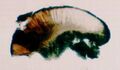 Sarcogyne regularis (section of apothecium; reddish part parasitized, hyaline normal)
.jpg)
References
- ↑ Wijayawardene, Nalin; Hyde, Kevin; Al-Ani, Laith Khalil Tawfeeq; Somayeh, Dolatabadi; Stadler, Marc; Haelewaters, Danny et al. (2020). "Outline of Fungi and fungus-like taxa". Mycosphere 11: 1060–1456. doi:10.5943/mycosphere/11/1/8.
- ↑ Knudsen, Kerry; Arcadia, Linda; Wirth, Volkmar (2021). "(2834) Proposal to conserve the name Sarcogyne ( Acarosporaceae , lichenised Ascomycota ) with a conserved type". Taxon 70 (5): 1129–1131. doi:10.1002/tax.12577.
- ↑ 3.0 3.1 3.2 3.3 3.4 3.5 Knudsen, K.; Kocourková, J.; Cannon, P.; Coppins, B.; Fletcher, A.; Simkin, J. (2021). Acarosporales: Acarosporaceae, including the genera Acarospora, Caeruleum, Myriospora, Pleopsidium, Sarcogyne and Trimmatothelopsis. Revisions of British and Irish Lichens. 12. pp. 5–6. https://britishlichensociety.org.uk/sites/default/files/Acarosporaceae.pdf.

- ↑ Source dataset. Species Fungorum Plus: Species Fungorum for CoL+. "Sarcogyne". Catalogue of Life Version 2021-10-18. https://www.catalogueoflife.org/data/taxon/7CFB.
- ↑ Knudsen, Kerry; Kocourková, Jana; Westberg, Martin; Wheeler, Tim (2016). "Two new species of Acarosporaceae from North America with carbonized epihymenial accretions". The Lichenologist 48 (5): 347–354. doi:10.1017/S0024282916000256.
- ↑ 6.0 6.1 6.2 6.3 Knudsen, Kerry; Adams, Julia N.; Kocourková, Jana; Wang, Yan; Ortañez, Jericho; Stajich, Jason E. (2020). "The monophyletic Sarcogyne canadensis–wheeleri clade, a newly recognized group sister to the European Acarospora glaucocarpa group". The Bryologist 123 (1): 11–30. doi:10.1639/0007-2745-123.1.011.
- ↑ Knudsen, Kerry; Flakus, Adam; Kukwa, Martin (2012). "A contribution to the study of Acarosporaceae in South America". The Lichenologist 44 (2): 253–262. doi:10.1017/S0024282911000703.
- ↑ 8.0 8.1 McCarthy, P.M.; Elix, J.A. (2017). "Two new species and a new record of Acarosporaceae (lichenized Ascomycota) from eastern Australia". Australasian Lichenology 80: 16–27.
- ↑ Knudsen, K.; Kocourková, J. (2010). "Lichenological notes 1: Acarosporaceae". Mycotaxon 112: 361–366.
- ↑ Tokizawa, M.; Takeshita, S.; Ohmura, Y.; Moon, K.H. (2015). "Sarcogyne endopetrophila (Acarosporaceae, lichenized Ascomycota), a new species from Japan". Journal of Japanese Botany 90 (1): 46–51.
- ↑ 11.0 11.1 McCarthy, P.M.; Kantvilas, G. (2013). "Two new species of Sarcogyne (lichenised Ascomycota, Acarosporaceae) from central and southern Australia". Journal of the Adelaide Botanic Gardens 26: 15–21.
- ↑ Knudsen, K.; Halici, M.G.; Kocakaya, M. (2009). "Sarcogyne magnispora (Acarosporaceae), a new species in the nivea group from Turkey". Mycotaxon 107: 413–417.
- ↑ McCarthy, P.M.; Elix, J.A. (2017). "Five new lichen species (Ascomycota) and a new record from southern New South Wales, Australia". Telopea 20: 333–353. doi:10.7751/TELOPEA12043.
- ↑ Knudsen, Kerry; Kocourková, J.; McCune, B. (2013). "Sarcogyne mitziae (Acarosporaceae), a new species from biotic soil crusts in western North America". The Bryologist 116 (2): 122–126.
- ↑ 15.0 15.1 15.2 McCarthy, P.M.; Elix, J.A. (2017). "Three new species of Sarcogyne (Acarosporaceae) from the Australian Capital Territory". Australasian Lichenology 86: 74–86.
- ↑ Knudsen, K.; Kocourková, J. (2020). "Acarospora scottii and Sarcogyne paradoxa spp. nov. from North America". Mycotaxon 135 (2): 453–463.
- ↑ Wang, J.H.; Wei, J.C. (2016). "A new lichenized fungus Sarcogyne parviascifera (Acarosporaceae, Ascomycota)". Mycosystema 35 (11): 1344–1347.
- ↑ Knudsen, K.; Kocourková, J. (2018). "Sarcogyne praetermissa (Acarosporaceae), a new calcicolous lichen species from Europe, with a key to the European Sarcogyne species". Herzogia 31 (1): 133–139.
- ↑ Knudsen, K.; Standley, S.M. (2007). "Sarcogyne". Lichen Flora of the Greater Sonoran Desert Region. 3. Tempe: Lichens Unlimited, Arizona State University. pp. 289–297.
- ↑ Nurtai, L.; Knudsen, K.; Abbas, A. (2016). "Sarcogyne saphyniana sp. nov., a saxicolous lichen from northwestern China". Mycotaxon 131 (1): 135–139.
- ↑ McCarthy, P.M.; Elix, J.A. (2014). "Two new lichens from Mount Canobolas, New South Wales". Telopea 16: 119–125.
- ↑ Magnusson, A.H. (1934). "On the species of Biatorella and Sarcogyne in America". Annales Cryptogamici Exotici 7: 115–146 [135].
- ↑ Knudsen, K.; McCune, B. (2013). "A new squamulose Sarcogyne from Oregon". North American Flora 8 (8): 1–6.
- ↑ Kondratyuk, S.Y.; Lőkös, L.; Halda, J.P.; Farkas, E.; Upreti, D.K.; Thell, A.; Woo, J.-J.; Oh, S.-O. et al. (2018). "New and noteworthy lichen-forming and lichenicolous fungi 7". Acta Botanica Hungarica 60 (1–2): 115–184. doi:10.1556/034.60.2018.1-2.8. http://real.mtak.hu/79025/1/034.60.2018.1-2.8.pdf.
<ref> tag with name "Index Fungorum synonymy: Sarcogyne" defined in <references> is not used in prior text.Wikidata ☰ Q10661786 entry
 |  |


