Biology:Spalgis epius
| Apefly | |
|---|---|
.jpg)
| |
| Upperside | |
.jpg)
| |
| Underside, Kerala, India | |
Scientific classification 
| |
| Kingdom: | Animalia |
| Phylum: | Arthropoda |
| Class: | Insecta |
| Order: | Lepidoptera |
| Family: | Lycaenidae |
| Genus: | Spalgis |
| Species: | S. epius
|
| Binomial name | |
| Spalgis epius (Westwood, 1851)
| |
| Synonyms | |
| |
Spalgis epius,[1] commonly known as the apefly, is a small species of butterfly found in the Indomalayan realm that belongs to the lycaenids or blues family.[2][3] It gets its name from the supposed resemblance of its pupa to the face of an ape.
Description
Male
Upperside: dull brown, slightly darker towards the apex of the forewing; also a more or less quadrate whitish spot beyond the apex of the cell on the same wing; in some specimens this spot is slightly diffuse. Underside: pale, silky, brownish white; forewings and hindwings crossed by numerous, very slender, short, sinuous, transverse, dark brown strigae which are outwardly slenderly edged with brownish white of a shade paler than that of the ground colour; both wings with an anteciliary dark brown line with on the inner side a similar edging. Forewing, in addition, with an oval white spot beyond the cell. Cilia of both forewings and hindwings of the same shade as the ground colour of the wings. Antenna, head, thorax and abdomen pale brown, club of antennae ochraceous at apex; beneath: the palpi and thorax brownish grey, abdomen pale brown.[4]
Female
Upperside: slightly paler brown. Forewing: the cell and apex darker; a white spot similar to that in the male but larger, beyond the apex of the cell; in most specimens extended diffusely outwards and downwards. Hindwing: similar to that of the male. Underside: precisely as in the male.[4][5]
Life cycle
-
 Mating Pair
 -
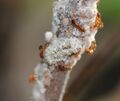
 Apefly first-instar caterpillar
 -
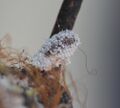
 Apefly second-instar caterpillar
 -
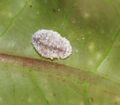
 Third-instar caterpillar
 -
 Final-instar caterpillar
 -
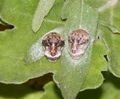 Pupa
Pupa -
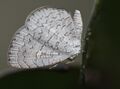 Freshly eclosed apefly butterfly
)_-_Apefly.jpg)


.jpg)

The caterpillars of this butterfly, like other members of the subfamily Miletinae, are entomophagous and are predators of scale insects like mealybugs.[6][7] The species unlike many other lycaenid butterflies is not myrmecophilous (it has no mutualistic associations with ants).[8]
Subspecies
- S. e. epeus (India, Sri Lanka to Peninsular Malaya, Nicobars, Mergui and southern Yunnan)
- S. e. dilama (Moore, 1878) (Taiwan)
- S. e. fangola (Kheil, 1884) (Sumatra, Nias, possibly Borneo)
- S. e. nubilus Moore, [1884] (Andamans, Pulau Tioman)
- S. e. pharnus Felder, 1860 (Kai, Buru, Ambon, Halmahera, West Irian)
- S. e. semperi Fruhstorfer, 1919 (northern Philippines, Luzon)
- S. e. strigatus Semper, 1889 (southern to central Philippines)
- S. e. substrigata (Snellen, 1878) (Sulawesi)
- S. e. titius Fruhstorfer, 1919 (Java, Bali, Sumba, Sumbawa, possibly Damar and Lombok)
Cited references
- ↑ Doubleday, Edward; Westwood, John Obadiah (1851). The genera of diurnal Lepidoptera: comprising their generic characters, a notice of their habits and transformations, and a catalogue of the species of each genus. London: Longman, Brown, Green, and Longmans. pp. 502. https://www.biodiversitylibrary.org/item/49324#page/258/mode/1up.
- ↑ Varshney, R. K.; Smetacek, Peter (2015). A Synoptic Catalogue of the Butterflies of India. New Delhi: Butterfly Research Centre, Bhimtal & Indinov Publishing. pp. 91. doi:10.13140/RG.2.1.3966.2164. ISBN 978-81-929826-4-9.
- ↑ Savela, Markku (September 25, 2016). "Spalgis epius (Westwood, 1852)". https://www.nic.funet.fi/pub/sci/bio/life/insecta/lepidoptera/ditrysia/papilionoidea/lycaenidae/miletinae/spalgis/#epius.
- ↑ 4.0 4.1
 This article incorporates text from a publication now in the public domain: Bingham, C. T. (1907). The Fauna of British India, Including Ceylon and Burma: Butterflies Volume II. London: Taylor and Francis, Ltd.. pp. 311. https://archive.org/stream/butterflies02bingiala#page/310/mode/2up/.
- ↑ This article incorporates text from a publication now in the public domain: Swinhoe, Charles (1905–1910). Lepidoptera Indica: Volume VII. London: Lovell Reeve and Co.. pp. 234–235. https://www.biodiversitylibrary.org/item/103631#page/248/mode/1up.
- ↑ Nitin, Ravikanthachari; Balakrishnan, V.C.; Churi, Paresh V.; Kalesh, S.; Prakash, Satya; Kunte, Krushnamegh (2018-04-10). "Larval host plants of the butterflies of the Western Ghats, India". Journal of Threatened Taxa 10 (4): 11495–11550. doi:10.11609/jott.3104.10.4.11495-11550.
- ↑ Venkatesha, M. G.; Shashikumar, L.; Gayathri Devi, S. S. (2004). "Protective devices of the carnivorous butterfly, Spalgis epius (Westwood) (Lepidoptera: Lycaenidae)". Current Science 87 (5): 571–572. http://www.ias.ac.in/currsci/sep102004/571.pdf.
- ↑ Venkatesha, M. G. (2005). "Why is homopterophagous butterfly, Spalgis epius (Westwood) (Lepidoptera: Lycaenidae) amyrmecophilous?". Current Science. 89 (2): 245–246. – via Internet Archive.

See also
References
- Evans, W. H. (1932). The Identification of Indian Butterflies (2nd ed.). Mumbai, India: Bombay Natural History Society.
- Gaonkar, Harish (1996). Butterflies of the Western Ghats, India (including Sri Lanka) - A Biodiversity Assessment of a Threatened Mountain System. Bangalore, India: Centre for Ecological Sciences.
- Haribal, Meena (1992). The Butterflies of Sikkim Himalaya and Their Natural History. Gangtok, Sikkim, India: Sikkim Nature Conservation Foundation.
- Kunte, Krushnamegh (2000). Butterflies of Peninsular India. India, A Lifescape. Hyderabad, India: Universities Press. ISBN 978-8173713545. https://books.google.com/books?id=cuPPjOMcu_4C.
- Wynter-Blyth, Mark Alexander (1957). Butterflies of the Indian Region. Bombay, India: Bombay Natural History Society. ISBN 978-8170192329. https://books.google.com/books?id=yEkgAQAAMAAJ.
External links
 |
Wikimedia Commons has media related to Spalgis epius. |
 |
Wikispecies has information related to Spalgis epius |
- Takanami, Yusuke; Seki, Yasuo (2001). "Genus Spalgis". http://www.asahi-net.or.jp/~EY4Y-TKNM/Miletini-Phil/Spalgis.html. With images.
Wikidata ☰ Q7573002 entry
 |  |


