Biology:Spigelia alabamensis
| Spigelia alabamensis | |
|---|---|
| File:Spigelia alabamensis flower front-view.jpg | |
| Spigelia alabamensis open flower | |
| File:Spigelia alabmensis full plant view.jpg | |
| Spigelia alabmensis full plant with flower | |
Scientific classification 
| |
| Kingdom: | Plantae |
| Clade: | Tracheophytes |
| Clade: | Angiosperms |
| Clade: | Eudicots |
| Clade: | Asterids |
| Order: | Gentianales |
| Family: | Loganiaceae |
| Genus: | Spigelia |
| Species: | S. alabamensis
|
| Binomial name | |
| Spigelia alabamensis (K.Gould) K.G.Mathews & Weakley
| |
Spigelia alabamensis, commonly known as Alabama pinkroot, is a species of flowering plant in the family Loganiaceae. It is endemic to Alabama in the southeastern United States, where it is restricted to dolomite glades in Bibb County.[2][3]
Description
Spigelia alabamensis is a perennial herb that grows in clumps and produces tubular flowers characteristic of the genus Spigelia. It typically occurs in shallow, rocky soils and may be locally abundant in suitable habitat.[1]
Phenology
Flowering occurs from May through June.[3]
Taxonomy
The species was originally described as Spigelia gentianoides var. alabamensis by K. Gould in 1996.[3] It was later elevated to species rank as Spigelia alabamensis by K. G. Mathews and A. S. Weakley in 2011.[2]
Spigelia alabamensis is one of several narrowly endemic taxa associated with the Ketona dolomite glade system of Bibb County, Alabama.[4]
Distribution and habitat
Spigelia alabamensis is known only from Bibb County in west-central Alabama.[3][1]
It occurs in Ketona dolomite glades, a distinctive calcareous outcrop system formed on unusually pure Cambrian dolomite. Soils in these habitats are shallow, alkaline, and rich in calcium and magnesium but low in nutrients.[4]
The species grows in open glades as well as along glade margins and forest edges, and may also occur in partially shaded conditions, where flowering can be more prolific.[1]
Conservation
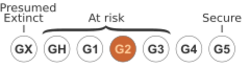
Spigelia alabamensis is a narrow endemic with a highly restricted range of less than 100 km2. It is ranked as G2 (globally imperiled) and S2 (imperiled within Alabama).[1]
The species is known from approximately 6–20 occurrences, with around 12 extant populations documented. Total population size is estimated at between 2,500 and 10,000 individuals, though only a portion of this has been directly surveyed.[1]
Threats include land development, livestock grazing, trash dumping, and forestry activities. Several populations occur on protected lands, including sites managed by conservation organizations, which contributes to the species' relative short-term stability.[1]
References
- ↑ 1.0 1.1 1.2 1.3 1.4 1.5 1.6 "Spigelia alabamensis". NatureServe. https://explorer.natureserve.org/Taxon/ELEMENT_GLOBAL.2.144594/Spigelia_alabamensis.
- ↑ 2.0 2.1 "Spigelia alabamensis (K.Gould) K.G.Mathews & Weakley". Royal Botanic Gardens, Kew. 2026. https://powo.science.kew.org/taxon/urn:lsid:ipni.org:names:60458075-2.
- ↑ 3.0 3.1 3.2 3.3 Weakley, Alan S.. "Spigelia alabamensis". North Carolina Botanical Garden. https://fsus.ncbg.unc.edu/main.php?pg=show-taxon.php&plantname=spigelia+alabamensis.
- ↑ 4.0 4.1 Allison, James R.; Stevens, Timothy E. (2001). "Vascular flora of the Ketona dolomite outcrops in Bibb County, Alabama". Castanea 66 (1–2): 154–205. https://www.jstor.org/stable/4033889. Retrieved 23 March 2026.
Wikidata ☰ {{{from}}} entry
 |  |


