Biology:Vachellia astringens
| Vachellia astringens | |
|---|---|

| |
Scientific classification 
| |
| Kingdom: | Plantae |
| Clade: | Tracheophytes |
| Clade: | Angiosperms |
| Clade: | Eudicots |
| Clade: | Rosids |
| Order: | Fabales |
| Family: | Fabaceae |
| Subfamily: | Caesalpinioideae |
| Clade: | Mimosoid clade |
| Genus: | Vachellia |
| Species: | V. astringens
|
| Binomial name | |
| Vachellia astringens (Gillies ex Hook. & Arn.) Speg.
| |
| Synonyms[2] | |
| |
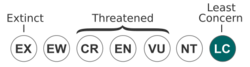
Vachellia astringens is a species of flowering plant in the family Fabaceae. It is a tree native to south America. The species was described in 1833, and is listed as of Least Concern by the IUCN.
Taxonomy
The species was described as Prosopis astringens by William Jackson Hooker and George Arnott Walker Arnott in 1833, following an earlier, invalid publication by John Gillies. In 1924, Carlo Luigi Spegazzini moved the species from Prosopis to Vachellia.[2][3]
Distribution
Vachellia astringens is native to the subtropical biome of north-east and north-west Argentina, southern Brazil, northern Chile, Paraguay, and Uruguay.[2] The species grows in forests and shrublands, at elevations of up to 1,000 metres (3,300 ft).[1]
Description
Vachellia astringens is a tree.[2]
Uses
The wood is used, and the bark is used for tanning.[1]
Conservation
In 2020, the IUCN assessed Vachellia astringens as of Least Concern. It has a wide distribution, and the population is thought to be large. The species is present in protected areas.[1]
Nomenclature
In Argentine Spanish, the species is known as Espinillo negro.[4]
References
- ↑ 1.0 1.1 1.2 1.3 IUCN SSC Global Tree Specialist Group; Botanic Gardens Conservation International (BGCI) (2025). "Vachellia astringens". IUCN Red List of Threatened Species 2025. doi:10.2305/IUCN.UK.2025-2.RLTS.T198984118A243328776.en. https://www.iucnredlist.org/species/198984118/243328776. Retrieved 2026-08-12.
- ↑ 2.0 2.1 2.2 2.3 "Vachellia astringens" (in en). Royal Botanic Gardens, Kew. http://www.plantsoftheworldonline.org/taxon/urn:lsid:ipni.org:names:299269-2.
- ↑ "Vachellia astringens Speg.". International Plant Names Index (IPNI). Royal Botanic Gardens, Kew. https://www.ipni.org/n/299269-2.
- ↑ "Vachellia astringens (Gillies) Speg.". Catalogue of Life. https://www.catalogueoflife.org/data/taxon/7F8W3.
Wikidata ☰ Q15544065 entry
 |  |


