Biology:White-bellied dacnis
| White-bellied dacnis | |
|---|---|

| |
Scientific classification 
| |
| Kingdom: | Animalia |
| Phylum: | Chordata |
| Class: | Aves |
| Order: | Passeriformes |
| Family: | Thraupidae |
| Genus: | Dacnis |
| Species: | D. albiventris
|
| Binomial name | |
| Dacnis albiventris (Sclater, PL, 1852)
| |

| |
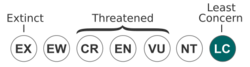
The white-bellied dacnis (Dacnis albiventris) is a species of bird in the family Thraupidae, the tanagers and allies.[2] It is found in Brazil, Colombia, Ecuador, Peru, and Venezuela.[3]
Taxonomy and systematics
The white-bellied dacnis was formally described in 1852 with the binomial Pipraeidea albiventris.[4] For a time it was assigned its own genus Hemidacnis but has been assigned to Dacnis since the middle of the twentieth century.[5] The species is monotypic.[2]
Description
The white-bellied dacnis is 10 cm (3.9 in)[5] to 12 cm (4.7 in)[6] long. It weighs 11 to 11.5 g (0.39 to 0.41 oz). It has a short, conical, pointed bill. The species is sexually dimorphic. Adult males have a bright cobalt-blue head with a triangular black mask from the lores through the eye onto the ear coverts. Their upperparts are mostly cobalt-blue withe black scapulars. Their wing's lesser coverts are cobalt-blue and the median and greater coverts black with wide cobalt-blue edges. Their flight feathers are black with cobalt-blue edges. Their tail is black. Their throat and breast are cobalt-blue, their belly to undertail coverts white, and their flanks light gray with light blue spotting. Adult females have a dull olive head with darker lores. Their back is dull olive that becomes greener on the rump. Their wing coverts are olive brown and the flight feathers olive with olive-brown edges. Their tail is dusky. Their throat is grayish white and their underparts mostly greenish yellow with a yellower center to the belly. Both sexes have a blackish bill and gray legs and feet. Males have a golden yellow iris and females' are light brown to grayish brown.[5]
Distribution and habitat
The white-bellied dacnis is primarily a bird of the far western Amazon Basin.[5] It is found across the southeastern third of Colombia south intermittently through eastern Ecuador into northeastern Peru as far as central Ucayali Department with a few reports further south.[6][7][8] From Colombia and Peru its range extends northeast across far western Brazil's Acre, Amazonas, and Roraima states into southwestern Amazonas state in southern Venezuela. There are also a few records in central and eastern Amazonian Brazil.[9][10]
The white-bellied dacnis "appears to prefer somewhat marginal habitats". These include white-sand forest and savanna, well-weathered terra firme, and campina.[5] In elevation it reaches 500 m (1,600 ft) in Colombia, 300 m (1,000 ft) in Ecuador, 200 m (700 ft) in Venezuela, and 400 m (1,300 ft) in Brazil.[6][7][9][10]
Behavior
Movement
The white-bellied dacnis is generally a year-round resident.[5] However, it is suspected of making some seasonal movements in Colombia.[6]
Feeding
The white-bellied dacnis feeds on berries, insects, and nectar. It usually forages singly or in pairs, though sometimes in small groups, and most of the time with mixed-species feeding flocks. It forages mostly in the forest canopy though lower at the edges. It gleans insects from foliage, often hanging upside down, and also takes them in mid-air.[5]
Breeding
Nothing is known about the white-bellied dacnis' breeding biology.[5]

Vocalization
The white-bellied dacnis' song is "a high and lisping see-suleleee, interspersed with call notes and trills such as tzet tzaleet saleet't't't't't with phrases separated by short intervals of 1 to 3 seconds".[5] Its calls include "a high, descending tseew and rising tee?, also a thin ti often given in series".[8]
Status
The IUCN originally in 1988 assessed the white-bellied dacnis as Threatened, then in 1994 as Near Threatened, and since 2000 as being of Least Concern. It has a large range; its population size is not known but is believed to be stable. No immediate threats have been identified.[1] It is considered "uncommon and seemingly seasonal" in Colombia, "rare and very local" in Ecuador, "rare [and] poorly known" in Peru, "rare" with only "scattered records" in Venezuela, and "uncommon to rare" in Brazil.[6][7][8][9][10] It has "a high degree of sensitivity to human disturbance relative to other Neotropical birds" but does occur in several protected areas.[5]
References
- ↑ 1.0 1.1 BirdLife International (2025). "White-bellied Dacnis Dacnis albiventris". IUCN Red List of Threatened Species 2025. doi:10.2305/IUCN.UK.2025-2.RLTS.T22722976A281009267.en. https://www.iucnredlist.org/species/22722976/281009267. Retrieved 23 August 2026.
- ↑ 2.0 2.1 Gill, Frank; Donsker, David; Rasmussen, Pamela, eds (April 2026). "Tanagers and allies". https://www.worldbirdnames.org/new/bow/tanagers/.
- ↑ Remsen, J. V., Jr., J. I. Areta, E. Bonaccorso, S. Claramunt, D. F. Lane, L, N. Naka, M. B. Robbins, F. G. Stiles, and K. J. Zimmer. Version 25 July 2026. Species Lists of Birds for South American Countries and Territories. South American Classification Committee associated with the International Ornithologists' Union. https://www.museum.lsu.edu/~Remsen/SACCCountryLists.htm retrieved 25 July 2026
- ↑ Sclater, Philip Lutley (1852). "Description de six Oiseaux nouveaux appartenant à la collection du Muséum d'histoire naturelle de Paris" (in Latin). Revue et magasin de zoologie pure et appliquée (Bureau de la Revue et Magasin de Zoologie) IV: 8. https://www.biodiversitylibrary.org/page/2318737. Retrieved August 23, 2026.
- ↑ 5.00 5.01 5.02 5.03 5.04 5.05 5.06 5.07 5.08 5.09 Iga, A., C. H. Richart, and K. J. Burns (2020). White-bellied Dacnis (Dacnis albiventris), version 1.0. In Birds of the World (T. S. Schulenberg, Editor). Cornell Lab of Ornithology, Ithaca, NY, USA. https://doi.org/10.2173/bow.whbdac1.01 retrieved August 23, 2026
- ↑ 6.0 6.1 6.2 6.3 6.4 McMullan, Miles; Donegan, Thomas M.; Quevedo, Alonso (2010). Field Guide to the Birds of Colombia. Bogotá: Fundación ProAves. pp. 198. ISBN 978-0-9827615-0-2.
- ↑ 7.0 7.1 7.2 Ridgely, Robert S.; Greenfield, Paul J. (2001). The Birds of Ecuador: Field Guide. II. Ithaca: Cornell University Press. pp. 617. ISBN 978-0-8014-8721-7.
- ↑ 8.0 8.1 8.2 Schulenberg, T.S.; Stotz, D.F.; Lane, D.F.; O'Neill, J.P.; Parker, T.A. III (2010). Birds of Peru. Princeton Field Guides (revised and updated ed.). Princeton, NJ: Princeton University Press. pp. 572. ISBN 978-0691130231.
- ↑ 9.0 9.1 9.2 Hilty, Steven L. (2003) (in English). Birds of Venezuela (second ed.). Princeton NJ: Princeton University Press. pp. 779.
- ↑ 10.0 10.1 10.2 van Perlo, Ber (2009). A Field Guide to the Birds of Brazil. New York: Oxford University Press. pp. 380–381. ISBN 978-0-19-530155-7.
Wikidata ☰ Q2630926 entry
 |  |


