Biology:Yellow mud turtle
| Yellow mud turtle | |
|---|---|
.jpg)
| |
| In the Chihuahuan Desert, Texas | |
Scientific classification 
| |
| Kingdom: | Animalia |
| Phylum: | Chordata |
| Class: | Reptilia |
| Order: | Testudines |
| Suborder: | Cryptodira |
| Family: | Kinosternidae |
| Genus: | Kinosternon |
| Species: | K. flavescens
|
| Binomial name | |
| Kinosternon flavescens (Agassiz, 1857)
| |
| Synonyms[2] | |
|
List
| |
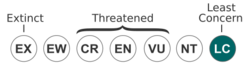
The yellow mud turtle (Kinosternon flavescens),[3] also commonly known as the yellow-necked mud turtle,[4] is a species of mud turtle in the family Kinosternidae. The species is endemic to the Central United States and Mexico.
Distribution
- Northeastern Mexico: Chihuahua, Coahuila, Nuevo León, and Tamaulipas.
- Midwestern and Southwestern United States: Arizona, Colorado, Illinois, Iowa, Kansas, Missouri, Nebraska, New Mexico, Oklahoma, and Texas.
Description
The yellow mud turtle is a small, olive-colored turtle. Both the common name, yellow mud turtle, and the specific name, flavescens (Latin: yellow), refer to the yellow-colored areas on the throat, head, and sides of the neck. The bottom shell (plastron) is yellow to brown with two hinges, allowing the turtle to close each end separately. The male's tail has a blunt spine on the end, but the female's tail does not.
-

-
Texas
-
Carapace, Texas
-
 Plastron, Texas

.jpg)
Lifespan
The yellow mud turtle can live for more than 40 years.[5]
Diet
Behaviour
This species spends most of the year estivating underground, becoming active again when ponds refill from the summer monsoon season. If the amount of rain in a given year is inadequate, this species will remain underground until there is enough rain, and may remain underground for up to 24 months.[6]
Reproduction

Most female aquatic turtles excavate a nest in the soil near a water source, deposit their eggs and leave, but yellow mud turtles exhibit a pattern of parental care. They are the only turtle that has been observed that stays with the eggs for any period of time. The female lays a clutch of 1-9 eggs[7] and stays with the eggs for a period of time of a few hours up to 38 days. It is believed that the female stays to keep the predators away from the eggs. It was also observed that the females would urinate on their nests in dry years. This is believed to aid in the hatch success rate of the eggs in dry years.
Predation
Yellow mud turtles have few natural predators as adults. As eggs and young they are preyed upon by striped skunks, raccoons, other turtles, water snakes (Nerodia), and large predatory fish.[8]
References
- ↑ Iverson, J.B. (2025). "Kinosternon flavescens". IUCN Red List of Threatened Species 2025. doi:10.2305/IUCN.UK.2025-1.RLTS.T163421A161721376.en. https://www.iucnredlist.org/species/163421/161721376. Retrieved 2 May 2025.
- ↑ Fritz, Uwe; Havaš, Peter (2007). "Checklist of Chelonians of the World". Vertebrate Zoology 57 (2): 252. doi:10.3897/vz.57.e30895. ISSN 1864-5755. http://www.cnah.org/pdf_files/851.pdf. Retrieved 29 May 2012.
- ↑ "Yellow Mud Turtle - Tucson Herpetological Society" (in en-US). Tucson Herpetological Society. https://tucsonherpsociety.org/inhabitants/yellow-mud-turtle/.
- ↑ Zim & Smith (1956), p. 23.
- ↑ van Dijk, P.P. (2011). "Kinosternon flavescens". IUCN Red List of Threatened Species 2011. doi:10.2305/IUCN.UK.2011-1.RLTS.T163421A5604699.en. https://www.iucnredlist.org/species/163421/5604699. Retrieved 7 September 2018.
- ↑ Iverson, John B. (September 1989). "The Arizona Mud Turtle, Kinosternon flavescens arizonense (Kinosternidae), in Arizona and Sonora". The Southwestern Naturalist 34 (3): 356–368. doi:10.2307/3672164. Bibcode: 1989SWNat..34..356I.
- ↑ O'Shea, Mark; Halliday, Tim (2010). Reptiles and Amphibians. London: Dorling Kindersley. p. 46. ISBN 978-1-4053-5793-7.
- ↑ "Kinosternon flavescens (Yellow Mud Turtle)". https://animaldiversity.org/accounts/Kinosternon_flavescens/.
Further reading
- Agassiz L (1857). Contributions to the Natural History of the United States of America. Vol. I. Boston: Little, Brown and Company. li + 452 pp. (Cinosternon flavescens, new species, p. 260).
- Behler JL, King FW (1979). The Audubon Society Field Guide to North American Reptiles and Amphibians. New York: Alfred A. Knopf. 743 pp. ISBN 0-394-50824-6. (Kinosternon flavescens, pp. 439–440 + Plate 313).
- Berry JF, Berry CM (1984). "A re-analysis of geographic variation and systematics in the yellow mud turtle, Kinosternon flavescens (Agassiz)". Annals of the Carnegie Museum 53 (7): 185-206.
- Conant R (1975). A Field Guide to Reptiles and Amphibians of Eastern and Central North America, Second Edition. Boston: Houghton Mifflin Company. xviii + 429 pp. + Plates 1-48. ISBN 0-395-19979-4 (hardcover), ISBN 0-395-19977-8 (paperback). (Kinosternon flavescens, pp. 44–46, Figures 6-7 + Plate 4 + Map 10).
- Smith HM, Brodie ED Jr (1982). Reptiles of North America: A Guide to Field Identification. New York: Golden Press. 240 pp. ISBN 0-307-13666-3. (Kinosternon flavescens, pp. 26–27).
- Stebbins RC (2003). A Field Guide to Western Reptiles and Amphibians, Third Edition. The Peterson Field Guide Series ®. Boston and New York: Houghton Mifflin Company. xiii + 533 pp. ISBN 978-0-395-98272-3. (Kinosternon flavescens, pp. 247–248 + Plate 20 + Map 67).
- Zim HS, Smith HM (1956). Reptiles and Amphibians: A Guide to Familiar American Species: A Golden Nature Guide. New York: Simon and Schuster. 160 pp. (Kinosternon flavescens, pp. 23, 155).
External links
 Data related to Kinosternon flavescens at Wikispecies
- Yellow Mud Turtle, Missouri Department of Conservation
- Yellow Mud Turtle, Reptiles and Amphibians of Iowa
- Yellow Mud Turtle , Illinois Natural History Survey
Template:Kinosternidae Wikidata ☰ Q1077041 entry
 |  |


