Chemistry:Oxanorbornadiene
Oxanorbornadiene (OND) is a bicyclic organic compound with an oxygen atom bridging the two opposing saturated carbons of 1,4-cyclohexadiene. OND is related to all-carbon bicycle norbornadiene.
Synthesis
OND can be prepared by cycloaddition of furan to cis-1,2-bis(phenylsulfonyl)ethylene followed by removal of the phenylsulfonyl groups.[1]
Useful OND derivatives are dialkyl OND-2,3-dicarboxylates, readily obtainable by a Diels–Alder cycloaddition between furans and acetylenedicarboxylates such as DMAD.[2]

Diels–Alder synthesis of OND dicarboxylates

Properties
OND-2,3-dicarboxylates (thereafter referred to as OND) display unusually high reactivity towards organic azides[3] and thiols.[4] OND–thiol adducts are prone to retro-Diels–Alder fragmentation, which occurs with widely variable rates.[5]
Reactions with azides
ONDs react with organic azides to yield a mixture of four products, arising from initial 1,3-dipolar cycloaddition onto either of the two olefins, followed by a retro-Diels–Alder reaction (a cycloelimination reaction) to form 1,2,3-triazoles and furans. The intermediate triazolines avoid detection because of a very strong thermodynamic drive to collapse into two aromatic products. The relative preference of attack on either double bond is governed by the electronic nature of the azides. Electron-rich aliphatic azides, e.g. benzyl azide, react preferentially via their HOMO orbital. Interaction of the azide HOMO with LUMO orbital of the OND, localized on the electron-poor C-2 and C-3, leads the products consistent with path A. Electron-poor aryl azides, such as p-nitrophenyl azide, react, to a significant extent, via their LUMO orbitals, interacting with OND HOMO (C-5 and C-6), leading to higher amounts of path B products. The dipolar reactivity of OND with azides is unusually high for olefins, and even exceeds that of parent electron-poor alkyne DMAD.[5][6]
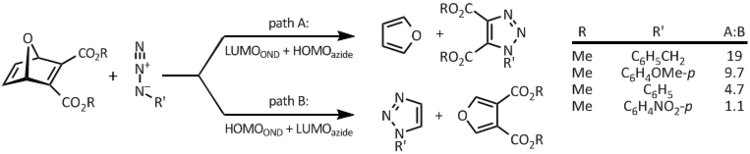
Reaction of OND with organic azides

References
- ↑ Mirsadeghi, Seid; Rickborn, Bruce (1985). "7-Oxabicyclo[2.2.1]hept-2-ene and related materials by reductive elimination". The Journal of Organic Chemistry 50 (22): 4340–4345. doi:10.1021/jo00222a028.
- ↑ Diels, Otto; Alder, Kurt (1931). "Synthesen in der hydroaromatischen Reihe. XII. Mitteilung. ("Dien-Synthesen" sauerstoffhaltiger Heteroringe. 2. Dien-Synthesen des Furans.)". Justus Liebig's Annalen der Chemie 490 (1): 243–257. doi:10.1002/jlac.19314900110.
- ↑ Van Berkel, Sander S.; Dirks, A. (Ton) J.; Debets, Marjoke F.; Van Delft, Floris L.; Cornelissen, Jeroen J. L. M.; Nolte, Roeland J. M.; Rutjes, Floris P. J. T. (2007). "Metal-Free Triazole Formation as a Tool for Bioconjugation". ChemBioChem 8 (13): 1504–8. doi:10.1002/cbic.200700278. PMID 17631666.
- ↑ Hong, Vu P.; Kislukhin, Alexander A.; Finn, M.G. (2009). "Thiol-Selective Fluorogenic Probes for Labeling and Release". J. Am. Chem. Soc. 131 (29): 9986–94. doi:10.1021/ja809345d. PMID 19621956. Bibcode: 2009JAChS.131.9986H.
- ↑ 5.0 5.1 Kislukhin, Alexander A.; Higginson, Cody J.; Hong, Vu P.; Finn, M.G. (2012). "Degradable Conjugates from Oxanorbornadiene Reagents". J. Am. Chem. Soc. 134 (14): 6491–7. doi:10.1021/ja301491h. PMID 22455380. Bibcode: 2012JAChS.134.6491K.
- ↑ Cristina, D.; De Amici, M.; De Micheli, S.; Gandolfi, R. (1981). "Site selectivity in the reactions of 1,3-dipoles with norbornadiene derivatives". Tetrahedron 37 (7): 1349–57. doi:10.1016/S0040-4020(01)92451-2.
 |  |


