Software:Chrono Quest
| Chrono Quest | |
|---|---|
 Cover art by Roger Dean | |
| Developer(s) | Infomedia |
| Publisher(s) | 16/32 Diffusion Psygnosis |
| Composer(s) | David Whittaker |
| Platform(s) | Amiga, Atari ST |
| Release | September 1988 |
| Genre(s) | Adventure |
| Mode(s) | Single-player |
Chrono Quest (Explora: Time Run in France)[1] is an adventure game released in September 1988 for the Amiga and Atari ST. It was developed by French developer Infomedia and published by 16/32 Diffusion in France and Psygnosis in the United Kingdom.[1] Chrono Quest is an historical adventure where the player (accused of murdering their father) travels to different time periods on a quest to find their father's true murderer. The box art was designed by Roger Dean.[2]
Gameplay

Chrono Quest is a point-and-click adventure game that uses a mouse driven icon-based interface. The game begins in 1922 at a family estate in France, with the player character accused of murdering his father. Using a time-traveling machine hidden within the castle, the protagonist travels to several historical periods to search for clues and prove his innocence.
The player explores several distinct eras such as: upper Paleolithic era, New Kingdom of Egypt, Mexico during the decline of the Maya civilisation or India at the beginning of Jahangir's reign. Each location has unique characters, items, and challenges. Players interact with the environment via mouse driven commands like "pick-up", "examine" or "use".[3] Clues and objects collected in one time zone may be essential in another.
The gameplay emphasizes item-based puzzles and deductive reasoning. Environmental dangers include aggressive animals, hostile humans, and deadly traps. Death is possible if players make incorrect choices or delay action in certain scenes.
Development
Chrono Quest was developed by the French studio Infomedia. The game was programmed by Jean‑Marc Cazale (Amiga) and Herve Hubert (Atari ST), with scenario design by Patrick de Mozas and Fabien Begom. The detailed background graphics were drawn by Fabien Begom, with title screen artwork by Jeff Bramfitt. Music was composed by David Whittaker. The development team utilized custom scripting tools and bitmap editors to construct the game's varied historical settings.[3]
Roger Dean was commissioned by Psygnosis to create the iconic cover art for the UK release. The game was showcased at various trade expos in 1988, generating anticipation for its ambitious visual presentation and time travel storyline. Although an IBM PC version was advertised in 1988, no release is known to have occurred, and it is generally believed the port was either cancelled or never completed.
Reception
Chrono Quest received a mixed reception from critics. Most reviewers praised the quality of the graphics and artwork, often singling out its painterly backdrops and moody atmosphere. The Games Machine gave it a score of 86%, highlighting the compelling plot and impressive visuals.[4]
However, the game's pacing and puzzle design received criticism. Commodore User noted that the game's early stages were slow and required considerable trial and error.[5] ACE (Advanced Computer Entertainment) gave the game 221 out of 400, calling the icons unintuitive and the logic inconsistent.[6]
ZZAP!64 praised the game's atmospheric graphics and ambitious scope, describing it as "great fun and extremely compelling" despite awkward mouse control and translation issues. The magazine highlighted the variety in time eras, the challenging puzzles, and the visual presentation, awarding the game an overall score of 78%.[7]
Legacy
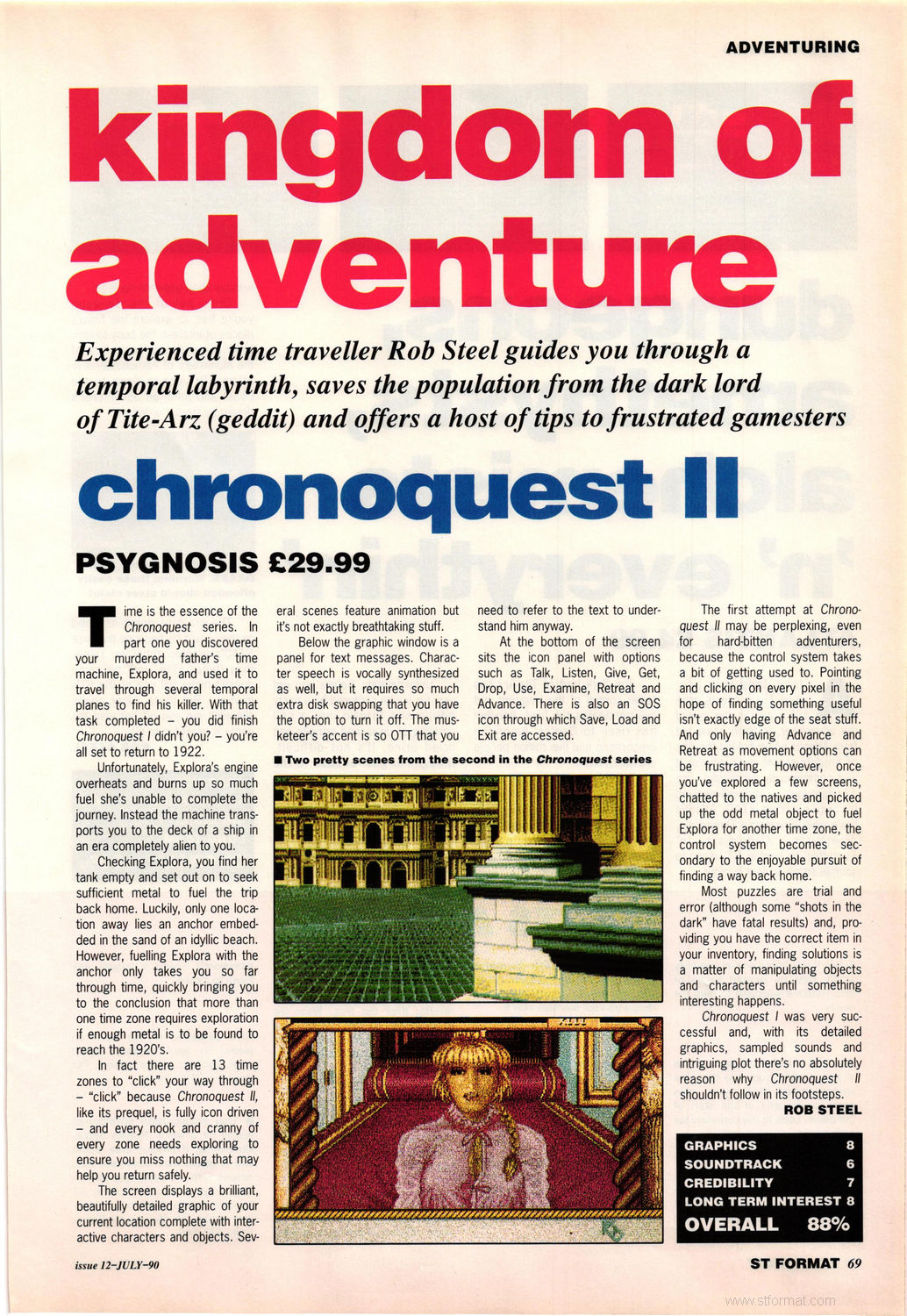
A sequel to the game, Chrono Quest 2, was released in 1989. Explora III: Sous le signe du serpent was never released in English, but saw a French release in 1990. Chrono Quest 2 had a similar critical reception.[8][9][10]
References
- ↑ 1.0 1.1 "Tough Guide". The Games Machine (Newsfield Publications) (11): 14. October 1988. https://archive.org/stream/thegamesmachine-11/TheGamesMachine_11_Oct_1988#page/n13/mode/2up.
- ↑ Plunkett, Luke (September 12, 2011). "Giant Plastic Alien Heads, Badass Fantasy Art & Video Games". Kotaku. Gizmodo Media Group. https://kotaku.com/5839158/giant-plastic-alien-heads-badass-fantasy-art--video-games/. Retrieved December 5, 2017.
- ↑ 3.0 3.1 "Chrono Quest Manual". https://www.atarimania.com/st/files/chrono_quest_psygnosis_manual.pdf. Retrieved 2025-06-20.
- ↑ "Chrono-Quest". The Games Machine (Newsfield Publications) (13): 33. December 1988. https://archive.org/stream/thegamesmachine-magazine-13/TheGamesMachine_13#page/n32/mode/1up.
- ↑ Campbell, Keith (November 1988). "Chrono Quest - Into the Valley". Commodore User (EMAP) (62): 91. https://archive.org/stream/commodore-user-magazine-62/Commodore_User_Issue_62_1988_Nov#page/n89/mode/2up.
- ↑ "Chronoquest". ACE (Future plc) (15): 101. December 1988. https://archive.org/details/ACE_Issue_15_1988-12_Future_Publishing_GB/page/n99/mode/2up.
- ↑ "Chrono Quest review". ZZap!64 (45): 49. January 1989. https://archive.org/details/zzap64-magazine-045/page/n49/mode/2up.
- ↑ Steel, Rob (July 1990). "Chronoquest II". ST Format (12): 69. http://www.stformat.com/stf12/pages_nx1500/stf12_069.jpg.
- ↑ "Kultboy.com - DIE Kult-Seite über die alten Spiele-Magazine und Retro-Games!". http://www.kultboy.com/index.php?site=t&id=11527.
- ↑ ACE Magazine Issue 34. July 1990. https://archive.org/details/ace-magazine-34.
External links
- MobyGames is a commercial database website that catalogs information on video games and the people and companies behind them via crowdsourcing. This includes over 300,000 games for hundreds of platforms.[1] Founded in 1999, ownership of the site has changed hands several times. It has been owned by Atari SA since 2022.
Features
Edits and submissions to the site (including screenshots, box art, developer information, game summaries, and more) go through a verification process of fact-checking by volunteer "approvers".[2] This approval process after submission can range from minutes to days or months.[3] The most commonly used sources are the video game's website, packaging, and credit screens. There is a published standard for game information and copy-editing.[4] A ranking system allows users to earn points for contributing accurate information.[5]
Registered users can rate and review games. Users can create private or public "have" and "want" lists, which can generate a list of games available for trade with other registered users. The site contains an integrated forum. Each listed game can have its own sub-forum.
History

MobyGames was founded on March 1, 1999, by Jim Leonard and Brian Hirt, and joined by David Berk 18 months later, the three of which had been friends since high school.[6][7] Leonard had the idea of sharing information about computer games with a larger audience. The database began with information about games for IBM PC compatibles, relying on the founders' personal collections. Eventually, the site was opened up to allow general users to contribute information.[5] In a 2003 interview, Berk emphasized MobyGames' dedication to taking video games more seriously than broader society and to preserving games for their important cultural influence.[5]
In mid-2010, MobyGames was purchased by GameFly for an undisclosed amount.[8] This was announced to the community post factum , and the site's interface was given an unpopular redesign.[7] A few major contributors left, refusing to do volunteer work for a commercial website.{{Citation needed|date=June 2025} On December 18, 2013, MobyGames was acquired by Jeremiah Freyholtz, owner of Blue Flame Labs (a San Francisco-based game and web development company) and VGBoxArt (a site for fan-made video game box art).[9] Blue Flame Labs reverted MobyGames' interface to its pre-overhaul look and feel,[10] and for the next eight years, the site was run by Freyholtz and Independent Games Festival organizer Simon Carless.[7]
On November 24, 2021, Atari SA announced a potential deal with Blue Flame Labs to purchase MobyGames for $1.5 million.[11] The purchase was completed on 8 March 2022, with Freyholtz remaining as general manager.[12][13][14] Over the next year, the financial boost given by Atari led to a rework of the site being built from scratch with a new backend codebase, as well as updates improving the mobile and desktop user interface.[1] This was accomplished by investing in full-time development of the site instead of its previously part-time development.[15]
In 2024, MobyGames began offering a paid "Pro" membership option for the site to generate additional revenue.[16] Previously, the site had generated income exclusively through banner ads and (from March 2014 onward) a small number of patrons via the Patreon website.[17]
On February 13, 2025, Freyholtz stepped down as the site lead to move onto new projects, leaving operations to Tracy Poff, a veteran coder on the site, and Atari staff.[18]
See also
- IGDB – game database used by Twitch for its search and discovery functions
References
- ↑ 1.0 1.1 Sheehan, Gavin (2023-02-22). "Atari Relaunches The Fully Rebuilt & Optimized MobyGames Website". https://bleedingcool.com/games/atari-relaunches-the-fully-rebuilt-optimized-mobygames-website/.
- ↑ Litchfield, Ted (2021-11-26). "Zombie company Atari to devour MobyGames". https://www.pcgamer.com/zombie-company-atari-to-devour-mobygames/.
- ↑ "MobyGames FAQ: Emails Answered § When will my submission be approved?". Blue Flame Labs. 30 March 2014. http://www.mobygames.com/info/faq7#g1.
- ↑ "The MobyGames Standards and Practices". Blue Flame Labs. 6 January 2016. http://www.mobygames.com/info/standards.
- ↑ 5.0 5.1 5.2 Miller, Stanley A. (2003-04-22). "People's choice awards honor favorite Web sites". Milwaukee Journal Sentinel.
- ↑ "20 Years of MobyGames" (in en). 2019-02-28. https://trixter.oldskool.org/2019/02/28/20-years-of-mobygames/.
- ↑ 7.0 7.1 7.2 Plunkett, Luke (2022-03-10). "Atari Buys MobyGames For $1.5 Million". https://kotaku.com/mobygames-retro-credits-database-imdb-atari-freyholtz-b-1848638521.
- ↑ "Report: MobyGames Acquired By GameFly Media". Gamasutra. 2011-02-07. https://www.gamedeveloper.com/game-platforms/report-mobygames-acquired-by-gamefly-media.
- ↑ Corriea, Alexa Ray (December 31, 2013). "MobyGames purchased from GameFly, improvements planned". http://www.polygon.com/2013/12/31/5261414/mobygames-purchased-from-gamefly-improvements-planned.
- ↑ Wawro, Alex (31 December 2013). "Game dev database MobyGames getting some TLC under new owner". Gamasutra. https://www.gamedeveloper.com/business/game-dev-database-mobygames-getting-some-tlc-under-new-owner.
- ↑ "Atari invests in Anstream, may buy MobyGames". November 24, 2021. https://www.gamesindustry.biz/articles/2021-11-24-atari-invests-in-anstream-may-buy-mobygames.
- ↑ Rousseau, Jeffrey (2022-03-09). "Atari purchases Moby Games". https://www.gamesindustry.biz/atari-purchases-moby-games.
- ↑ "Atari Completes MobyGames Acquisition, Details Plans for the Site's Continued Support". March 8, 2022. https://www.atari.com/atari-completes-mobygames-acquisition-details-plans-for-the-sites-continued-support/.
- ↑ "Atari has acquired game database MobyGames for $1.5 million" (in en-GB). 2022-03-09. https://www.videogameschronicle.com/news/atari-has-acquired-game-database-mobygames-for-1-5-million/.
- ↑ Stanton, Rich (2022-03-10). "Atari buys videogame database MobyGames for $1.5 million". https://www.pcgamer.com/atari-buys-videogame-database-mobygames-for-dollar15-million/.
- ↑ Harris, John (2024-03-09). "MobyGames Offering “Pro” Membership". https://setsideb.com/mobygames-offering-pro-membership/.
- ↑ "MobyGames on Patreon". http://www.patreon.com/mobygames.
- ↑ "An update on MobyGames leadership". 2025-02-13. https://www.mobygames.com/forum/3/thread/269628/an-update-on-mobygames-leadership/#post-269628.
 |
Wikidata has the property:
|

External links
- No URL found. Please specify a URL here or add one to Wikidata.

 |  |
| |