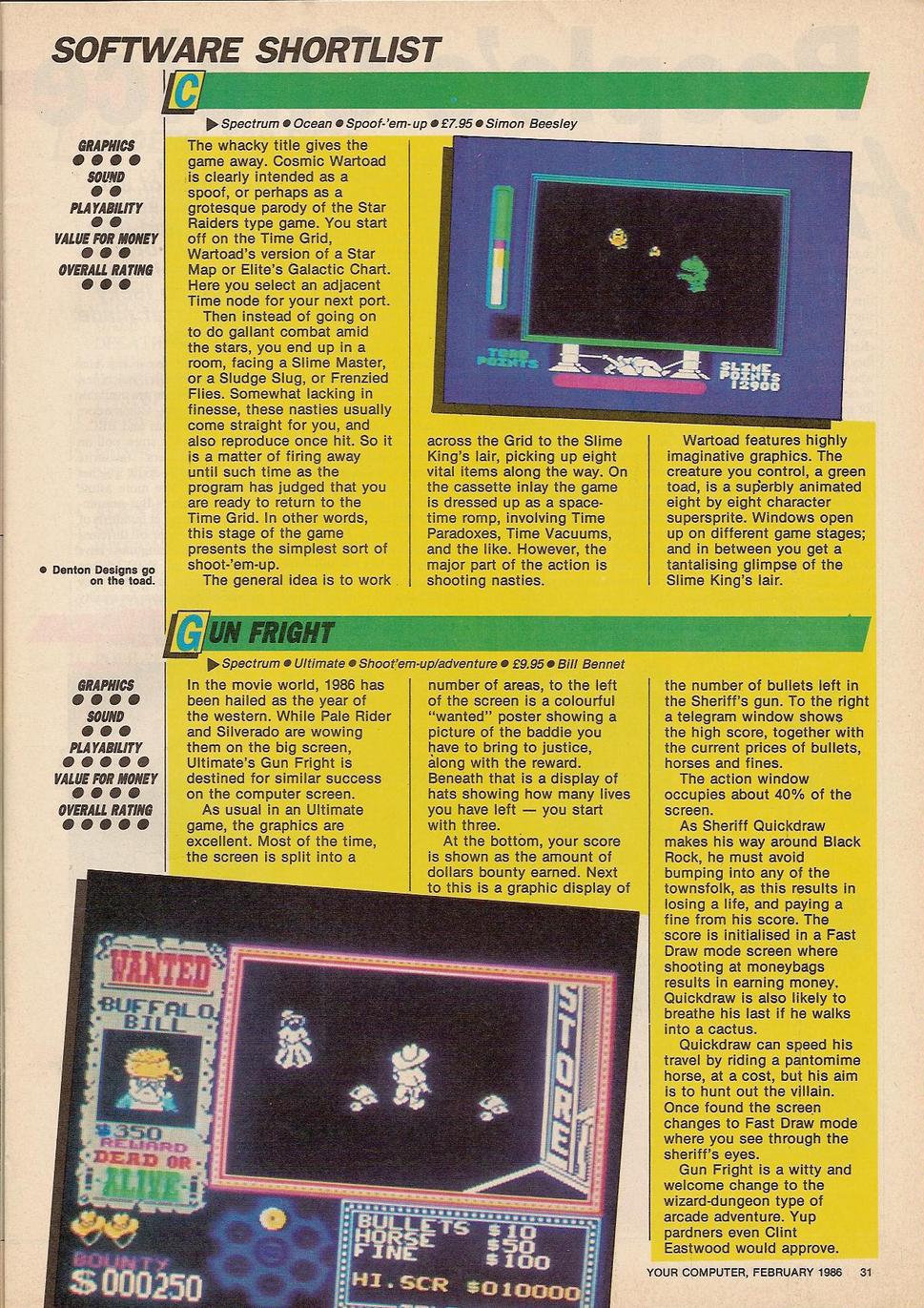
Software:Gunfright
Gunfright is an open-world[1] action-adventure game developed by Ultimate Play the Game and published by U.S. Gold. It was first released for the ZX Spectrum in December 1985, then released for Amstrad CPC and the MSX the following year. The player takes the role of a sheriff in the town of Black Rock and is tasked with eliminating outlaws who are scattered throughout the settlement.
The game was developed directly after Nightshade, and re-uses the latter game's Filmation II game engine that allows images to be rendered without overlapping each other. The game received mostly positive reviews upon release; praise was directed at the graphics and presentation, but criticism was directed at the game's similarity to Nightshade. It was later included in Rare Replay, Rare's 2015 Xbox One retrospective compilation.
Gameplay

Gunfright is presented in an isometric format and set in the fictional town of Black Rock. The player takes on the role of Sheriff Quickdraw, whose main objective is to track down and kill a gang of outlaws who are hiding in the town.[2] The game begins with a first-person perspective targeting minigame in which vertically scrolling bags of money can be shot at using crosshairs. Shooting the bags give the player initial sums of money which can be used to purchase ammunition.[2]
Sheriff Quickdraw must locate the wanted outlaws one by one. Once an outlaw has been found and shot to initiate a duel, the game shifts to the first-person targeting minigame. This time, the player must shoot the rapidly moving outlaw as quickly as possible. The player can either wait for the outlaw to draw, or take the initiative and shoot first, which will make the bandit draw his weapon as well. If the player successfully shoots an outlaw, a bounty is paid (increasing with every round), and a new outlaw enters the town.[2]
Players encounter helpful residents who will point the way to outlaws. The residents need to be protected during gameplay, as the player has to pay a fine if any are shot by either bandits or Sheriff Quickdraw himself. Some outlaws are mounted on horseback, meaning that the player may have to saddle a horse power-up to pursue them.[2][3]
Development
Gunfright was developed with the isometric projection game engine known as Filmation II, which was used previously in Ultimate's 1985 ZX Spectrum game Nightshade.[4] The Filmation engine was created by the Stamper brothers to portray 3D imagery. Filmation II used an image masking technique that drew and filled holes in the background, allowing the game to create composite structures out of pixelated drawings without visual overlay, despite the limitations platforms such as the ZX Spectrum offered.[5]
Gunfright was initially released for the ZX Spectrum in December 1985,[6] and was the last game to be developed under the direct involvement of the Stamper brothers.[7] Realising that the graphical limits of platforms such as the ZX Spectrum had been pushed, future projects such as Blackwyche and Dragon Skulle were handed over to designer brothers Dave and Bob Thomas, who were often uncredited for their work.[8] Gunfright, along with Knight Lore, Alien 8 and Nightshade, were re-released for the MSX in 1986, with Gunfright and Sabre Wulf being ported to the Amstrad CPC later that year.[7]
Reception
| Reception | ||||||||||
|---|---|---|---|---|---|---|---|---|---|---|
| ||||||||||
The game received mostly positive reviews upon release. Reviewers writing for Crash praised the game's graphics as highly detailed and "colourful", but stated that the game was visually similar to Ultimate's immediately previous game, Nightshade.[2] Gwyn Hughes of Your Sinclair thought the graphics were the best aspect of the game, despite similarly comparing them to those of Nightshade. Hughes also praised the game's smooth animation and the techniques used to portray the western town.[9] A reviewer for CVG suggested that the game's style and gameplay was a mix of Nightshade and Nintendo's Duck Hunt.[10] Reviewing the MSX version, a reviewer for Computer Gamer praised the game's plot, and was complimentary of the way the game was able to separate itself from Ultimate's previous game, which had used the same Filmation engine.[3]
Reviewers writing for Crash praised the gameplay, stating that the game's "element" was considerably developed and that the several different stages were "highly addictive".[2] Writers in CVG criticised the gameplay, noting that they found it difficult to distinguish the outlaws from other male inhabitants of the town. They also noted the absence of puzzle elements which was considered "unusual" for an Ultimate game.[10] Bill Bennett of Your Computer similarly considered the omission of puzzle elements unusual, but welcomed the "witty" change in genre from the previous dungeon-themed video games.[11]
Legacy
Gunfright is part of an Xbox One compilation of 30 Rare titles, Rare Replay, released in August 2015.[12]
References
- ↑ "Rare Replay Review: Rare Game Preserve | Shacknews". https://www.shacknews.com/article/90621/rare-replay-review-rare-game-preserve.
- ↑ 2.0 2.1 2.2 2.3 2.4 2.5 2.6 "Gunfright Review". Crash (Newsfield) (25): 134. February 1986. http://www.crashonline.org.uk/25/gunfright.htm.
- ↑ 3.0 3.1 3.2 "Gunfright review". Computer Gamer (Argus Specialist Publications) (16): 7. July 1986. https://archive.org/stream/Computer_Gamer_Issue_16_1986-07_Argus_Press_GB#page/n94/mode/1up.
- ↑ "Looking For An Old Angle". Crash (Newsfield) (51). April 1988. http://www.crashonline.org.uk/51/runagain.htm. Retrieved 3 October 2006.
- ↑ "Game Design". Crash (Newsfield) (29). June 1986. http://www.crashonline.org.uk/29/game_design.htm. Retrieved 9 September 2015.
- ↑ "Ultimate's latest". Popular Computing Weekly (Sunshine Publications) 5 (1): 1. 26 December 1985. http://archive.org/details/popular-computing-weekly-1985-12-26/mode/1up?view=theater. "Gunfright costs ₤9.95 and is released this week.".
- ↑ 7.0 7.1 "History of Ultimate Play the Game". The Centre for Computing History. http://www.computinghistory.org.uk/det/32829/Ultimate-Play-The-Game/.
- ↑ Thomas, Dave (October 2008). "The Ultimate Adventure of Sir Arthur Pendragon". Retro Gamer (56): 49. http://scans.bytemaniacos.com/en/retro_gamer/Retro_Gamer_Issue_056.pdf. Retrieved 12 September 2015.
- ↑ 9.0 9.1 "Gunfright Review". Your Sinclair (Dennis Publishing) (8): 34. August 1986. http://www.ysrnry.co.uk/articles/gunfright.htm.
- ↑ 10.0 10.1 "Gunfright". C+VG (Future Publishing) (52): 18. February 1986. http://wos.meulie.net/pub/sinclair/magazines/C+VG/Issue052/Pages/CVG05200018.jpg.
- ↑ Bennett, Bill (February 1986). "Gunfright review". Your Computer (IPC Electrical-Electronic Press) 6 (2): 31. http://wos.meulie.net/pub/sinclair/magazines/YourComputer/Issue8602/Pages/YourComputer860200031.jpg. Retrieved 9 September 2015.
- ↑ McWhertor, Michael (15 June 2015). "Rare Replay for Xbox One includes 30 Rare games for $30 (update)". Polygon. Vox Media. http://www.polygon.com/2015/6/15/8783621/rare-replay-xbox-one.
External links
- Gunfright can be played for free in the browser at the Internet Archive
- MobyGames is a commercial database website that catalogs information on video games and the people and companies behind them via crowdsourcing. This includes over 300,000 games for hundreds of platforms.[1] Founded in 1999, ownership of the site has changed hands several times. It has been owned by Atari SA since 2022.
Features
Edits and submissions to the site (including screenshots, box art, developer information, game summaries, and more) go through a verification process of fact-checking by volunteer "approvers".[2] This approval process after submission can range from minutes to days or months.[3] The most commonly used sources are the video game's website, packaging, and credit screens. There is a published standard for game information and copy-editing.[4] A ranking system allows users to earn points for contributing accurate information.[5]
Registered users can rate and review games. Users can create private or public "have" and "want" lists, which can generate a list of games available for trade with other registered users. The site contains an integrated forum. Each listed game can have its own sub-forum.
History

MobyGames was founded on March 1, 1999, by Jim Leonard and Brian Hirt, and joined by David Berk 18 months later, the three of which had been friends since high school.[6][7] Leonard had the idea of sharing information about computer games with a larger audience. The database began with information about games for IBM PC compatibles, relying on the founders' personal collections. Eventually, the site was opened up to allow general users to contribute information.[5] In a 2003 interview, Berk emphasized MobyGames' dedication to taking video games more seriously than broader society and to preserving games for their important cultural influence.[5]
In mid-2010, MobyGames was purchased by GameFly for an undisclosed amount.[8] This was announced to the community post factum , and the site's interface was given an unpopular redesign.[7] A few major contributors left, refusing to do volunteer work for a commercial website.{{Citation needed|date=June 2025} On December 18, 2013, MobyGames was acquired by Jeremiah Freyholtz, owner of Blue Flame Labs (a San Francisco-based game and web development company) and VGBoxArt (a site for fan-made video game box art).[9] Blue Flame Labs reverted MobyGames' interface to its pre-overhaul look and feel,[10] and for the next eight years, the site was run by Freyholtz and Independent Games Festival organizer Simon Carless.[7]
On November 24, 2021, Atari SA announced a potential deal with Blue Flame Labs to purchase MobyGames for $1.5 million.[11] The purchase was completed on 8 March 2022, with Freyholtz remaining as general manager.[12][13][14] Over the next year, the financial boost given by Atari led to a rework of the site being built from scratch with a new backend codebase, as well as updates improving the mobile and desktop user interface.[1] This was accomplished by investing in full-time development of the site instead of its previously part-time development.[15]
In 2024, MobyGames began offering a paid "Pro" membership option for the site to generate additional revenue.[16] Previously, the site had generated income exclusively through banner ads and (from March 2014 onward) a small number of patrons via the Patreon website.[17]
On February 13, 2025, Freyholtz stepped down as the site lead to move onto new projects, leaving operations to Tracy Poff, a veteran coder on the site, and Atari staff.[18]
See also
- IGDB – game database used by Twitch for its search and discovery functions
References
- ↑ 1.0 1.1 Sheehan, Gavin (2023-02-22). "Atari Relaunches The Fully Rebuilt & Optimized MobyGames Website". https://bleedingcool.com/games/atari-relaunches-the-fully-rebuilt-optimized-mobygames-website/.
- ↑ Litchfield, Ted (2021-11-26). "Zombie company Atari to devour MobyGames". https://www.pcgamer.com/zombie-company-atari-to-devour-mobygames/.
- ↑ "MobyGames FAQ: Emails Answered § When will my submission be approved?". Blue Flame Labs. 30 March 2014. http://www.mobygames.com/info/faq7#g1.
- ↑ "The MobyGames Standards and Practices". Blue Flame Labs. 6 January 2016. http://www.mobygames.com/info/standards.
- ↑ 5.0 5.1 5.2 Miller, Stanley A. (2003-04-22). "People's choice awards honor favorite Web sites". Milwaukee Journal Sentinel.
- ↑ "20 Years of MobyGames" (in en). 2019-02-28. https://trixter.oldskool.org/2019/02/28/20-years-of-mobygames/.
- ↑ 7.0 7.1 7.2 Plunkett, Luke (2022-03-10). "Atari Buys MobyGames For $1.5 Million". https://kotaku.com/mobygames-retro-credits-database-imdb-atari-freyholtz-b-1848638521.
- ↑ "Report: MobyGames Acquired By GameFly Media". Gamasutra. 2011-02-07. https://www.gamedeveloper.com/game-platforms/report-mobygames-acquired-by-gamefly-media.
- ↑ Corriea, Alexa Ray (December 31, 2013). "MobyGames purchased from GameFly, improvements planned". http://www.polygon.com/2013/12/31/5261414/mobygames-purchased-from-gamefly-improvements-planned.
- ↑ Wawro, Alex (31 December 2013). "Game dev database MobyGames getting some TLC under new owner". Gamasutra. https://www.gamedeveloper.com/business/game-dev-database-mobygames-getting-some-tlc-under-new-owner.
- ↑ "Atari invests in Anstream, may buy MobyGames". November 24, 2021. https://www.gamesindustry.biz/articles/2021-11-24-atari-invests-in-anstream-may-buy-mobygames.
- ↑ Rousseau, Jeffrey (2022-03-09). "Atari purchases Moby Games". https://www.gamesindustry.biz/atari-purchases-moby-games.
- ↑ "Atari Completes MobyGames Acquisition, Details Plans for the Site's Continued Support". March 8, 2022. https://www.atari.com/atari-completes-mobygames-acquisition-details-plans-for-the-sites-continued-support/.
- ↑ "Atari has acquired game database MobyGames for $1.5 million" (in en-GB). 2022-03-09. https://www.videogameschronicle.com/news/atari-has-acquired-game-database-mobygames-for-1-5-million/.
- ↑ Stanton, Rich (2022-03-10). "Atari buys videogame database MobyGames for $1.5 million". https://www.pcgamer.com/atari-buys-videogame-database-mobygames-for-dollar15-million/.
- ↑ Harris, John (2024-03-09). "MobyGames Offering “Pro” Membership". https://setsideb.com/mobygames-offering-pro-membership/.
- ↑ "MobyGames on Patreon". http://www.patreon.com/mobygames.
- ↑ "An update on MobyGames leadership". 2025-02-13. https://www.mobygames.com/forum/3/thread/269628/an-update-on-mobygames-leadership/#post-269628.
 |
Wikidata has the property:
|

External links
- No URL found. Please specify a URL here or add one to Wikidata.

 |  |
- Gunfright at SpectrumComputing.co.uk
| |