Software:Pushover (video game)
| Pushover | |
|---|---|
 | |
| Developer(s) | Red Rat Software |
| Publisher(s) | Ocean Software |
| Platform(s) | Amiga, Atari ST, MS-DOS, Super NES |
| Release | 1992 |
| Genre(s) | Puzzle-platform |
| Mode(s) | Single-player |
Pushover is a puzzle-platform game developed by Red Rat Software and published by Ocean Software in 1992 for the Amiga, Atari ST, MS-DOS and Super NES. The game was sponsored by Smiths' British snack Quavers (now owned by Walkers), and the plot revolves around the then Quavers mascot Colin Curly losing his Quavers packets down a giant ant hill. The player is tasked with controlling G.I. Ant, a large soldier ant, to recover the Quavers by solving a series of puzzles. The SNES version lacks the Quavers branding, and instead the aim is to recover bundles of cash dropped down the ant hill by Captain Rat.
Gameplay
The game consists of 100 levels of increasing complexity over nine different themed worlds. Each level features several interconnected platforms holding a number of "dominoes". The aim is to rearrange the dominoes, such that with a single push, all of the dominoes are toppled, thus opening the exit to the next level. There are 11 different types of domino, identified by red and yellow patterns, each with different actions. The player controls G.I. Ant, who can move certain dominoes by carrying them one at a time.
Various factors can result in failure to complete a level. As well as toppling all of the dominoes, the player must be able to access the exit door once the dominoes have fallen. For instance, the player will be unable to reach the exit if a ledge leading to the exit has been destroyed, or if a gap leading to the exit has not been bridged, or if a line of dominoes lie across the exit. G.I. Ant may die by falling from a large height, by falling off the bottom of the screen, or by being crushed under a falling domino. The player is then greeted with the message "You Failed, You Died" and has to restart the level. Also, the level will be failed if any dominoes are destroyed by landing one domino on top of another.
Each level has a time limit during which it must be completed. However, if the time runs out the player is still able to continue with the puzzle if they wish. By pausing the game once the time has run out, a small hint will be displayed, giving advice on how to complete the level. As a side note, the hint for level 98 informs the player that the game's designer cannot remember how to complete the level without trickery ("Use a drop! There is a way to make it work with a push, but I can't find it!").
The themed worlds, in order, are an industrial complex, an Aztec world, a space station, an electronic world, a Greek temple, a Medieval castle, a Meccano-inspired world, a dungeon and a Japanese temple. Each world has 11 levels, making a total of 99 regular levels. A packet of Colin's Quavers is retrieved after each world, with nine packets in all to be collected. Many of the early levels are tutorials demonstrating how each type of domino will act. Often there is only a single solution to each level, though some levels have multiple solutions. The final level, level 100, must be completed using dominoes with hidden markings.
A password system allows the player to continue an earlier game, without having to restart from the first level. Additionally, upon completing a level the player gains a token, which once a level has been failed, allows the player to return to the point before the domino push, rather than having to return to the initial state of the level.
Development
Creative differences between RedRat Software and Ocean Software around branding and graphical changes overshadowed this title and a breakdown between both parties occurred once legal action was taken by RedRat to regain creative control/claim a breach of contract. The legal battle led to the downfall of RedRat Software, who were unable to fund continual legal costs vs the much deeper pockets of Ocean Software.
Reception
| Reception | ||||||||
|---|---|---|---|---|---|---|---|---|
| ||||||||

The game was reviewed in 1993 in Dragon #193 by Hartley, Patricia, and Kirk Lesser in the "Role of Computers" column. The reviewers gave the game 5 out of 5 stars.[1]
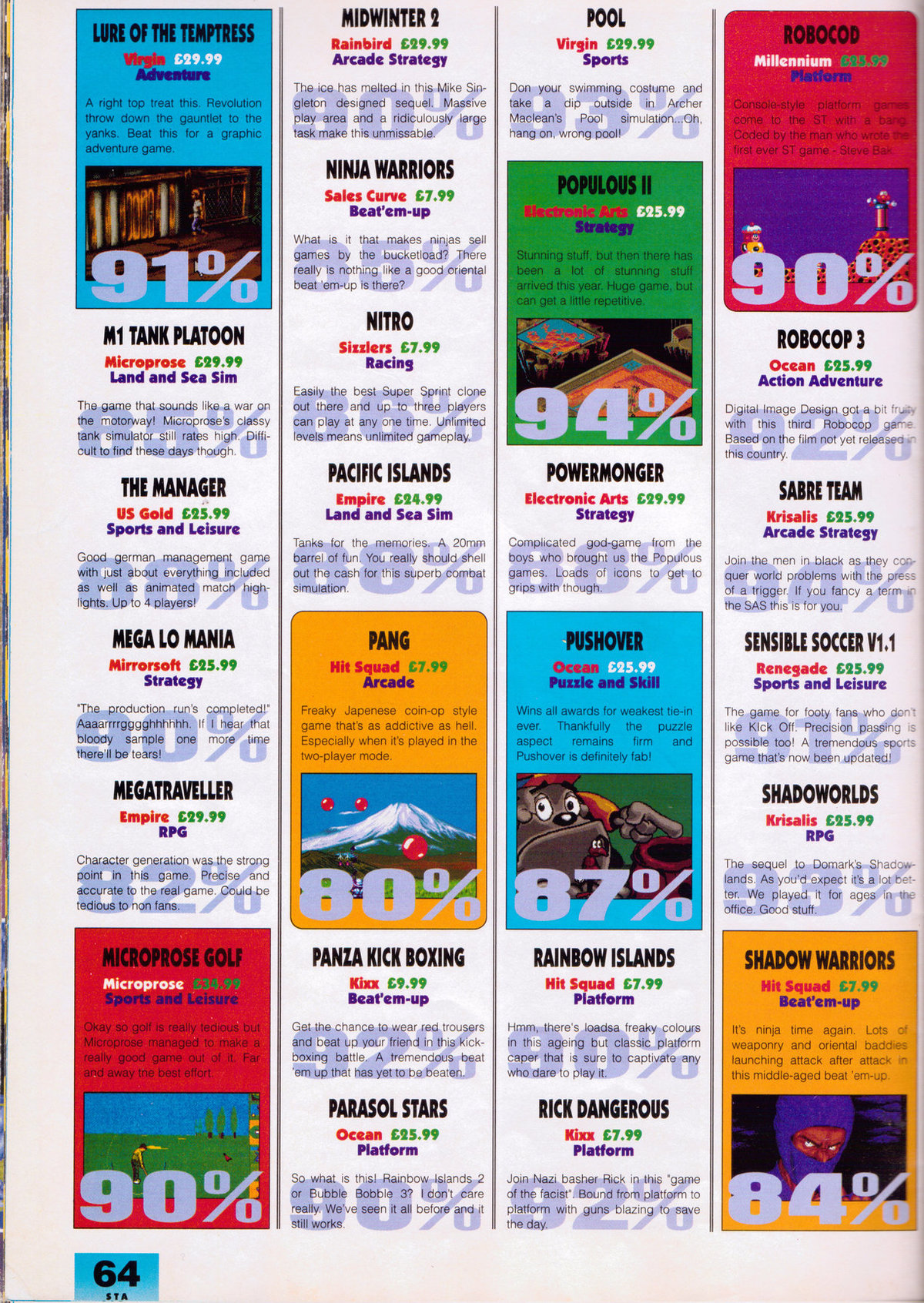
Entertainment Weekly gave the game a B- and wrote that "The theme of Pushover (Ocean of America, for Super NES) is ingenious — players have to line up 10 kinds of dominoes, then get them all to fall with a single push — but the static execution will have small kids dozing off way before their bedtime."[2]
Reviews
- Amiga User International (Nov, 1992)[3]
- ST Format (Oct, 1992)[4]
- Amiga Action (Jul, 1992)[5]
- ST Action (Mar, 1993)[6]
- Amiga Format (Sep, 1992)[7]
- The One Amiga (Jun, 1992)[8]
- Power Play (Aug, 1992)[9]
- Zero (Jul, 1992)[10]
- Amiga Power (Jun, 1992)[11]
- Amiga Joker (Sep, 1992)[12]
- ST Format (Jan, 1994)[13]
References
- ↑ 1.0 1.1 Lesser, Hartley; Lesser, Patricia; Lesser, Kirk (May 1993). "The Role of Computers". Dragon (TSR, Inc.) (193): 57–63. ISSN 0279-6848. https://archive.org/stream/DragonMagazine260_201801/DragonMagazine193#page/n61/mode/2up.
- ↑ 2.0 2.1 Strauss, Bob (April 2, 1993). "Pushover". Entertainment Weekly (Time). https://ew.com/article/1993/04/02/pushover/.
- ↑ "Pushover review from AUI Vol 6 No 11 (Nov 1992) - Amiga Magazine Rack". http://amr.abime.net/review_7551.
- ↑ https://archive.org/stream/ST_Format_Issue_039_1992-10_Future_Publishing_GB#page/n109/mode/2up
- ↑ "Push-Over review from Amiga Action 34 (Jul 1992) - Amiga Magazine Rack". http://amr.abime.net/review_40874.
- ↑ http://www.atarimania.com/mags/hi_res/atari_st_action_59_64.jpg [bare URL image file]
- ↑ https://archive.org/stream/Amiga_Format_Issue_038_1992-09_Future_Publishing_GB#page/n83/mode/2up
- ↑ "Pushover review from the One Amiga 45 (Jun 1992) - Amiga Magazine Rack". http://amr.abime.net/review_9078.
- ↑ http://www.kultboy.com/index.php?site=t&id=5583 [bare URL]
- ↑ "Amiga Reviews: Push over". https://amigareviews.leveluphost.com/pushover.htm#pushoverzero.
- ↑ "Amiga Reviews: Push over". https://amigareviews.leveluphost.com/pushover.htm#pushoverap.
- ↑ http://amigareviews.classicgaming.gamespy.com/pushover.htm#pushoveraj
- ↑ https://archive.org/stream/ST_Format_Issue_054_1994-01_Future_Publishing_GB#page/n76/mode/2up
External links
- MobyGames is a commercial database website that catalogs information on video games and the people and companies behind them via crowdsourcing. This includes over 300,000 games for hundreds of platforms.[1] Founded in 1999, ownership of the site has changed hands several times. It has been owned by Atari SA since 2022.
Features
Edits and submissions to the site (including screenshots, box art, developer information, game summaries, and more) go through a verification process of fact-checking by volunteer "approvers".[2] This approval process after submission can range from minutes to days or months.[3] The most commonly used sources are the video game's website, packaging, and credit screens. There is a published standard for game information and copy-editing.[4] A ranking system allows users to earn points for contributing accurate information.[5]
Registered users can rate and review games. Users can create private or public "have" and "want" lists, which can generate a list of games available for trade with other registered users. The site contains an integrated forum. Each listed game can have its own sub-forum.
History

MobyGames was founded on March 1, 1999, by Jim Leonard and Brian Hirt, and joined by David Berk 18 months later, the three of which had been friends since high school.[6][7] Leonard had the idea of sharing information about computer games with a larger audience. The database began with information about games for IBM PC compatibles, relying on the founders' personal collections. Eventually, the site was opened up to allow general users to contribute information.[5] In a 2003 interview, Berk emphasized MobyGames' dedication to taking video games more seriously than broader society and to preserving games for their important cultural influence.[5]
In mid-2010, MobyGames was purchased by GameFly for an undisclosed amount.[8] This was announced to the community post factum , and the site's interface was given an unpopular redesign.[7] A few major contributors left, refusing to do volunteer work for a commercial website.{{Citation needed|date=June 2025} On December 18, 2013, MobyGames was acquired by Jeremiah Freyholtz, owner of Blue Flame Labs (a San Francisco-based game and web development company) and VGBoxArt (a site for fan-made video game box art).[9] Blue Flame Labs reverted MobyGames' interface to its pre-overhaul look and feel,[10] and for the next eight years, the site was run by Freyholtz and Independent Games Festival organizer Simon Carless.[7]
On November 24, 2021, Atari SA announced a potential deal with Blue Flame Labs to purchase MobyGames for $1.5 million.[11] The purchase was completed on 8 March 2022, with Freyholtz remaining as general manager.[12][13][14] Over the next year, the financial boost given by Atari led to a rework of the site being built from scratch with a new backend codebase, as well as updates improving the mobile and desktop user interface.[1] This was accomplished by investing in full-time development of the site instead of its previously part-time development.[15]
In 2024, MobyGames began offering a paid "Pro" membership option for the site to generate additional revenue.[16] Previously, the site had generated income exclusively through banner ads and (from March 2014 onward) a small number of patrons via the Patreon website.[17]
On February 13, 2025, Freyholtz stepped down as the site lead to move onto new projects, leaving operations to Tracy Poff, a veteran coder on the site, and Atari staff.[18]
See also
- IGDB – game database used by Twitch for its search and discovery functions
References
- ↑ 1.0 1.1 Sheehan, Gavin (2023-02-22). "Atari Relaunches The Fully Rebuilt & Optimized MobyGames Website". https://bleedingcool.com/games/atari-relaunches-the-fully-rebuilt-optimized-mobygames-website/.
- ↑ Litchfield, Ted (2021-11-26). "Zombie company Atari to devour MobyGames". https://www.pcgamer.com/zombie-company-atari-to-devour-mobygames/.
- ↑ "MobyGames FAQ: Emails Answered § When will my submission be approved?". Blue Flame Labs. 30 March 2014. http://www.mobygames.com/info/faq7#g1.
- ↑ "The MobyGames Standards and Practices". Blue Flame Labs. 6 January 2016. http://www.mobygames.com/info/standards.
- ↑ 5.0 5.1 5.2 Miller, Stanley A. (2003-04-22). "People's choice awards honor favorite Web sites". Milwaukee Journal Sentinel.
- ↑ "20 Years of MobyGames" (in en). 2019-02-28. https://trixter.oldskool.org/2019/02/28/20-years-of-mobygames/.
- ↑ 7.0 7.1 7.2 Plunkett, Luke (2022-03-10). "Atari Buys MobyGames For $1.5 Million". https://kotaku.com/mobygames-retro-credits-database-imdb-atari-freyholtz-b-1848638521.
- ↑ "Report: MobyGames Acquired By GameFly Media". Gamasutra. 2011-02-07. https://www.gamedeveloper.com/game-platforms/report-mobygames-acquired-by-gamefly-media.
- ↑ Corriea, Alexa Ray (December 31, 2013). "MobyGames purchased from GameFly, improvements planned". http://www.polygon.com/2013/12/31/5261414/mobygames-purchased-from-gamefly-improvements-planned.
- ↑ Wawro, Alex (31 December 2013). "Game dev database MobyGames getting some TLC under new owner". Gamasutra. https://www.gamedeveloper.com/business/game-dev-database-mobygames-getting-some-tlc-under-new-owner.
- ↑ "Atari invests in Anstream, may buy MobyGames". November 24, 2021. https://www.gamesindustry.biz/articles/2021-11-24-atari-invests-in-anstream-may-buy-mobygames.
- ↑ Rousseau, Jeffrey (2022-03-09). "Atari purchases Moby Games". https://www.gamesindustry.biz/atari-purchases-moby-games.
- ↑ "Atari Completes MobyGames Acquisition, Details Plans for the Site's Continued Support". March 8, 2022. https://www.atari.com/atari-completes-mobygames-acquisition-details-plans-for-the-sites-continued-support/.
- ↑ "Atari has acquired game database MobyGames for $1.5 million" (in en-GB). 2022-03-09. https://www.videogameschronicle.com/news/atari-has-acquired-game-database-mobygames-for-1-5-million/.
- ↑ Stanton, Rich (2022-03-10). "Atari buys videogame database MobyGames for $1.5 million". https://www.pcgamer.com/atari-buys-videogame-database-mobygames-for-dollar15-million/.
- ↑ Harris, John (2024-03-09). "MobyGames Offering “Pro” Membership". https://setsideb.com/mobygames-offering-pro-membership/.
- ↑ "MobyGames on Patreon". http://www.patreon.com/mobygames.
- ↑ "An update on MobyGames leadership". 2025-02-13. https://www.mobygames.com/forum/3/thread/269628/an-update-on-mobygames-leadership/#post-269628.
 |
Wikidata has the property:
|

External links
- No URL found. Please specify a URL here or add one to Wikidata.
 |  |
- Pushover at Amiga Hall of Light
Warning: Default sort key "Pushover (Video Game)" overrides earlier default sort key "Mobygames".
| |