Software:Sky Target
| Sky Target | |
|---|---|
 | |
| Developer(s) | Sega |
| Publisher(s) | Sega |
| Platform(s) | Arcade, Sega Saturn, Microsoft Windows |
| Release | Arcade Sega Saturn PC
|
| Genre(s) | Flight simulator/Shoot 'em up |
| Mode(s) | Single player |
| Arcade system | Sega Model 2[3] |
Sky Target (スカイターゲット, Sukai Tāgetto) is a 1995 arcade game by Sega. A rail shooter featuring a number of planes including the default F-14D Super Tomcat, it is best remembered for its semi-official connection to Sega's earlier hit After Burner. Although never billed as a sequel, its overt similarities to the 1987 classic were nonetheless referenced in official promotional materials[4] and recognized by the media.[3][5][6][7] Plus, it features a revised version of the "After Burner" music theme within its soundtrack.
In 1997, Sky Target was ported to Sega Saturn by external developer Appaloosa Interactive.[8] The port retains the gameplay of the original but has completely redone cutscenes, a difficulty select option, and a new Ranking Mode. This version was also later released for Microsoft Windows exclusively in Japan.
Gameplay
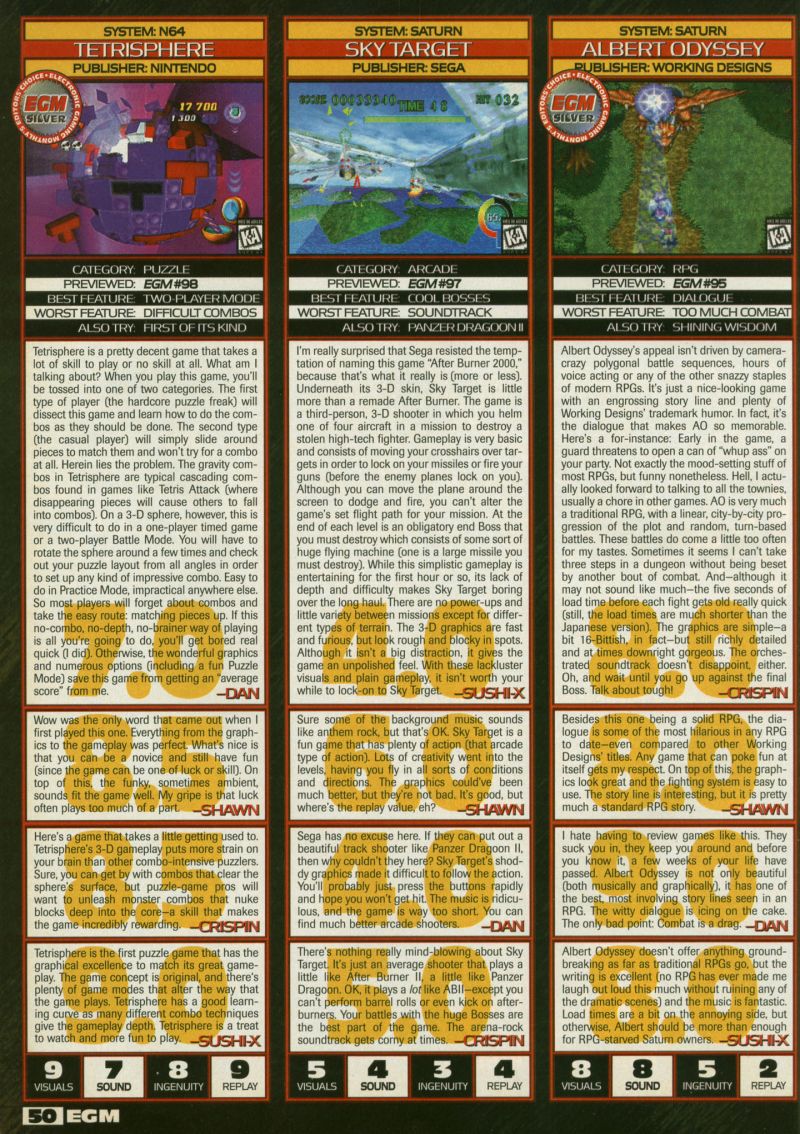
Like After Burner, Sky Target places players in control of a modern fighter jet. Players can select from four planes: the F-14D Super Tomcat, Rafale M, F-16C, and F-15S/MTD.[9] The camera follows in chase view (with two selectable follow distances), and players control movement with an analog flight stick. As in After Burner, moving the reticule over a target allows the player to lock on (denoted by a voice shouting "Fire!") and fire homing missiles.[8]
Unlike After Burner II, there is no throttle to control speed,[9][10] nor an ability to barrel roll.[11] After certain stages, players may have a choice of two different stages, an element later revisited in After Burner Climax. Also unlike After Burner, Sky Target has large, sci-fi-inspired bosses that need to be destroyed in a set amount of time in order to receive a score bonus.[12]
In the Saturn version's Ranking Mode, each level is played individually, and players are graded on their performance. Sufficiently strong performances are rewarded with promotions, which unlock additional levels in the Ranking Mode, though there are no levels beyond those included in the regular game.[11]
Reception
| Reception | ||||||||||||||||||||
|---|---|---|---|---|---|---|---|---|---|---|---|---|---|---|---|---|---|---|---|---|
| ||||||||||||||||||||


Sky Target was negatively received by critics. Reviewing the arcade version, Next Generation called the game "a fancy-shmantzy remake of After Burner, and a lot less fun". The reviewer praised the visuals for their cutting edge level of detail, lack of draw in, and strong design, but said the gameplay is so simplistic and repetitive that the average player will have mastered it by the end of the first two levels. He noted that the game was even simpler than its predecessor After Burner, since it lacks a means of controlling acceleration.[19] In spite of the negative reception, Japan's Game Machine listed the game on their December 1, 1995 issue as the fourth most-successful dedicated arcade game of the month.[21]
The Saturn version was also primarily criticized for its generally shallow gameplay,[15][20][12][22] and limited controls,[15][20][12] which a Next Generation critic summed up by saying that the player's plane "acts more like a targeting icon than a pilotable craft."[20] GamePro concluded, "Sky Target might have made a decent arcade game a decade ago, but it certainly won't do anything to calm all those Saturn owners worrying about the system's future."[22][lower-alpha 3] In Japan, Famitsu gave it a score of 26 out of 40.[16]
Most critics also disapproved of the Saturn version's graphics.[15][20][22] GamePro described them as "only marginally better" than After Burner (which was by then a decade old),[22] and Ken "Sushi-X" Williams of Electronic Gaming Monthly said they "are fast and furious, but look rough and blocky in spots. Although it isn't a big distraction, it gives the game an unpolished feel."[15] Sushi-X's co-reviewer Crispin Boyer and Lee Nutter of Sega Saturn Magazine both said the huge bosses are impressive.[12][15] The music was derided; Nutter described it as "standard soft-rock tunes occasionally interrupted by a deranged keyboard player on speed"[12] and EGM's Dan Hsu and Crispin Boyer called it "corny" and "ridiculous".[15]
See also
Notes
- ↑ Sushi-X and Dan Hsu each gave a score of 4/10, Shawn Smith gave a score of 6/10, and Crispin Boyer gave a score of 5/10.
- ↑ Three critics of GameFan gave the Saturn version each a score of 65, 68, and 77.
- ↑ GamePro gave the Saturn version 3.0/5 for graphics, 3.0/5 for fun factor, 3.5/5 for sound, and 4.0/5 for control.
References
- ↑ "Video Game Flyers: Sky Target, Sega". https://flyers.arcade-museum.com/?page=thumbs&db=videodb&id=1642.
- ↑ Gerstmann, Jeff (May 7, 1997). "Sky Target Takes Aim in Japan". Archived from the original on February 24, 1999. https://web.archive.org/web/19990224210854/http://headline.gamespot.com/news/97_05/07_sky/index.html. Retrieved July 16, 2022.
- ↑ 3.0 3.1 "Coin-op Giants Reveal Latest at JAMMA". Next Generation (Imagine Media) (12): 16–17. December 1995. https://archive.org/details/NEXT_Generation_12/page/n17/mode/2up. Retrieved January 2, 2021. "Sky Target, another Model 2 game from Sega, is a shooter in the style of Afterburner.".
- ↑ "Video Game Flyers: Sky Target, Sega". Archived from the original on July 9, 2014. https://web.archive.org/web/20140709001918/http://flyers.arcade-museum.com/?page=wide-flyer&db=videodb&id=998&image=1. Retrieved January 2, 2021.
- ↑ "Afterburner: The Return?". Sega Saturn Magazine (EMAP) (22): 75. August 1997. https://archive.org/details/Official_Sega_Saturn_Magazine_022/page/n73/mode/2up. Retrieved January 2, 2021.
- ↑ "1995 JAMMA Show Report". Maximum: The Video Game Magazine (EMAP) (2): 112–14. November 1995. https://archive.org/details/maximum-the-video-game-magazine-issue-2-november-1995-uk/page/112/mode/2up. Retrieved January 2, 2021. "Despite some utterly brilliant graphics, the game is little more than a 1995 enhanced version of the classic Afterburner ...".
- ↑ "TGS 1997 Spring". Electronic Gaming Monthly (Ziff Davis) (95): 58. June 1997. "... Sky Target ... is an indirect chapter of the Afterburner series ...".
- ↑ 8.0 8.1 "Preview: Sky Target". Sega Saturn Magazine (EMAP) (18): 22–23. April 1997. https://archive.org/details/Official_Sega_Saturn_Magazine_018/page/n21/mode/2up. Retrieved January 2, 2021.
- ↑ 9.0 9.1 "NG Alphas: Sky Target". Next Generation (Imagine Media) (14): 108. February 1996. https://archive.org/details/NEXT_Generation_14/page/n109/mode/2up. Retrieved January 2, 2021.
- ↑ Ogasawara, Nob (May 1996). "Sky Target (Preview)". GamePro (IDG) (92): 54. https://archive.org/details/GamePro_Issue_082_May_1996/page/n55/mode/2up. Retrieved January 2, 2021.
- ↑ 11.0 11.1 "Sky Target: Fly the Unfriendly Skies". Electronic Gaming Monthly (Ziff Davis) (97): 96. August 1997.
- ↑ 12.0 12.1 12.2 12.3 12.4 12.5 Nutter, Lee (August 1997). "Review: Sky Target". Sega Saturn Magazine (EMAP) (22): 74–75.
- ↑ Williamson, Colin. "Sky Target - Review". All Media Network. Archived from the original on November 15, 2014. https://web.archive.org/web/20141115042841/http://www.allgame.com/game.php?id=1950&tab=review. Retrieved January 3, 2021.
- ↑ "Sky Target (Arcade)". Computer and Video Games (EMAP) (169): 75. December 1995. https://archive.org/details/Computer_and_Video_Games_Issue_169_1995-12_EMAP_Images_GB/page/n73/mode/2up. Retrieved January 3, 2021.
- ↑ 15.0 15.1 15.2 15.3 15.4 15.5 15.6 Williams, Ken "Sushi-X"; Smith, Shawn; Hsu, Dan; Boyer, Crispin (September 1997). "Review Crew: Sky Target". Electronic Gaming Monthly (Ziff Davis) (98): 50. http://www.nintendo64ever.com/scans/mags/Scan-Magazine-1958-50.jpg. Retrieved January 3, 2021.
- ↑ 16.0 16.1 "スカイターゲット [セガサターン"] (in ja). Famitsu (Enterbrain). https://www.famitsu.com/cominy/?m=pc&a=page_h_title&title_id=14690&redirect=no. Retrieved January 3, 2021.
- ↑ "Sky Target - Saturn". Game Informer (FuncoLand) (53). September 1997. http://www.gameinformer.com/cgi-bin/review.cgi?sys=sat&path=sep97&doc=sky. Retrieved January 3, 2021.
- ↑ Halverson, Dave "E. Storm"; Griffin, Mike "Griffin"; Hobbs, Michael "Substance D" (August 1998). "Sky Target (Saturn)". GameFan (Metropolis Media) 5 (8): 18. https://archive.org/details/Gamefan_Vol_5_Issue_08/page/n19/mode/2up. Retrieved January 3, 2021.
- ↑ 19.0 19.1 "Sky Target (Arcade)". Next Generation (Imagine Media) (17): 104, 107. May 1996. https://archive.org/details/NEXT_Generation_17/page/n109/mode/2up. Retrieved January 3, 2021.
- ↑ 20.0 20.1 20.2 20.3 20.4 "Sky Target (Saturn)". Next Generation (Imagine Media) (34): 175. October 1997. https://archive.org/details/NEXT_Generation_34/page/n177/mode/2up. Retrieved January 3, 2021.
- ↑ "Game Machine's Best Hit Games 25 - 完成品夕イプのTVゲーム機 (Dedicated Videos)" (in ja). Game Machine (Amusement Press, Inc.) (508): 21. December 1, 1995.
- ↑ 22.0 22.1 22.2 22.3 Special K (November 1997). "Saturn ProReview: Sky Target". GamePro (IDG) (110): 153.
External links
- Sky Target at the Killer List of Videogames
- MobyGames is a commercial database website that catalogs information on video games and the people and companies behind them via crowdsourcing. This includes over 300,000 games for hundreds of platforms.[1] Founded in 1999, ownership of the site has changed hands several times. It has been owned by Atari SA since 2022.
Features
Edits and submissions to the site (including screenshots, box art, developer information, game summaries, and more) go through a verification process of fact-checking by volunteer "approvers".[2] This approval process after submission can range from minutes to days or months.[3] The most commonly used sources are the video game's website, packaging, and credit screens. There is a published standard for game information and copy-editing.[4] A ranking system allows users to earn points for contributing accurate information.[5]
Registered users can rate and review games. Users can create private or public "have" and "want" lists, which can generate a list of games available for trade with other registered users. The site contains an integrated forum. Each listed game can have its own sub-forum.
History

MobyGames was founded on March 1, 1999, by Jim Leonard and Brian Hirt, and joined by David Berk 18 months later, the three of which had been friends since high school.[6][7] Leonard had the idea of sharing information about computer games with a larger audience. The database began with information about games for IBM PC compatibles, relying on the founders' personal collections. Eventually, the site was opened up to allow general users to contribute information.[5] In a 2003 interview, Berk emphasized MobyGames' dedication to taking video games more seriously than broader society and to preserving games for their important cultural influence.[5]
In mid-2010, MobyGames was purchased by GameFly for an undisclosed amount.[8] This was announced to the community post factum , and the site's interface was given an unpopular redesign.[7] A few major contributors left, refusing to do volunteer work for a commercial website.{{Citation needed|date=June 2025} On December 18, 2013, MobyGames was acquired by Jeremiah Freyholtz, owner of Blue Flame Labs (a San Francisco-based game and web development company) and VGBoxArt (a site for fan-made video game box art).[9] Blue Flame Labs reverted MobyGames' interface to its pre-overhaul look and feel,[10] and for the next eight years, the site was run by Freyholtz and Independent Games Festival organizer Simon Carless.[7]
On November 24, 2021, Atari SA announced a potential deal with Blue Flame Labs to purchase MobyGames for $1.5 million.[11] The purchase was completed on 8 March 2022, with Freyholtz remaining as general manager.[12][13][14] Over the next year, the financial boost given by Atari led to a rework of the site being built from scratch with a new backend codebase, as well as updates improving the mobile and desktop user interface.[1] This was accomplished by investing in full-time development of the site instead of its previously part-time development.[15]
In 2024, MobyGames began offering a paid "Pro" membership option for the site to generate additional revenue.[16] Previously, the site had generated income exclusively through banner ads and (from March 2014 onward) a small number of patrons via the Patreon website.[17]
On February 13, 2025, Freyholtz stepped down as the site lead to move onto new projects, leaving operations to Tracy Poff, a veteran coder on the site, and Atari staff.[18]
See also
- IGDB – game database used by Twitch for its search and discovery functions
References
- ↑ 1.0 1.1 Sheehan, Gavin (2023-02-22). "Atari Relaunches The Fully Rebuilt & Optimized MobyGames Website". https://bleedingcool.com/games/atari-relaunches-the-fully-rebuilt-optimized-mobygames-website/.
- ↑ Litchfield, Ted (2021-11-26). "Zombie company Atari to devour MobyGames". https://www.pcgamer.com/zombie-company-atari-to-devour-mobygames/.
- ↑ "MobyGames FAQ: Emails Answered § When will my submission be approved?". Blue Flame Labs. 30 March 2014. http://www.mobygames.com/info/faq7#g1.
- ↑ "The MobyGames Standards and Practices". Blue Flame Labs. 6 January 2016. http://www.mobygames.com/info/standards.
- ↑ 5.0 5.1 5.2 Miller, Stanley A. (2003-04-22). "People's choice awards honor favorite Web sites". Milwaukee Journal Sentinel.
- ↑ "20 Years of MobyGames" (in en). 2019-02-28. https://trixter.oldskool.org/2019/02/28/20-years-of-mobygames/.
- ↑ 7.0 7.1 7.2 Plunkett, Luke (2022-03-10). "Atari Buys MobyGames For $1.5 Million". https://kotaku.com/mobygames-retro-credits-database-imdb-atari-freyholtz-b-1848638521.
- ↑ "Report: MobyGames Acquired By GameFly Media". Gamasutra. 2011-02-07. https://www.gamedeveloper.com/game-platforms/report-mobygames-acquired-by-gamefly-media.
- ↑ Corriea, Alexa Ray (December 31, 2013). "MobyGames purchased from GameFly, improvements planned". http://www.polygon.com/2013/12/31/5261414/mobygames-purchased-from-gamefly-improvements-planned.
- ↑ Wawro, Alex (31 December 2013). "Game dev database MobyGames getting some TLC under new owner". Gamasutra. https://www.gamedeveloper.com/business/game-dev-database-mobygames-getting-some-tlc-under-new-owner.
- ↑ "Atari invests in Anstream, may buy MobyGames". November 24, 2021. https://www.gamesindustry.biz/articles/2021-11-24-atari-invests-in-anstream-may-buy-mobygames.
- ↑ Rousseau, Jeffrey (2022-03-09). "Atari purchases Moby Games". https://www.gamesindustry.biz/atari-purchases-moby-games.
- ↑ "Atari Completes MobyGames Acquisition, Details Plans for the Site's Continued Support". March 8, 2022. https://www.atari.com/atari-completes-mobygames-acquisition-details-plans-for-the-sites-continued-support/.
- ↑ "Atari has acquired game database MobyGames for $1.5 million" (in en-GB). 2022-03-09. https://www.videogameschronicle.com/news/atari-has-acquired-game-database-mobygames-for-1-5-million/.
- ↑ Stanton, Rich (2022-03-10). "Atari buys videogame database MobyGames for $1.5 million". https://www.pcgamer.com/atari-buys-videogame-database-mobygames-for-dollar15-million/.
- ↑ Harris, John (2024-03-09). "MobyGames Offering “Pro” Membership". https://setsideb.com/mobygames-offering-pro-membership/.
- ↑ "MobyGames on Patreon". http://www.patreon.com/mobygames.
- ↑ "An update on MobyGames leadership". 2025-02-13. https://www.mobygames.com/forum/3/thread/269628/an-update-on-mobygames-leadership/#post-269628.
 |
Wikidata has the property:
|

External links
- No URL found. Please specify a URL here or add one to Wikidata.

 |  |
| |