Software:Space Megaforce
| Space Megaforce | |
|---|---|
 North American box art | |
| Developer(s) | Compile |
| Publisher(s) | Toho |
| Designer(s) | Takayuki Hirono |
| Composer(s) | Keiji Takeuchi Akiyoshi "Einosuke" Nagao Katsumi Tanaka |
| Series | Aleste |
| Platform(s) | Super NES |
| Release | |
| Genre(s) | Scrolling shooter |
| Mode(s) | Single-player |
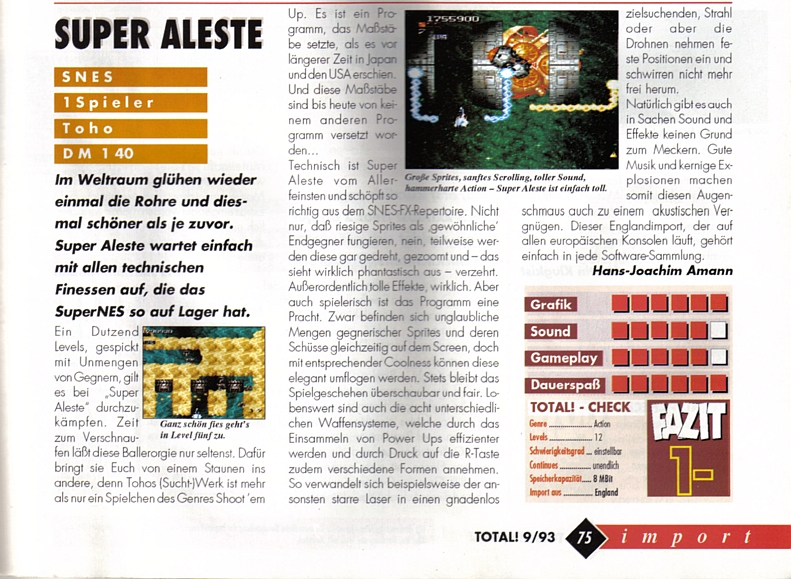
Space Megaforce, known in Japan and Europe as Super Aleste (スーパーアレスタ, Sūpā Aresuta), is a vertically scrolling shooter developed by Compile. It was published by Toho in 1992 for the Super Nintendo Entertainment System as part of the Aleste series. The player pilots a spacecraft through a variety of locales shooting enemy ships. The story in the Japanese version is different from the American and European one. Super Aleste also offers a "Short Game", with segments of the regular levels; the emphasis is on scoring as many points as possible.
Plot
The story differs slightly depending on which version is played, though the opening premise is always the same.
In the year 2048, a large mechanical sphere falls from space and starts attacking major cities around the world. After much destruction, the sphere hovers over the jungles of South America, drawing lines into the ground similar to the Nazca Line drawings as it expands itself and draws energy from the jungle foliage. Equipped with its own defense system, The Sphere destroys all attacks made on it by Earth's military. The original Aleste fighter ship's failure to stop the sphere's growth prompts the construction of a space fighter capable of wielding amazing weaponry, that fighter being the Super Aleste. Tasked with flying into and destroying the sphere, the Super Aleste must also destroy any reinforcements the sphere calls for which come from the deepest depths of space.
In the original Japanese story, the Super Aleste is piloted by an ace named Raz and his co-pilot is a mysterious young alien woman named Thi, a prisoner aboard the sphere who harnesses strange powers freed by the constant attacks against the sphere. Thi's role in the game is to fly with Raz into the sphere, weaken its defenses and properly wrest the sphere's power source. The presence of both characters, and thus the game's original ending, were cut from Space Megaforce and the European version of Super Aleste.
Gameplay
There are eight types of weapons to use, and each can be powered up by collecting chips (small egg-shaped items). Picking up chips causes the player's current weapon to level-up, to a maximum of six. There are two types of chips to find; Orange chips contribute to a level-up, but at higher levels, more chips are required to reach the next level. Green chips make the weapon level up instantly. Each weapon has a function that can be manipulated with the Shot-Control button, changing around the weapon's abilities to suit different situations. Switching to another weapon is done by picking up a numbered item, with initials representing one of the eight weapons.
The player's health is tied to the level of their weapon. When the ship is hit, the weapon loses four levels of power (but it cannot go below 0). If the weapon is already at level 0 upon getting hit, the player dies. This means the weapon must be at level 5 or 6 for the ship to survive two hits. Also, there are two types of extra lives; normally, if the player dies, they try the level again at the last checkpoint. However, it is possible to convert lives into Special Lives with a certain power-up; these allow the player to come back at the exact place they were killed, losing no progress. If the player has enough lives that a number is used to display them, then the icon becomes red if they have at least one Special Life left.
The player's ship cannot be directly harmed by on-screen background structures, but will be crushed if caught between an edge of the screen and an object scrolling towards that edge.
Version differences
The Japanese version[1] has more content than the European and American versions:
- It has super deformed art on the options and game over screen.
- The ending is twice as long and reveals the mystery behind the enemy invasion. More information is revealed upon beating the game on the harder, very hard, and then the hardest difficulty levels.
- The names of the levels and their bosses are different.
- Some voice samples are different.
- Certain Super Aleste music tracks that may have infringed on songs by band New Order were removed from US/EU Space Megaforce. Tracks for the bonus stages (levels 3, 6, 9 and 10) were swapped around, and one track was entirely removed (this track sounds close to several New Order's hit songs, such as 'The Perfect Kiss' or 'Fine Time').
Reception
| Reception | ||||||||||||||||||||||||||||
|---|---|---|---|---|---|---|---|---|---|---|---|---|---|---|---|---|---|---|---|---|---|---|---|---|---|---|---|---|
| ||||||||||||||||||||||||||||
According to Famitsu, Space Megaforce sold 2,463 copies in its first week on the market and 6,618 copies during its lifetime in Japan.[15] The Japanese publication Micom BASIC Magazine ranked the game fourteenth in popularity in its July 1992 issue, and it received a 21.45/30 score in a 1993 readers' poll conducted by Super Famicom Magazine, ranking among Super Famicom titles at the number 106 spot.[16][17] It also received generally favorable reviews from critics.[18][19][20][21][22]
In 1997, Electronic Gaming Monthly ranked it the 46th best console video game of all time, citing its ingenuous power-ups and usage of the Super NES's mode 7 graphical features to present differing level styles.[23]
Legacy
A manga based on the game and written by Kubo Muneo, was published by 'Monthly ASCII Comic' and released on February 22, 1993 in Japan.[24]
See also
- Naoyuki Kato, Super Aleste illustrator[25]
References
- ↑ Intro, ending and music of the Japanese version at The Cutting Room Floor
- ↑ O'Connor, Frank; Boone, Tim (July 1992). "Review: Super Aleste". Computer and Video Games (EMAP) (128): 32–33. https://archive.org/details/computer-and-video-games-magazine/Computer%20and%20Video%20Games%20128/page/n31/mode/2up.
- ↑ "NEW GAMES CROSS REVIEW: スーパーアレスタ" (in ja). Famitsu (ASCII Corporation) (177–178): 38. May 8–15, 1992. https://archive.org/details/famitsu-0177-178/page/38/mode/1up. (Transcription by Famitsu.com. ).
- ↑ "Classic GI". Game Informer (Sunrise Publications) (63): 68. July 1998. https://archive.org/details/game-informer-issue-63-july-1998/page/n69/mode/1up.
- ↑ Rockstar78 (January 11, 2010). "Test de Super Aleste sur SNES par jeuxvideo.com" (in fr). Jeuxvideo.com. Webedia. http://www.jeuxvideo.com/articles/0001/00012060-super-aleste-test.htm.
- ↑ "Nintendo Magazine System Super NES Index". Nintendo Magazine System (EMAP) (9): 100–109. June 1993. https://archive.org/details/nintendo-magazine-system-9/page/106/mode/1up.
- ↑ Bielby, Matt (January 1993). "UK Review: Super Aleste". Super Play (Future Publishing) (3): 42–44.
- ↑ Dyer, Andy (December 1992). "SNES Reviews: Super Aleste". Total! (Future Publishing) (12): 64–65. https://archive.org/details/total-12/page/n63/mode/2up.
- ↑ Amann, Hans-Joachim (September 1993). "Import Corner: Super Aleste" (in de). Total! (MVL-Verlag) (4): 75. https://total.seppatoni.ch/wp-content/uploads/2021/12/snes_superaleste.jpg. Retrieved 2025-05-16.
- ↑ Simmons, Alex; Walkland, Nick (February 1993). "Review Control: Space Megaforce". Control (Maverick Magazines) (6): 26–29. https://archive.org/details/control-6/page/n25/mode/2up.
- ↑ Alessi, Martin (December 1992). "Video Game Gallery: Space Megaforce". Electronic Games (Decker Publications) 1 (3): 82. https://archive.org/details/Electronic-Games-1992-12/page/n81/mode/1up.
- ↑ "Guide Directory Enquiries". SNES Force (Impact Magazines) (1): 92–97. July 1993. https://archive.org/details/snes-nforce-magazine-01/page/n95/mode/1up.
- ↑ "Crusty Library". Super Action (Europress) (5): 104–113. February 1993. https://archive.org/details/super-action-05/page/n106/mode/1up.
- ↑ "Feature: Shooting Stars". Super Pro (Paragon Publishing) (5): 40–47. April 1993. https://archive.org/details/super-pro-05/page/n44/mode/1up.
- ↑ "Game Search". https://sites.google.com/site/gamedatalibrary/game-search.
- ↑ Tezuka, Ichirō (July 1992). "Super Soft Hot Information - Super Famicom: 今月の人気ソフト・ランキング" (in ja). Micom BASIC Magazine (ja) (The Dempa Shimbunsha Corporation (ja)) (121): 236–237. https://archive.org/details/micomBASIC_1992-07/page/n260/mode/1up.
- ↑ Super Famicom Magazine (August 1, 1993). "ゲーム通信簿" (in ja). 90年11月から'93年6月21日発売までの323本を収録!! スーパーファミコンオールカタログ'93 (special supplement). Tokuma Shoten. p. 51.
- ↑ Harris, Steve; Semrad, Ed; Alessi, Martin; Williams, Ken (September 1992). "Review Crew: Space Megaforce". Electronic Gaming Monthly (Sendai Publishing) (38): 20. https://archive.org/details/Electronic_Gaming_Monthly_038/page/n19/mode/1up.
- ↑ "Console Countdown: Super NES". Game Zone (Dennis Publishing) (12): 104–105. October 1992. https://archive.org/details/game-zone-12/page/104/mode/1up.
- ↑ Sinfield, George; Noel, Rob; Jade (November 1992). "Super Shooters: Space Megaforce; Now Playing: Space Megaforce". Nintendo Power (Nintendo of America) 42: 84–87, 107.
- ↑ Halverson, Dave; Off, Greg; Bud D. (December 1992). "Viewpoint: Space Megaforce; Planet SNES - Super NES Review: Space Megaforce". GameFan (DieHard Gamers Club) 1 (2): 8, 36.
- ↑ Neotype (2007). "Review Archive: Super Aleste (Compile - SNES)". SHMUPS!. GameSpy. http://shmups.classicgaming.gamespy.com/reviews/superaleste/.
- ↑ "100 Best Games of All Time". Electronic Gaming Monthly (Ziff Davis) (100): 100–160. November 1997. https://archive.org/details/electronic-gaming-monthly-issue-100-november-1997_202106/page/n136/mode/1up.
- ↑ "Baka-Updates Manga - Super Aleste". https://www.mangaupdates.com/series.html?id=96156.
- ↑ Super Aleste (Japanese back cover) at MobyGames
External links
- MobyGames is a commercial database website that catalogs information on video games and the people and companies behind them via crowdsourcing. This includes over 300,000 games for hundreds of platforms.[1] Founded in 1999, ownership of the site has changed hands several times. It has been owned by Atari SA since 2022.
Features
Edits and submissions to the site (including screenshots, box art, developer information, game summaries, and more) go through a verification process of fact-checking by volunteer "approvers".[2] This approval process after submission can range from minutes to days or months.[3] The most commonly used sources are the video game's website, packaging, and credit screens. There is a published standard for game information and copy-editing.[4] A ranking system allows users to earn points for contributing accurate information.[5]
Registered users can rate and review games. Users can create private or public "have" and "want" lists, which can generate a list of games available for trade with other registered users. The site contains an integrated forum. Each listed game can have its own sub-forum.
History

MobyGames was founded on March 1, 1999, by Jim Leonard and Brian Hirt, and joined by David Berk 18 months later, the three of which had been friends since high school.[6][7] Leonard had the idea of sharing information about computer games with a larger audience. The database began with information about games for IBM PC compatibles, relying on the founders' personal collections. Eventually, the site was opened up to allow general users to contribute information.[5] In a 2003 interview, Berk emphasized MobyGames' dedication to taking video games more seriously than broader society and to preserving games for their important cultural influence.[5]
In mid-2010, MobyGames was purchased by GameFly for an undisclosed amount.[8] This was announced to the community post factum , and the site's interface was given an unpopular redesign.[7] A few major contributors left, refusing to do volunteer work for a commercial website.{{Citation needed|date=June 2025} On December 18, 2013, MobyGames was acquired by Jeremiah Freyholtz, owner of Blue Flame Labs (a San Francisco-based game and web development company) and VGBoxArt (a site for fan-made video game box art).[9] Blue Flame Labs reverted MobyGames' interface to its pre-overhaul look and feel,[10] and for the next eight years, the site was run by Freyholtz and Independent Games Festival organizer Simon Carless.[7]
On November 24, 2021, Atari SA announced a potential deal with Blue Flame Labs to purchase MobyGames for $1.5 million.[11] The purchase was completed on 8 March 2022, with Freyholtz remaining as general manager.[12][13][14] Over the next year, the financial boost given by Atari led to a rework of the site being built from scratch with a new backend codebase, as well as updates improving the mobile and desktop user interface.[1] This was accomplished by investing in full-time development of the site instead of its previously part-time development.[15]
In 2024, MobyGames began offering a paid "Pro" membership option for the site to generate additional revenue.[16] Previously, the site had generated income exclusively through banner ads and (from March 2014 onward) a small number of patrons via the Patreon website.[17]
On February 13, 2025, Freyholtz stepped down as the site lead to move onto new projects, leaving operations to Tracy Poff, a veteran coder on the site, and Atari staff.[18]
See also
- IGDB – game database used by Twitch for its search and discovery functions
References
- ↑ 1.0 1.1 Sheehan, Gavin (2023-02-22). "Atari Relaunches The Fully Rebuilt & Optimized MobyGames Website". https://bleedingcool.com/games/atari-relaunches-the-fully-rebuilt-optimized-mobygames-website/.
- ↑ Litchfield, Ted (2021-11-26). "Zombie company Atari to devour MobyGames". https://www.pcgamer.com/zombie-company-atari-to-devour-mobygames/.
- ↑ "MobyGames FAQ: Emails Answered § When will my submission be approved?". Blue Flame Labs. 30 March 2014. http://www.mobygames.com/info/faq7#g1.
- ↑ "The MobyGames Standards and Practices". Blue Flame Labs. 6 January 2016. http://www.mobygames.com/info/standards.
- ↑ 5.0 5.1 5.2 Miller, Stanley A. (2003-04-22). "People's choice awards honor favorite Web sites". Milwaukee Journal Sentinel.
- ↑ "20 Years of MobyGames" (in en). 2019-02-28. https://trixter.oldskool.org/2019/02/28/20-years-of-mobygames/.
- ↑ 7.0 7.1 7.2 Plunkett, Luke (2022-03-10). "Atari Buys MobyGames For $1.5 Million". https://kotaku.com/mobygames-retro-credits-database-imdb-atari-freyholtz-b-1848638521.
- ↑ "Report: MobyGames Acquired By GameFly Media". Gamasutra. 2011-02-07. https://www.gamedeveloper.com/game-platforms/report-mobygames-acquired-by-gamefly-media.
- ↑ Corriea, Alexa Ray (December 31, 2013). "MobyGames purchased from GameFly, improvements planned". http://www.polygon.com/2013/12/31/5261414/mobygames-purchased-from-gamefly-improvements-planned.
- ↑ Wawro, Alex (31 December 2013). "Game dev database MobyGames getting some TLC under new owner". Gamasutra. https://www.gamedeveloper.com/business/game-dev-database-mobygames-getting-some-tlc-under-new-owner.
- ↑ "Atari invests in Anstream, may buy MobyGames". November 24, 2021. https://www.gamesindustry.biz/articles/2021-11-24-atari-invests-in-anstream-may-buy-mobygames.
- ↑ Rousseau, Jeffrey (2022-03-09). "Atari purchases Moby Games". https://www.gamesindustry.biz/atari-purchases-moby-games.
- ↑ "Atari Completes MobyGames Acquisition, Details Plans for the Site's Continued Support". March 8, 2022. https://www.atari.com/atari-completes-mobygames-acquisition-details-plans-for-the-sites-continued-support/.
- ↑ "Atari has acquired game database MobyGames for $1.5 million" (in en-GB). 2022-03-09. https://www.videogameschronicle.com/news/atari-has-acquired-game-database-mobygames-for-1-5-million/.
- ↑ Stanton, Rich (2022-03-10). "Atari buys videogame database MobyGames for $1.5 million". https://www.pcgamer.com/atari-buys-videogame-database-mobygames-for-dollar15-million/.
- ↑ Harris, John (2024-03-09). "MobyGames Offering “Pro” Membership". https://setsideb.com/mobygames-offering-pro-membership/.
- ↑ "MobyGames on Patreon". http://www.patreon.com/mobygames.
- ↑ "An update on MobyGames leadership". 2025-02-13. https://www.mobygames.com/forum/3/thread/269628/an-update-on-mobygames-leadership/#post-269628.
 |
Wikidata has the property:
|

External links
- No URL found. Please specify a URL here or add one to Wikidata.

 |  |
- Space Megaforce/Super Aleste at Giant Bomb
| |