Astronomy:NGC 4698
| NGC 4698 | |
|---|---|
 NGC 4698 imaged by the Hubble Space Telescope | |
| Observation data (J2000 epoch) | |
| Constellation | Virgo |
| Right ascension | 12h 48m 22.9151s[1] |
| Declination | +08° 29′ 14.514″[1] |
| Redshift | 0.003366±0.00000200[1] |
| Helio radial velocity | 1,002[2] km/s |
| Distance | 73.22 ± 4.17 Mly (22.448 ± 1.279 Mpc)[3] |
| Group or cluster | Virgo Cluster |
| Apparent magnitude (V) | 10.6[4] |
| Apparent magnitude (B) | 11.46[5] |
| Characteristics | |
| Type | SA(s)ab[6] |
| Apparent size (V) | 4′.0 × 2′.9[4] |
| Notable features | Seyfert-2 galaxy[7] |
| Other designations | |
| VCC 2070, IRAS 12458+0845, UGC 7970, MCG+02-33-024, PGC 43254[1] | |
NGC 4698 is a barred spiral galaxy[5] in the constellation Virgo. It belongs to the Virgo Cluster of galaxies and is positioned near the northeastern edge of this assemblage.[4] Its velocity with respect to the cosmic microwave background is 1,335±23 km/s, which corresponds to a Hubble distance of 64.2 ± 4.6 Mly (19.69 ± 1.42 Mpc).[1] However, 28 non-redshift measurements give a farther mean distance of 73.22 ± 4.17 Mly (22.448 ± 1.279 Mpc).[3] It was discovered by German-British astronomer William Herschel on 18 January 1784.[8]
The morphological classification of NGC 4698 in the De Vaucouleurs system is SA(s)ab,[6] which indicates a purely spiral structure with moderate to tightly wound arms.[9] It is inclined to the line of sight from the Earth by an angle of 53° along a position angle of 170°.[10]
A unique feature of this galaxy is that the stars and dust of the nuclear disk are rotating in a direction that is aligned perpendicularly to the galactic disk. The bulge likewise appears elongated out of the galactic plane. This unusual alignment may have been the result of a past merger event.[5]
NGC 4698 is classified as a Seyfert-2 galaxy with an active galactic nucleus, which displays a prominent emission of radio and X-ray energy from the core while showing narrow emission lines in the optical spectrum.[7] The unified model of Seyfert galaxies proposes that the nucleus of a Seyfert 2 galaxy is obscured by a thick torus of gas and dust. However, the varying X-ray emission of the core of NGC 4698 shows little indication of being obstructed, suggesting instead that the source of the energy emission is generally unobscured but anemic in nature.[11]
Gallery
-
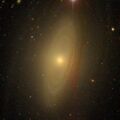 NGC 4698 (SDSS DR14)
-
 NGC 4698 (HST)
-
 NGC 4698 by a Schulman telescope at Mt. Lemmon, AZ.
-
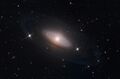 NGC 4698 imaged with the 32-inch Schulman Telescope at Mount Lemmon Observatory


References
- ↑ 1.0 1.1 1.2 1.3 1.4 "Results for object NGC 4698". NASA and Caltech. https://ned.ipac.caltech.edu/byname?objname=NGC+4698.
- ↑ Crook, Aidan C. et al. (February 2007), "Groups of Galaxies in the Two Micron All Sky Redshift Survey", The Astrophysical Journal 655 (2): 790–813, doi:10.1086/510201, Bibcode: 2007ApJ...655..790C.
- ↑ 3.0 3.1 "Distance Results for NGC 4698". NASA. https://ned.ipac.caltech.edu/cgi-bin/nDistance?name=NGC+4698.
- ↑ 4.0 4.1 4.2 Finlay, W. H. (2003), Concise Catalog of Deep-sky Objects: Astrophysical Information for 500 Galaxies, Clusters and Nebulae, Springer, p. 175, ISBN 978-1852336912, https://books.google.com/books?id=t35J1QRSFAEC&pg=PT180.
- ↑ 5.0 5.1 5.2 Corsini, E. M. et al. (June 2012), "Polar bulges and polar nuclear discs: the case of NGC 4698", Monthly Notices of the Royal Astronomical Society: Letters 423 (1): L79–L83, doi:10.1111/j.1745-3933.2012.01261.x, Bibcode: 2012MNRAS.423L..79C.
- ↑ 6.0 6.1 de Looze, Ilse et al. (October 2011), "The reliability of [C II] as an indicator of the star formation rate", Monthly Notices of the Royal Astronomical Society 416 (4): 2712–2724, doi:10.1111/j.1365-2966.2011.19223.x, Bibcode: 2011MNRAS.416.2712D.
- ↑ 7.0 7.1 Georgantopoulos, I. et al. (September 2003), "Chandra Observations of NGC 4698: A Seyfert 2 Galaxy with No Absorption", The Astrophysical Journal 594 (2): 704–708, doi:10.1086/377120, Bibcode: 2003ApJ...594..704G.
- ↑ Seligman, Courtney. "New General Catalogue Objects: NGC 4698". https://cseligman.com/text/atlas/ngc46a.htm#4698.
- ↑ Buta, Ronald J. et al. (2007), Atlas of Galaxies, Cambridge University Press, pp. 13–17, ISBN 978-0521820486, https://books.google.com/books?id=g-P7dCbB5MEC&pg=PA16.
- ↑ Giovanardi, C. et al. (March 1996), "Near-Infrared Low-Resolution Mapping of Early-Type Spirals", Astronomical Journal 111 (2): 1086–1097, doi:10.1086/117854, Bibcode: 1996AJ....111.1086G.
- ↑ Tran, Hien D. et al. (January 2011), "Indecent Exposure in Seyfert 2 Galaxies: A Close Look", The Astrophysical Journal Letters 726 (2): L21, doi:10.1088/2041-8205/726/2/L21, Bibcode: 2011ApJ...726L..21T.
External links
Coordinates:  12h 48m 22.9151s, +08° 29′ 14.514″


 |  |


