Biology:Agathis dammara
| Agathis dammara | |
|---|---|

| |
Scientific classification 
| |
| Kingdom: | Plantae |
| Clade: | Tracheophytes |
| Clade: | Gymnospermae |
| Division: | Pinophyta |
| Class: | Pinopsida |
| Order: | Araucariales |
| Family: | Araucariaceae |
| Genus: | Agathis |
| Species: | A. dammara
|
| Binomial name | |
| Agathis dammara (Lamb.) Poir.[2]
| |
| Synonyms[2] | |
| |
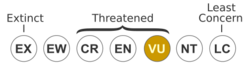
Agathis dammara, commonly known as the Amboina pine or dammar pine,[3] is a coniferous timber[4] tree native to Sulawesi, the Maluku Islands and the Philippines.[1]
Description
_West-Preanger_TMnr_60051135.jpg)
Agathis dammara is a medium-large conifer up to 60 m (200 ft) tall and 1.8 m (5 ft 11 in) dmh[clarification needed][5][6] found in lowland to upland tropical rainforests as well as lowland to lower montane rainforests.[7] It belongs to the family Araucariaceae,[8] widespread throughout the Jurassic, Cretaceous and Paleogene periods[9] and emerging in the Early Jurassic (around 201 Ma),[10] but now confined to the southern hemisphere.[11] Mature specimens are described as long clear boles with an emergent crown of first-order branches. The bark has been described to be of various gray tones and covered with resin blisters. The leaves have been described to be thick and highly variable in color in every tree.[5][6] This tree is a source of dammar gum, also known as cat-eye resin, and is also used as timber.[7]
Taxonomy
Agathis celebica and Agathis philippinensis were previously considered distinct species but since 2010 have been synonymous with Agathis dammara.[1]
References
- ↑ 1.0 1.1 1.2 Farjon, A. (2013). "Agathis dammara". IUCN Red List of Threatened Species 2013. doi:10.2305/IUCN.UK.2013-1.RLTS.T202906A2757847.en. https://www.iucnredlist.org/species/202906/2757847.
- ↑ 2.0 2.1 "Agathis dammara" (in en). Royal Botanic Gardens, Kew. http://www.plantsoftheworldonline.org/taxon/261669-1.
- ↑ {{citation | mode = cs1 | title = Agathis dammara | work = Germplasm Resources Information Network (GRIN) | url = | publisher = [[Organization:Agricultural Research ServAgricultural Research Service (ARS), United States Department of Agriculture (USDA) | access-date = 22 April 2022 }}
- ↑ "Agathis wood". http://tropix.cirad.fr/asia/agathis.pdf.
- ↑ 5.0 5.1 Whitmore, T. C. (1980). "A monograph of Agathis" (in en). Plant Systematics and Evolution 135 (1–2): 41–69. doi:10.1007/BF00983006. ISSN 0378-2697. Bibcode: 1980PSyEv.135...41W.
- ↑ 6.0 6.1 Silba, John (1986). An international census of the Coniferae. Phytologia Memoir. 8. Corvallis, OR: H.N. Moldenke and A.L. Moldenke. https://archive.org/details/internationalcen01silb.
- ↑ 7.0 7.1 "Agathis dammara". https://threatenedconifers.rbge.org.uk/conifers/agathis-dammara.
- ↑ Kitamura, Keiko; Rahman, Mohamad Yusof Bin Abdul (1992-10-01). "Genetic diversity among natural populations of Agathis borneensis (Araucariaceae), a tropical rain forest conifer from Brunei Darussalam, Borneo, Southeast Asia" (in en). Canadian Journal of Botany 70 (10): 1945–1949. doi:10.1139/b92-242. ISSN 0008-4026. Bibcode: 1992CaJB...70.1945K. http://www.nrcresearchpress.com/doi/10.1139/b92-242.
- ↑ Poinar, George Jr.; Archibald, Bruce; Brown, Alex (April 1999). "New Amber Deposit Provides Evidence of Early Paleogene Extinctions, Paleoclimates, and Past Distributions" (in en). The Canadian Entomologist 131 (2): 171–177. doi:10.4039/Ent131171-2. ISSN 1918-3240. https://www.cambridge.org/core/journals/canadian-entomologist/article/abs/new-amber-deposit-provides-evidence-of-early-paleogene-extinctions-paleoclimates-and-past-distributions/0FFB6E470A02387FF6D2385EC4B1C930.
- ↑ Leslie, Andrew B.; Beaulieu, Jeremy; Holman, Garth; Campbell, Christopher S.; Mei, Wenbin; Raubeson, Linda R.; Mathews, Sarah (September 2018). "An overview of extant conifer evolution from the perspective of the fossil record" (in en). American Journal of Botany 105 (9): 1531–1544. doi:10.1002/ajb2.1143. ISSN 0002-9122. PMID 30157290. https://bsapubs.onlinelibrary.wiley.com/doi/10.1002/ajb2.1143.
- ↑ Kershaw, Peter; Wagstaff, Barbara (November 2001). "The Southern Conifer Family Araucariaceae: History, Status, and Value for Paleoenvironmental Reconstruction" (in en). Annual Review of Ecology and Systematics 32 (1): 397–414. doi:10.1146/annurev.ecolsys.32.081501.114059. ISSN 0066-4162. Bibcode: 2001AnRES..32..397K. https://www.annualreviews.org/doi/10.1146/annurev.ecolsys.32.081501.114059.
External links
- Agathis dammara at the Gymnosperm Database.
Wikidata ☰ Q607535 entry
 |  |


