Biology:Agathis
Agathis, commonly known as kauri or dammara, is a genus of evergreen coniferous trees, native to Australasia and Southeast Asia. It is one of three extant genera in the family Araucariaceae, alongside Wollemia and Araucaria (being more closely related to the former).[1][2] Its leaves are much broader than most conifers. Kauri gum was historically commercially harvested from living New Zealand kauri and from swamp ground.[not verified in body] They are mainly tropical conifers, however a few species are found in temperate climates.[3]
Description

Mature kauri trees have characteristically large trunks, with little or no branching below the crown. In contrast, young trees are normally conical in shape, forming a more rounded or irregularly shaped crown as they achieve maturity.[4]
The bark is smooth and light grey to grey-brown, usually peeling into irregular flakes that become thicker on more mature trees. The branch structure is often horizontal or, when larger, ascending. The lowest branches often leave annular branch scars when they detach from the lower trunk.
The juvenile leaves in all species are larger than the adult, more or less acute, varying among the species from ovate to lanceolate. Adult leaves are opposite, elliptical to linear, very leathery and quite thick. Young leaves are often a coppery-red, contrasting markedly with the usually green or glaucous-green foliage of the previous season.
The male pollen cones appear usually only on larger trees after seed cones have appeared. The female seed cones usually develop on short lateral branchlets, maturing after two years. They are normally oval or globe shaped. Agathis is monoecious.[3]
Seeds of some species are attacked by the caterpillars of Agathiphaga, some of the most primitive of all living moths.
Uses

Various species of kauri give diverse resins such as kauri gum. The timber is generally straight-grained and of fine quality with an exceptional strength-to-weight ratio and rot resistance, making it ideal for yacht hull construction. The wood is commonly used in the manufacture of guitars and ukuleles due to its low density and relatively low price of production. It is also used for some Go boards (goban). The uses of the New Zealand species (A. australis) included shipbuilding, house construction, wood panelling, furniture making, mine braces, and railway sleepers. Due to the hard resin of the wood, it was the traditionally preferred material used by Māori for wooden weapons, patu aruhe (fernroot beaters) and barkcloth beaters.[5]
Evolutionary history
Within Araucariaceae, it is thought that Agathis and Wollemia share a common ancestor which lived between 90 and 55 million years ago, and the two genera form a sister clade to the older Araucaria.[6] The oldest fossils currently confidently assignable to Agathis are those of Agathis immortalis from the Salamanca Formation of Patagonia, which dates to the Paleocene, approximately 64.67–63.49 million years ago. Agathis-like leaves are also known from the slightly older Lefipán Formation of the same region, which date to the very end of the Cretaceous.[7] Some authors have suggested that Agathis is known from earlier in the Cretaceous (Aptian to Cenomanian in North Africa.[8] Other fossils of the genus are known from the Eocene of Patagonia, the Late Paleocene-Miocene of southern Australia, and the Oligocene–Miocene of New Zealand.[9]
Species list
| Phylogeny of Agathis[10] | |||||||||||||||||||||||||||||||||||||||||||||||||||||||||||||||||||||||||||||||||||||||||||||
|
- Accepted species[1]
| Image | Scientific name | Common name | Distribution |
|---|---|---|---|
| 120px | Agathis atropurpurea | black kauri, blue kauri | Queensland, Australia |
| 120px | Agathis australis | New Zealand kauri | North Island, New Zealand |
| 120px | Agathis borneensis | Borneo kauri | western Malesia, Borneo |
| 120px | Agathis dammara | Sulawesi kauri | Philippines, Sulawesi, Maluku Islands |
| Agathis flavescens | Tahan Agathis | Peninsular Malaysia | |
| 120px | Agathis kinabaluensis | Kinabalu kauri | Borneo |
| Agathis labillardierei | New Guinea kauri | New Guinea | |
| 120px | Agathis lanceolata | Koghi kauri | New Caledonia |
| Agathis lenticula | Sabah kauri | Borneo | |
| 120px | Agathis macrophylla (syn. A. vitiensis) | Pacific kauri, dakua | Fiji, Vanuatu, Solomon Islands |
| 120px | Agathis microstachya | bull kauri | Queensland, Australia |
| Agathis montana | New Caledonia | ||
| 120px | Agathis moorei | white kauri | New Caledonia |
| Agathis orbicula | Sarawak kauri | Borneo | |
| 120px | Agathis ovata | Scrub kauri | New Caledonia |
| 120px | Agathis robusta | Queensland kauri | Queensland, Australia; Papua New Guinea |
| Agathis robusta subsp. robusta | Queensland and Papua New Guinea | ||
| Agathis robusta subsp. nesophila | New Guinea kauri | Papua New Guinea | |
| Agathis silbae | Vanuatu | ||
| Agathis zamunerae | Patagonia, South America Argentina |
- Formerly included[1]
Moved to Nageia
- Agathis motleyi - Nageia motleyi
- Agathis veitchii - Nageia nagi
The placement of the fossil species "Agathis" jurassica from the Late Jurassic of Australia in this genus is doubtful.[11]
Gallery
-
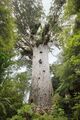 Tāne Mahuta, an Agathis australis in Waipoua Forest, the largest tree in New Zealand by volume
 -
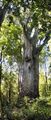 Te Matua Ngahere, an A. australis in Waipoua Forest, the oldest (and 2nd largest) tree in New Zealand
 -
 Trunk of the Yakas kauri (7th largest)
 -
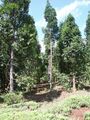 Agathis lanceolata
 -
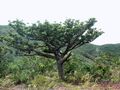 Agathis ovata
 -
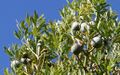 Agathis macrophylla
 -
 Agathis robusta
 -
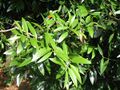 Agathis borneensis
 -
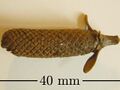 Agathis australis male pollen cone
 -
 Scale from Agathis australis female cone
 -
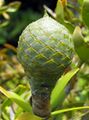 Agathis australis cone
 -
 Agathis australis leaves and cones


References
- ↑ 1.0 1.1 1.2 Cite error: Invalid
<ref>tag; no text was provided for refs namedPOWO - ↑ de Laubenfels, David J. 1988. Coniferales. P. 337–453 in Flora Malesiana, Series I, Volume 10. Dordrecht: Kluwer Academic.
- ↑ 3.0 3.1 "Agathis (kauri) description". https://www.conifers.org/ar/Agathis.php.
- ↑ Whitmore, T.C. 1977. A first look at Agathis. Tropical Forestry Papers No. 11. University of Oxford Commonwealth Forestry Institute.
- ↑ , Wikidata Q58677501
- ↑ Complete Chloroplast Genome of the Wollemi Pine (Wollemia nobilis): Structure and Evolution
- ↑ Escapa, Ignacio H.; Iglesias, Ari; Wilf, Peter; Catalano, Santiago A.; Caraballo-Ortiz, Marcos A.; Rubén Cúneo, N. (August 2018). "Agathis trees of Patagonia's Cretaceous-Paleogene death landscapes and their evolutionary significance" (in en). American Journal of Botany 105 (8): 1345–1368. doi:10.1002/ajb2.1127. ISSN 0002-9122. PMID 30074620. Bibcode: 2018AmJB..105.1345E.
- ↑ Ijouiher, Jamale (2022). "Flora of North Africa". The desert bones: the paleontology and paleoecology of Mid-Cretaceous North Africa. Life of the past. Bloomington: Indiana University Press. pp. 37–38. ISBN 978-0-253-06331-1.
- ↑ Wilf, Peter; Escapa, Ignacio H.; Cúneo, N. Rubén; Kooyman, Robert M.; Johnson, Kirk R.; Iglesias, Ari (January 2014). "First South American Agathis (Araucariaceae), Eocene of Patagonia" (in en). American Journal of Botany 101 (1): 156–179. doi:10.3732/ajb.1300327. ISSN 0002-9122. PMID 24418576. https://onlinelibrary.wiley.com/doi/10.3732/ajb.1300327.
- ↑
Stull, Gregory W.; Qu, Xiao-Jian; Parins-Fukuchi, Caroline; Yang, Ying-Ying; Yang, Jun-Bo; Yang, Zhi-Yun; Hu, Yi; Ma, Hong et al. (19 July 2021). "Gene duplications and genomic conflict underlie major pulses of phenotypic evolution in gymnosperms". Nature Plants 7 (8): 1015–1025. doi:10.1038/s41477-021-00964-4. PMID 34282286. https://www.biorxiv.org/content/10.1101/2021.03.13.435279v2.full.pdf.
- supplementary data:
- ↑ Hill, Robert S.; Brodribb, Tim J. (1999). "Southern conifers in time and space". Australian Journal of Botany 47 (5): 639–696. doi:10.1071/BT98093. Bibcode: 1999AuJB...47..639H. cited in Dettmann, Mary E.; Clifford, H. Trevor (2005). "Biogeography of Araucariaceae". in Dargavel, John. Araucarian Forests. Kingston, Australia: Australian Forest History Society. pp. 1–9. ISBN 978-0-9757906-1-8. https://foresthistory.org.au/AuNZForestHistSeries/anzfh2entire.pdf. Retrieved 2021-05-17.
External links
 |
Wikispecies has information related to Agathis |
- Systematics of Agathis (archived copy)
- Gymnosperm Database: Agathis
- Kauri forest in The Encyclopedia of New Zealand
- Threatened Conifers of the World
- https://www.researchgate.net/publication/309508851_A_reconstruction_of_the_palaeoecology_and_environmental_dynamics_of_the_Bahariya_Formation_of_Egypt
Template:Acrogymnospermae classification Wikidata ☰ Q216113 entry
 |  |


