Biology:Blue ringtail
| Blue ringtail | |
|---|---|

| |
| Male, Tasmania, Australia | |

| |
| Female, Tasmania, Australia | |
Scientific classification 
| |
| Kingdom: | Animalia |
| Phylum: | Arthropoda |
| Class: | Insecta |
| Order: | Odonata |
| Suborder: | Zygoptera |
| Family: | Lestidae |
| Genus: | Austrolestes |
| Species: | A. annulosus
|
| Binomial name | |
| Austrolestes annulosus (Selys, 1862)[2]
| |

| |
| Synonyms[3] | |
| |
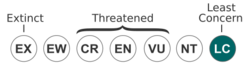
The blue ringtail (Austrolestes annulosus) is an Australian damselfly.[1] It is found on most of the continent.
Taxonomy
The blue ringtail was first described by Edmond de Sélys Longchamps in 1862.[4]
Description
The abdomen is 3 cm long.[5] It can easily be confused with Austrocoenagrion lyelli or Caliagrion billinghursti, but can be differentiated through dorsal patterns. They are a thin, medium-sized damselfly with varying coloration, which depends on maturity and temperature. However most are a striking blue with minimal black markings. Females are slightly more robust than males, and have a black and white/pale blue coloration.
Distribution and habitat
It is widely distributed in most of Australia, except for the northern and north-eastern parts.[4] It is active through September to April in still water bodies such as riverine pools, lakes and ponds, including temporary pools.
Etymology
The genus name Austrolestes combines the prefix austro- (from Latin auster, meaning “south wind”, hence “southern”) with Lestes, a genus name derived from Greek λῃστής (lēstēs, “robber”).[6]
The species name annulosus is derived from the Latin annulus ("ring") and the suffix -osus ("abounding in"), referring to the broad ring on the second abdominal segment.[7]
Gallery
-
 Male
Male -
 Mating pair
 -
 Female wings
 -
 Male wings


.jpg)
.jpg)
References
- ↑ 1.0 1.1 Dow, R.A. (2017). "Austrolestes annulosus". IUCN Red List of Threatened Species 2017. doi:10.2305/IUCN.UK.2017-1.RLTS.T87534133A87539919.en. https://www.iucnredlist.org/species/87534133/87539919. Retrieved 20 November 2021.
- ↑ Selys-Longchamps, E. (1862). "Synopsis des Agrionines, seconde légion: Lestes" (in French). Bulletin de la Classe des Science, Académie Royale de Belgique. 2 13: 288–338 [332]. https://www.biodiversitylibrary.org/page/36917029.
- ↑ "World Odonata List". University of Puget Sound. https://www.pugetsound.edu/academics/academic-resources/slater-museum/biodiversity-resources/dragonflies/world-odonata-list2/.
- ↑ 4.0 4.1 "Species Austrolestes annulosus (Selys, 1862)". Australian Biological Resources Study. 2022. https://biodiversity.org.au/afd/taxa/Austrolestes_annulosus.
- ↑ Daley, Elizabeth; Daley, Anthony (2007). Wings: an introduction to Tasmania's winged insects. Riffles Pty. Ltd. p. 7. ISBN 978-0-9804006-2-5. https://books.google.com/books?id=PQOaPwAACAAJ&q=elizabeth+daley.
- ↑ Endersby, Ian (2012). "Etymology of the Dragonflies (Insecta: Odonata) named by R.J. Tillyard, F.R.S.". Proceedings of the Linnean Society of New South Wales 134: 1-16. https://openjournals.library.sydney.edu.au/LIN/article/view/5941.
- ↑ Endersby, Ian; Fliedner, Heinrich (2015). The Naming of Australia's Dragonflies. Eltham, Victoria, Australia: Busybird Publishing. ISBN 9781925260625. https://www.researchgate.net/publication/283318421_The_Naming_of_Australia's_Dragonflies.
Wikidata ☰ {{{from}}} entry
 |  |


