Biology:Boat-tailed grackle
| Boat-tailed grackle | |
|---|---|
| File:Boat Tailed Grackle Male JG.jpg | |
| Breeding Male | |
| File:Boat Tailed Grackle Female JG.jpg | |
| Female | |
Scientific classification 
| |
| Kingdom: | Animalia |
| Phylum: | Chordata |
| Class: | Aves |
| Order: | Passeriformes |
| Family: | Icteridae |
| Genus: | Quiscalus |
| Species: | Q. major
|
| Binomial name | |
| Quiscalus major Vieillot, 1819
| |

| |
| Range of Q. major Year-round range Wintering range
| |

The boat-tailed grackle (Quiscalus major) is a passerine bird of the family Icteridae found as a permanent resident on the coasts of the Southeastern and Mid-Atlantic United States.
Habitat
The boat-tailed grackle is found in coastal saltwater marshes and across the Florida peninsula.[2] In salt marsh areas, least bitterns will often associate with and make mixed colonies with grackles.[3] Boat-tailed grackles have established significant populations in several United States Gulf Coast cities and towns, using human activity as protection against predation and scavenging through human trash. Urban boat-tailed grackle populations can be found foraging in trash bins, parking lots, and outdoor restaurant patios.[4]
Breeding
The nest is a well-concealed cup in trees and shrubs near water; the average clutch size is just over three eggs.[5]
Male boat-tailed grackles compete to defend and mate with a harem of closely nesting females, although DNA evidence shows that females often successfully mate with other males while away from their colony, with only about a quarter of the young being fathered by the dominant male.[4]
Description
The male boat-tailed grackle is 37–43 cm (15–17 in) long and weighs 165–250 g (5.8–8.8 oz).[6] Adult males have entirely iridescent black plumage, a long dark bill, a pale yellowish or brown iris, and a long keel-shaped tail. The adult female is much smaller at 26–33 cm (10–13 in) long and a weight of 90–115 g (3.2–4.1 oz).[7] She is also distinguished by her shorter tail and tawny-brown coloration, which covers the body apart from the darker wings and tail. The wingspan in adult birds is 39–50 cm (15–20 in).[8] In standard measurements, this species measures 13–20 cm (5.1–7.9 in) along the wing bone, 11–20 cm (4.3–7.9 in) in tail length, 2–4.2 cm (0.79–1.65 in) along the culmen, and 3.6–5.8 cm (1.4–2.3 in) along the tarsus.[9] On average, the boat-tailed grackle weighs about 10% more than the closely related great-tailed grackle, although the male great-tailed grackle has an even longer tail.[9][10]
Young males are black but lack the adult's iridescence. Immature females are duller versions of the adult female and have blotches or spots on the breast. The eye color of the boat-tailed grackle varies with range. Gulf Coast and inland birds have dark eyes, whereas Atlantic birds have pale eyes.[11]

Taxonomy
Diet
They forage on the ground, in shallow water, or in shrubs; they will steal food from other birds, animals, or humans. They are omnivorous opportunistic feeders, eating insects, crustaceans, minnows, frogs, eggs, berries, seeds, grain, and even small birds.[2]
Call
Its song is a harsh jeeb, and it has a variety of typically grackle-like chatters and squeaks. Their call lacks of whistles and clucks typical of the great-tailed grackle.[12]
Gallery
-
 Male vocalizing on Sanibel Island, Florida
-
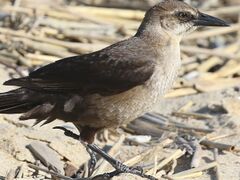 Female at Rodanthe Public Beach, North Carolina
-
Male at Deerfield Beach, Florida
-
A gathering of Grackles at Winding Waters Nature Area, Florida


References
- ↑ BirdLife International (2025). "Quiscalus major". IUCN Red List of Threatened Species 2025. doi:10.2305/IUCN.UK.2025-2.RLTS.T22724311A136662294.en. https://www.iucnredlist.org/species/22724311/136662294.
- ↑ 2.0 2.1 "Boat-tailed Grackle Life History, All About Birds, Cornell Lab of Ornithology" (in en). https://www.allaboutbirds.org/guide/Boat-tailed_Grackle/lifehistory.
- ↑ Post, William; Seals, Carol A. (1993). "Nesting Associations of Least Bitterns and Boat-Tailed Grackles". The Condor 95 (1): 139–144. doi:10.2307/1369395.
- ↑ 4.0 4.1 "Boat-tailed Grackle Overview, All About Birds, Cornell Lab of Ornithology" (in en). https://www.allaboutbirds.org/guide/Boat-tailed_Grackle/overview.
- ↑ Tutor, Billy M. (1962). "Nesting Studies of the Boat-tailed Grackle". The Auk 79 (1): 77–84. doi:10.2307/4082451.
- ↑ "FieldGuides: Species Detail". eNature. http://www.enature.com/fieldguides/detail.asp?recNum=BD0337.
- ↑ Bancroft, G.T. (1984). "Growth and sexual dimorphism of the Boat-tailed Grackle". Condor 86 (4): 423–432. doi:10.2307/1366822. http://sora.unm.edu/sites/default/files/journals/condor/v086n04/p0423-p0432.pdf.
- ↑ "Boat-tailed Grackle". All About Birds. Cornell Lab of Ornithology. http://www.allaboutbirds.org/guide/Boat-tailed_Grackle/id. "Boat-tailed Grackle, Life History, All About Birds – Cornell Lab of Ornithology". Allaboutbirds.org. http://www.allaboutbirds.org/guide/boat-tailed_grackle/lifehistory.
- ↑ 9.0 9.1 Jaramillo, Alvaro; Burke, Peter (1999). New World Blackbirds: The Icterids. Christopher Helm Publishing. ISBN 978-0-7136-4333-6.
- ↑ Dunning Jr., John B., ed (1992). CRC Handbook of Avian Body Masses. CRC Press. ISBN 978-0-8493-4258-5.
- ↑ "Grackles – Are you getting them right?". http://ebird.org/content/ebird/news/grackles.
- ↑ "Boat-tailed Grackle | Audubon Field Guide" (in en). https://www.audubon.org/field-guide/bird/boat-tailed-grackle.
External links
 |
Wikispecies has information related to Quiscalus major |
- Boat-tailed grackle at Florida Bird Sounds (Florida Museum of Natural History)
- BirdLife species factsheet for Quiscalus major
- "Quiscalus major". Avibase. https://avibase.bsc-eoc.org/species.jsp?lang=EN&avibaseid=.
- "Boat-tailed grackle media". Internet Bird Collection. http://www.hbw.com/ibc/species/boat-tailed-grackle-quiscalus-major.
- Boat-tailed grackle photo gallery at VIREO (Drexel University)
- Interactive range map of Quiscalus major at IUCN Red List
- Audio recordings of Boat-tailed grackle on Xeno-canto.
- Citizen science observations for Boat-tailed grackle at iNaturalist
Wikidata ☰ Q1589368 entry
 |  |


