Biology:Buff-breasted buttonquail
| Buff-breasted buttonquail | |
|---|---|

| |
| Turnix olivii | |
Scientific classification 
| |
| Kingdom: | Animalia |
| Phylum: | Chordata |
| Class: | Aves |
| Order: | Charadriiformes |
| Family: | Turnicidae |
| Genus: | Turnix |
| Species: | T. olivii
|
| Binomial name | |
| Turnix olivii Robinson, 1900
| |
The buff-breasted buttonquail (Turnix olivii) is the largest and possibly the rarest of the buttonquail. This species is endemic to Cape York Peninsula, in Queensland, Australia.
Description
The buff-breasted buttonquail measures from 18–23 cm (7.1–9.1 in) and usually weighs over 110 g (3.9 oz). Both the tail and wings are short. The back is chestnut. The sides of the head are marked with chestnut on an otherwise plain gray head; while the breast is warm buff-colored. The painted buttonquail and the brown quail both coexist with this species. The buff-breasted is larger (and longer-legged) than either and is quite different from the all-dark quail. The painted species is almost totally mottled, with bold white spotting on the breast and no warm buff coloration. The most similar species to the buff-breasted is the chestnut-backed buttonquail, which does not overlap in the wild. The advertising (or booming) call made by the female is , repeated up to 20 times. The notes are almost inaudible initially, then become gradually louder, higher-pitched and shorter until they are far-carrying. The males will respond with a deep, rapid chu-chu-chu erhaps in reaction to danger, include gug-gug-gug, a soft {{not a typo a loud kwaare-kwaare
Distribution and habitat
These birds favor lowland, subcoastal grasslands or woodlands. They may be found at any elevation to 400 m (1,300 ft). Reports describe this species as dependent on grassy woods made up of Melaleuca, Acacia, Alphitonia and Tristania. They have been seen in area of heavy scrub ground cover, up to 1 m (3.3 ft) high in some cases, but can also be seen in rocky areas where almost no scrub cover is present.
Important Bird Areas
Sites identified by BirdLife International as being important for buff-breasted buttonquail conservation are the Iron and McIlwraith Ranges, and the Morehead River of Far North Queensland.[2]
Conservation status
The buff-breasted buttonquail is an endangered species, with a population estimated at 500 individuals and an historical range of 2,070 km2 (800 sq mi). They have been extirpated from large portions of their original range, probably due in part due to cattle overgrazing, sites made unsuitable by fire regimes and general habitat clearances to make way for human habitation. A series of targeted surveys for this species from 2018-2022 failed to find any individuals despite locating four other species of buttonquail within the region, suggesting that some reports of buff-breasted buttonquail since the 1920s may be misidentifications of related taxa.[3]
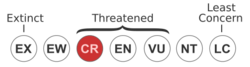
T. olivii has been listed as Critically Endangered by the IUCN Red List and the Australian EPBC Act.[2][4]
Behaviour
Diet
Breeding
References
- ↑ BirdLife International (2022). "Turnix olivii". IUCN Red List of Threatened Species 2022. doi:10.2305/IUCN.UK.2022-1.RLTS.T22680572A210960314.en. https://www.iucnredlist.org/species/22680572/210960314. Retrieved 23 July 2022.
- ↑ 2.0 2.1 "Buff-breasted Buttonquail". Important Bird Areas. BirdLife International. 2012. http://www.birdlife.org.
- ↑ Webster, Patrick T. D.; Leseberg, N. P.; Murphy, S. A.; Watson, J. E. M. (2024). "Four years of targeted surveys across northern Queensland failed to detect any evidence of Buff-breasted Button-quail Turnix olivii". Emu - Austral Ornithology. doi:10.1080/01584197.2024.2343680.
- ↑ "Turnix olivii — Buff-breasted Button-quail". Australian Department of Climate Change, Energy, the Environment and Water. 2024. https://www.environment.gov.au/cgi-bin/sprat/public/publicspecies.pl?taxon_id=59293.
- Madge, Steve; McGowan, Phil (2002). Pheasants, Partridges & Grouse. Princeton University Press. ISBN 978-0-691-08908-9.
External links
 |
Wikispecies has information related to Turnix olivii |
- BirdLife species factsheet for Turnix olivii
- "Turnix olivii". Avibase. https://avibase.bsc-eoc.org/species.jsp?lang=EN&avibaseid=1365719670879.
- "Buff-breasted buttonquail media". Internet Bird Collection. http://www.hbw.com/ibc/species/buff-breasted-buttonquail-turnix-olivii.
- Interactive range map of Turnix olivii at IUCN Red List
- Audio recordings of Buff-breasted buttonquail on Xeno-canto.
Wikidata ☰ Q1270828 entry
 |  |


