Biology:Geoxus annectens
From HandWiki
Short description: Species of rodent
| Geoxus annectens | |
|---|---|
Scientific classification 
| |
| Kingdom: | Animalia |
| Phylum: | Chordata |
| Class: | Mammalia |
| Order: | Rodentia |
| Family: | Cricetidae |
| Subfamily: | Sigmodontinae |
| Genus: | Geoxus |
| Species: | G. annectens
|
| Binomial name | |
| Geoxus annectens (Patterson, 1992)
| |
| Synonyms | |
|
Pearsonomys annectens | |
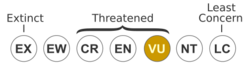
Geoxus annectens, also known as Pearson's long-clawed akodont[2] or Pearson's long-clawed mouse,[3] is a species of rodent in the tribe Abrotrichini of family Cricetidae. Molecular data suggests that its closest relative is Geoxus valdivianus.[4] Formerly classified in its own genus, Pearsonomys, named after American zoologist Oliver Payne Pearson,[5][6] it was moved to Geoxus in 2016 after a morphological and genetic reevaluation of the tribe Abrotrichini.[7] This rodent is endemic to Chile , where it is found in Nothofagus forest of the Valdivian temperate rainforest ecoregion.[1]
References
- ↑ 1.0 1.1 Patterson, B.; D'Elia, G. (2018). "Geoxus annectens". IUCN Red List of Threatened Species 2018: e.T40768A22345036. doi:10.2305/IUCN.UK.2018-2.RLTS.T40768A22345036.en. https://www.iucnredlist.org/species/40768/22345036. Retrieved 20 November 2021.
- ↑ Musser, G.G.; Carleton, M.D. (2005). "Superfamily Muroidea". in Wilson, D.E.; Reeder, D.M. Mammal Species of the World: A Taxonomic and Geographic Reference (3rd ed.). Johns Hopkins University Press. p. 1160. ISBN 978-0-8018-8221-0. OCLC 62265494. http://www.departments.bucknell.edu/biology/resources/msw3/browse.asp?id=13000848.
- ↑ Duff, A.; Lawson, A. (2004-07-11). Mammals of the World: A checklist. New Haven, Connecticut: Yale University Press. pp. 63. ISBN 978-0-7136-6021-0. OCLC 56204329. http://google.com/books?id=kMxjL_xRkC4C&dq&pg=PA63.
- ↑ Musser, G.G.; Carleton, M.D. (2005). "Genus Geoxus". in Wilson, D.E.; Reeder, D.M. Mammal Species of the World: A Taxonomic and Geographic Reference (3rd ed.). Johns Hopkins University Press. p. 1116. ISBN 978-0-8018-8221-0. OCLC 62265494. http://www.departments.bucknell.edu/biology/resources/msw3/browse.asp?id=13000655.
- ↑ Lidicker, W. Z.; Patton, J. L.. "In Memoriam: Oliver Payne Pearson". Online Biographies of UC Faculty and Administrators. University of California. http://www.universityofcalifornia.edu/senate/inmemoriam/oliverpaynepearson.html.
- ↑ Beolens, Bo; Watkins, Michael; Grayson, Michael (2009-09-28). The Eponym Dictionary of Mammals. The Johns Hopkins University Press. pp. 312–313. ISBN 978-0801893049. OCLC 270129903. http://google.com/books?id=I-kSmWLc6vYC&pg=PA312.
- ↑ Teta, P.; Cañón, C.; Patterson, B. D.; Pardiñas, U. F. J. (2016-04-28). "Phylogeny of the tribe Abrotrichini (Cricetidae, Sigmodontinae): integrating morphological and molecular evidence into a new classification". Cladistics 33 (2): 153–182. doi:10.1111/cla.12164.
Wikidata ☰ Q1766999 entry
 |  |


