Biology:Great knot
| Great knot | |
|---|---|
.jpg)
| |
| Breeding plumage, Primorsky Krai, Russia | |

| |
| Winter plumage, Thailand | |
Scientific classification 
| |
| Kingdom: | Animalia |
| Phylum: | Chordata |
| Class: | Aves |
| Order: | Charadriiformes |
| Family: | Scolopacidae |
| Genus: | Calidris |
| Species: | C. tenuirostris
|
| Binomial name | |
| Calidris tenuirostris (Horsfield, 1821)
| |
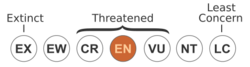
The great knot (Calidris tenuirostris) is a small wader. It is one of the largest species in the genus Calidris. It is a migratory bird which breeds in eastern Siberia, Russia, and flies to southern Asia and Australia in the northern winter.
Taxonomy
Within the genus Calidris the great knot is most closely related to the surfbird (Calidris virgata).[3]
The genus name is from Ancient Greek kalidris or skalidris, a term used by Aristotle for some grey-coloured waterside birds. The specific tenuirostris is from Latin tenuis "slender" and rostrum "bill".[4]
Distribution
Their breeding habitat is tundra in northeast Siberia, Russia. They nest on the ground laying about four eggs in a ground scrape. They are strongly migratory wintering on coasts in southern Asia through to Australia. This species forms enormous flocks in winter.
The species is also recorded in summer in low numbers in western Alaska, United States in most years, and in winter in small numbers west to Pakistan, Oman, and the United Arab Emirates.[5] It has occurred as a vagrant in Great Britain, Morocco,[5] New Zealand, British Columbia in Canada, and in the lower 48 states of the USA in Oregon, West Virginia, and Maine.
Taxonomy and description

Calidris tenuirostris, commonly known as the great knot, is one of the largest species of the genus Calidris, in the family Scolopacidae. The ruff C. pugnax, with its marked sexual dimorphism in size, can have larger males, but its females are much smaller. Its sister species, the surfbird C. virgata and red knot C. canutus, are the next largest. Adult great knots can measure 26 to 30 cm (10 to 12 in), with a wingspan of 56 to 66 cm (22 to 26 in), and weighing 115 to 261 g (4.1 to 9.2 oz).[6][7]Cite error: Closing </ref> missing for <ref> tag A study published in Biological Conservation in March 2023 listed 23 species which the authors considered to no longer meet the criteria as threatened species under the EPBC Act, including the great knot. The reason for the assessment was "Populations now stable or declining at a rate less than threshold".[8][9]
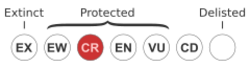
Under state and territory legislation, the species is as of August 2023[update] listed as vulnerable in New South Wales and the Northern Territory; endangered in South Australia; and critically endangered in Queensland, Victoria, and Western Australia.[2]
References
- ↑ BirdLife International (2019). "Calidris tenuirostris". IUCN Red List of Threatened Species 2019. doi:10.2305/IUCN.UK.2016-3.RLTS.T22693359A155482913.en. https://www.iucnredlist.org/species/22693359/155482913. Retrieved 5 September 2024.
- ↑ 2.0 2.1 Cite error: Invalid
<ref>tag; no text was provided for refs namedsprat - ↑ Černý, David; Natale, Rossy (2022). "Comprehensive taxon sampling and vetted fossils help clarify the time tree of shorebirds (Aves, Charadriiformes)". Molecular Phylogenetics and Evolution 177. doi:10.1016/j.ympev.2022.107620. https://www.biorxiv.org/content/biorxiv/early/2021/07/16/2021.07.15.452585.full.pdf.
- ↑ Jobling, James A (2010). The Helm Dictionary of Scientific Bird Names. London: Christopher Helm. pp. 84, 381. ISBN 978-1-4081-2501-4. https://archive.org/details/Helm_Dictionary_of_Scientific_Bird_Names_by_James_A._Jobling.
- ↑ 5.0 5.1 Lewington, Ian; Alström, Per; Colston, Peter (1991). A Field Guide to the Rare Birds of Britain and Europe. HarperCollins. pp. 115–116. ISBN 0-00-219917-3.
- ↑ Jeyarajasingam, A. (2012). A field guide to the birds of Peninsular Malaysia and Singapore. Oxford University Press.
- ↑ Van Gils, J., P. Wiersma, G. M. Kirwan, and C. J. Sharpe (2020). "Great Knot (Calidris tenuirostris), version 1.0". In Birds of the World (J. del Hoyo, A. Elliott, J. Sargatal, D. A. Christie, and E. de Juana, Editors). Cornell Lab of Ornithology, Ithaca, NY, USA.
- ↑ Woinarski, John C.Z.; Garnett, Stephen T. et al. (2023). "Lights at the end of the tunnel: The incidence and characteristics of recovery for Australian threatened animals". Biological Conservation (Elsevier BV) 279. doi:10.1016/j.biocon.2023.109946. ISSN 0006-3207. Bibcode: 2023BCons.27909946W.
- ↑ "Researchers find 26 Australian species recovered from the brink of extinction". 24 February 2023. https://www.abc.net.au/news/2023-02-24/australian-animals-no-longer-meet-criteria-as-threatened-species/102020276.
External links
 |
Wikispecies has information related to Calidris tenuirostris |
- Great knot – Photos on Oiseaux.net
Template:Scolopacidae Wikidata ☰ Q18876 entry
 |  |


