Biology:Hemiphlebia
Hemiphlebia, commonly known as the ancient greenling,[1] is a genus of damselfly, containing only one species Hemiphlebia mirabilis and is the only living genus in the family Hemiphlebiidae.[2][3] It is very small with a long, metallic-green body and clear wings. It is endemic to south-eastern Australia. Its natural swamp habitat is threatened by habitat loss. The oldest representatives of the family date to the Late Jurassic.
Distribution and habitat
The ancient greenling has been recorded from a small number of scattered sites, including on King Island and in Mount William, Tasmania; in Wilsons Promontory National Park and near Yea, Victoria; and in Piccaninnie Ponds Conservation Park in south-eastern South Australia. Its recorded habitat includes permanent freshwater ponds, riverine lagoons and swamps that may dry out seasonally.[4] A favoured site discovered in 2008, Long Swamp in the Discovery Bay Coastal Park of south-western Victoria, contains extensive areas of twig-rush (Baumea sp.) which is seasonally flooded but dries out by late summer[5][1]
Conservation
The greenling's conservation status was raised from Vulnerable to Endangered in 2008 because of the limited area of habitat occupied, as well as the small and scattered character of the populations, at least some of which were in decline. However, it is now considered by IUCN to be of Least Concern, in part because it occurs in at least one protected area. [4]
Etymology
The genus name Hemiphlebia is derived from the Greek ἡμι- (hēmi, "half") and φλέψ (phleps, "vein"), referring to the reduced venation of the forewing.[6]
The species name mirabilis is Latin for "wonderful", "extraordinary", or "unusual", likewise referring to this reduced wing venation.[6]
Gallery
-
 Female wings
 -
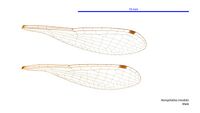 Male wings
.jpg)
.jpg)
References
- ↑ 1.0 1.1 Theischinger, Günther; Hawking, John (2006). The Complete Field Guide to Dragonflies of Australia. CSIRO Publishing. p. 22. ISBN 0-643-09073-8.
- ↑ Vasilenko, D. V. (2005). "New damselflies (Odonata: Synlestidae, Hemiphlebiidae) from the Mesozoic Transbaikalian locality of Chernovskie Kopi" (PDF). Paleontologicheskii Zhurnal 39 (3): 280. https://www.researchgate.net/publication/238798001.
- ↑ "Species Hemiphlebia mirabilis Selys, 1869". Australian Biological Resources Study. 2013. https://biodiversity.org.au/afd/taxa/Hemiphlebia_mirabilis.
- ↑ 4.0 4.1 Dow, R.A. (2019). "Hemiphlebia mirabilis". IUCN Red List of Threatened Species 2019. doi:10.2305/IUCN.UK.2019-2.RLTS.T9891A14278529.en. https://www.iucnredlist.org/species/9891/14278529. Retrieved 16 November 2021.
- ↑ Richter, Reiner (2010-06-18). "Discovery of New Populations of Hemiphlebia mirabilis (Ancient Greenling)". Author. http://photos.rnr.id.au/reports/Hemiphlebia_mirabilis_2010.pdf.
- ↑ 6.0 6.1 Endersby, Ian; Fliedner, Heinrich (2015). The Naming of Australia's Dragonflies. Eltham, Victoria, Australia: Busybird Publishing. ISBN 9781925260625. https://www.researchgate.net/publication/283318421_The_Naming_of_Australia's_Dragonflies.
Cite error: <ref> tag with name "Kennedy 1920" defined in <references> is not used in prior text.
Cite error: <ref> tag with name "Selys 1869b" defined in <references> is not used in prior text.
Cite error: <ref> tag with name "Selys 1869a" defined in <references> is not used in prior text.
 |
Wikimedia Commons has media related to Hemiphlebia. |
 |
Wikispecies has information related to Hemiphlebia |
Wikidata ☰ {{{from}}} entry
 |  |


