Biology:Hygrocybe subpapillata
| Hygrocybe subpapillata | |
|---|---|
Scientific classification 
| |
| Kingdom: | Fungi |
| Division: | Basidiomycota |
| Class: | Agaricomycetes |
| Order: | Agaricales |
| Family: | Hygrophoraceae |
| Genus: | Hygrocybe |
| Species: | H. subpapillata
|
| Binomial name | |
| Hygrocybe subpapillata Kühner (1979)
| |
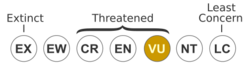
Hygrocybe subpapillata is a species of agaric (gilled mushroom) in the family Hygrophoraceae. It has been given the recommended English name of papillate waxcap.[2] The species has a European distribution and typically occurs in grassland where it produces basidiocarps (fruit bodies) in the autumn. Threats to its habitat have resulted in the species being assessed as globally "vulnerable" on the IUCN Red List of Threatened Species.[1]
Taxonomy
The species was first described from France in 1979 by the French mycologist Robert Kühner.
Recent molecular research, based on cladistic analysis of DNA sequences, suggests that Hygrocybe subpapillata belongs within the concept of Hygrocybe sensu stricto.[3]
Description
The basidiocarps are agaricoid, up to 5 cm (2 in) tall, the cap hemispherical becoming flat with age, up to 3 cm (1.5 in) across. The cap surface is smooth, greasy, scarlet to orange, often with a raised, central spot (papilla). The lamellae (gills) are waxy, pale yellow to orange, and broadly attached to the stipe. The stipe (stem) is smooth, cylindrical, dry, and cap-coloured or paler. The spore print is white, the spores (under a microscope) smooth, inamyloid, ellipsoid to oblong, about 7 to 9 by 4.5 to 5.5 μm.[4]
Similar species
Hygrocybe glutinipes is similar, but differs in having a viscid or glutinous stipe and viscid pileus lacking a papilla. Hygrocybe insipida typically has decurrent lamellae and a greasy stipe.[4]
Distribution and habitat
The papillate waxcap is widespread but rare throughout Europe, where it typically grows in old, unimproved, short-sward grassland (pastures and lawns). Recent research suggests waxcaps are neither mycorrhizal nor saprotrophic but may be associated with mosses.[5]
Conservation
Hygrocybe subpapillata is typical of waxcap grasslands, a declining habitat due to changing agricultural practices. As a result, the species is of global conservation concern and is listed as "vulnerable" on the IUCN Red List of Threatened Species.[1]
See also
References
- ↑ 1.0 1.1 1.2 Kautmanova I, Ainsworth AM, Mešić A, Jordal J. "Hygrocybe subpapillata. The IUCN Red List of Threatened Species". https://www.iucnredlist.org/species/148000217/148000393. Retrieved 2025-08-29.
- ↑ "Recommended English Names for Fungi in the UK". British Mycological Society. Archived from the original on 2011-07-16. https://web.archive.org/web/20110716083053/http://www.fungi4schools.org/Reprints/ENGLISH_NAMES.pdf. Retrieved 2012-01-25.
- ↑ Lodge, D. Jean; Padamsee, Mahajabeen; Matheny, P. Brandon; Aime, M. Catherine; Cantrell, Sharon A.; Boertmann, David; Kovalenko, Alexander; Vizzini, Alfredo et al. (2014-01-01). "Molecular phylogeny, morphology, pigment chemistry and ecology in Hygrophoraceae (Agaricales)" (in en). Fungal Diversity 64 (1): 1–99. doi:10.1007/s13225-013-0259-0. ISSN 1560-2745. https://iris.unito.it/bitstream/2318/136089/1/1205754_Molecular%20phylogeny.pdf.
- ↑ 4.0 4.1 Boertmann D. (2010). The genus Hygrocybe (2nd ed.). Copenhagen: Danish Mycological Society. pp. 200. ISBN 978-87-983581-7-6.
- ↑ "Conservation of biotrophy in Hygrophoraceae inferred from combined stable isotope and phylogenetic analyses". Mycologia 103 (2): 280–290. 2011. doi:10.3852/10-195. PMID 21139028.
Wikidata ☰ Q10546712 entry
 |  |


