Biology:Scarlet kingsnake
| Scarlet kingsnake | |
|---|---|
.jpg)
| |
| Adult Lampropeltis elapsoides in Florida | |
Scientific classification 
| |
| Kingdom: | Animalia |
| Phylum: | Chordata |
| Class: | Reptilia |
| Order: | Squamata |
| Suborder: | Serpentes |
| Family: | Colubridae |
| Genus: | Lampropeltis |
| Species: | L. elapsoides
|
| Binomial name | |
| Lampropeltis elapsoides (Holbrook, 1838)
| |

| |
| Synonyms | |
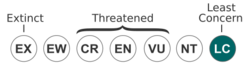
The scarlet kingsnake (Lampropeltis elapsoides) is a species of kingsnake found in the southeastern and eastern portions of the United States.[4] Like all kingsnakes, they are nonvenomous. They are found in pine flatwoods,[5] hydric hammocks, pine savannas, mesic pine-oak forests, prairies, cultivated fields, and a variety of suburban habitats; not unusually, people find scarlet kingsnakes in their swimming pools, especially during the spring. Until recently, and for much of the 20th century, scarlet kingsnakes were considered a subspecies of the milk snake; however, Pyron and Bubrink[6] demonstrated the phylogenetic distinction of this species and its closer relationship to the mountain kingsnakes of the southwestern United States. These largely fossorial snakes are the smallest of all the species within the genus Lampropeltis, usually ranging from 40 to 50 cm (16 to 20 in) at maturity. The maximum recorded length is in Jonesboro, AR 76.2 cm (30.0 in). Hatchlings range in size from 8 to 18 cm (3.1 to 7.1 in).[7]
Taxonomy


The generic name, Lampropeltis, is derived from the Ancient Greek lamprós (λαμπρος) meaning "shiny" and peltas (πελτας) meaning "shield", after the sheen of their scales.[8] Its specific name, elapsoides, is a Latinization of the Greek word éllops (ελλοπς)[9] which refers to coral and was used to describe the 19th century genus, Elaps (the type genus of the family Elapidae), which included the eastern coral snake (Micrurus fulvius), a venomous species which the scarlet kingsnake resembles and with which the scarlet kingsnake is partly sympatric.[10] The range of scarlet kingsnakes extends considerably further north and northeast than the eastern coral snake.[11][12]
The scarlet kingsnake was once believed to have intergraded with the eastern milk snake, which produced a variation once named as a subspecies called the Coastal Plains milk snake (L. t. temporalis), but this is no longer recognized as a legitimate taxon.[5][13]
Description
 | This section includes a list of references, related reading or external links, but its sources remain unclear because it lacks inline citations. (May 2016) (Learn how and when to remove this template message) |

Hatchling scarlet kingsnakes show a strong predisposition for ground skinks (Scincella lateralis), often to the exclusion of other prey items. One study showed that elongate squamates made up about 97% of these snakes diets, potentially due to their small mouths. Out of those elongate squamates, the aforementioned skinks made up 74%, while colubroid snakes made up only 15%. All prey items ingested in this study were consumed headfirst, and on average prey was 19% of predator mass. It has also been noted that the diet of Lampropeltis elapsoides is unusually narrow compared to adults of most other species.[14]
Reproduction
The scarlet kingsnake is polygynandrous, meaning both males and females will mate with multiple partners.[15] They mate from late May to early June and females lay eggs in June and July.[16] Females have multiple egg clutches that incubate for 40–65 days.[17]
Lampropeltis elapsoides is an oviparous species of snake that lays eggs in clutches of 4-12, usually under rotting wood and between rocks and logs. These eggs are white and slender, with most adhering to one another. Eggs typically hatch within 2-2.5 months, though times may vary.[18]
Diet
Scarlet Kingsnakes are specialized predators with 82% being lizards and 89% skinks. This diet is the narrowest of all the Lampropeltis genus. [19]
In other media
Film
Scarlet kingsnakes were used to simulate coral snakes in the 2006 film Snakes on a Plane.[20] A scarlet kingsnake also appears briefly as an unidentified venomous snake in an early scene of 2001 film The Mummy Returns.[21]
Television
In Season 5 of Peep Show Super Hans rents a scarlet kingsnake as a prop for a house party. Despite Hans' mnemonic stating "Red next to black, jump the fuck back, red next to yellow, cuddly fellow", kingsnakes are not venomous.
References
- ↑ Hammerson, G.A. (2019). "Lampropeltis elapsoides". IUCN Red List of Threatened Species 2019. doi:10.2305/IUCN.UK.2019-2.RLTS.T67662850A67662876.en. https://www.iucnredlist.org/species/67662850/67662876. Retrieved 6 June 2022.
- ↑ Stejneger, Leonhard; Barbour, Thomas. 1917. A Check List of North American Amphibians and Reptiles. Cambridge, Massachusetts: Harvard University Press. 125 pp. (Lampropeltis elapsoides, p. 88).
- ↑ The Reptile Database. www.reptile-database.org.
- ↑ Willson, J (2023-10-19). "Scarlet Kingsnake / Eastern Milksnake (Lampropeltis triangulum)". https://srelherp.uga.edu/snakes/lamtri.htm#:~:text=The%20scarlet%20king%20is%20found,Georgia%20and%20northwestern%20South%20Carolina..
- ↑ 5.0 5.1 Armstrong, Michael P.; Frymire, David; Zimmerer, Edmund J. (December 2001), "Analysis of sympatric populations of Lampropeltis triangulum syspila and Lampropeltis triangulum elapsoides, in western Kentucky and adjacent Tennessee with relation to the taxonomic status of the scarlet kingsnake", Journal of Herpetology (Society for the Study of Amphibians and Reptiles) 35 (4): 688–93, doi:10.2307/1565915, ISSN 0022-1511, http://vnweb.hwwilsonweb.com/hww/jumpstart.jhtml?recid=0bc05f7a67b1790e050a2140da939dde29bfd13582719af621eb734dba33044f9d443e023694dc49&fmt=P
- ↑ Pyron, R.A.; Burbrink, F.T. (2009), "Neogene diversification and taxonomic stability in the snake tribe Lampropeltini Serpentes: Colubridae", Molecular Phylogenetics and Evolution 52 (2): 524–529, doi:10.1016/j.ympev.2009.02.008, PMID 19236930, Bibcode: 2009MolPE..52..524P, http://163.238.8.180/~fburbrink/Research/Publications/selected_publications.htm
- ↑ " "Lakewood Ranch Snake Removal | Nuisance Wildlife Control and Removal Lakewood Ranch Snake Trapping | Lakewood Ranch Animal Control Trapping Removal Service | Attic Repair and Restoration in Lakewood Ranch | Wildlife Trapper". http://wildlifetrapper.com/eastern-coral-snake".
- ↑ Tennant, Alan (2006). Lone Star Field Guide to Texas Snakes. Taylor Trade Publishing. p. 193. ISBN 978-1-4616-3564-2. https://books.google.com/books?id=T23nAgAAQBAJ&pg=PA193. "the smooth dorsal scales have an enamel-like surface to which the genus' Latin name, Lampropeltis, or "shining skin shield," refers."
- ↑ "Virginia Herpetological Society" (in en). http://www.virginiaherpetologicalsociety.com/.
- ↑ "Scarlet Kingsnake". https://a-z-animals.com/animals/scarlet-kingsnake/.
- ↑ "Species Profile: Scarlet Kingsnake / Eastern Milksnake (Lampropeltis triangulatum) | SREL Herpetology". https://srelherp.uga.edu/snakes/lamtri.htm.
- ↑ "Species Profile: Eastern Coral Snake (Micrurus fulvius) | SREL Herpetology". https://srelherp.uga.edu/snakes/micful.htm.
- ↑ Williams, Kenneth L. (1988), Systematics and natural history of the American milk snake, Lampropeltis triangulum., Milwaukee, WI: Milwaukee Public Museum, http://md1.csa.com/partners/viewrecord.php?collection=ENV&recid=1964640
- ↑ Greene, Harry W.; Zimmerer, Edmund J.; Palmer, William M.; Benard, Michael F. (2010-03-01). "Diet Specialization by the Scarlet Kingsnake, Lampropeltis elapsoides (Colubridae)" (in en). Reptiles & Amphibians 17 (1): 18–22. doi:10.17161/randa.v17i1.16057. ISSN 2332-4961.
- ↑ Armstrong, Michael P.; Frymire, David; Zimmerer, Edmund J. (2001). "Analysis of Sympatric Populations of Lampropeltis triangulum syspila and Lampropeltis triangulum elapsoides, in Western Kentucky and Adjacent Tennessee with Relation to the Taxonomic Status of the Scarlet Kingsnake". Journal of Herpetology 35 (4): 688–693. doi:10.2307/1565915. ISSN 0022-1511.
- ↑ Row, Jeffrey R.; Blouin-Demers, Gabriel (2006). "Thermal Quality Influences Effectiveness of Thermoregulation, Habitat Use, and Behaviour in Milk Snakes". Oecologia 148 (1): 1–11. doi:10.1007/s00442-005-0350-7. ISSN 0029-8549. PMID 16425042. Bibcode: 2006Oecol.148....1R.
- ↑ Groves, J. D., & Sachs, P. S. (1973). Eggs and young of the scarlet king snake, Lampropeltis triangulum elapsoides. Journal of Herpetology, 7(4), 389. https://doi.org/10.2307/
- ↑ "Virginia Herpetological Society" (in en). http://www.virginiaherpetologicalsociety.com/.
- ↑ Greene, Harry; Zimmerer, Edmund; Palmer, William; Benard, Michael (2010). "Diet Specialization by the Scarlet Kingsnake, Lampropeltis elapsoides (Colubridae)". Reptiles and Amphibians 17 (1). https://doi.org/10.17161/randa.v17i1.16057.
- ↑ Case, Russ (2011-12-01). "Snakes On A Plane" (in en-US). https://reptilesmagazine.com/snakes-on-a-plane/.
- ↑ "The Mummy Returns (2001)". https://californiaherps.com/films/snakefilms/TheMummyReturns.html.
Further reading
- Conant, Roger. 1975. A Field Guide to Reptiles and Amphibians of Eastern and Central North America, Second Edition. Boston: Houghton Mifflin. xviii + 429 pp. ISBN 0-395-19979-4 (hardcover), ISBN 0-395-19977-8 (paperback). (Lampropeltis triangulum elapsoides, p. 209 + Plate 30 + Map 153.)
- Holbrook, John Edwards. 1936. North American Herpetology; or, A Description of the Reptiles Inhabiting the United States. Vol. II. Philadelphia: J. Dobson. 130 pp. + Plates I.- XXX. (Coluber elapsoides, pp. 123–125 + Plate XXVIII.)
- Schmidt, Karl P.; Davis, D. Dwight. 1941. Field Book of Snakes of the United States and Canada. New York: G.P. Putnam's Sons. 365 pp. (Lampropeltis elapsoides, p. 173 + Plate 6.)
- Smith, Hobart M.; Brodie, Edmund D., Jr. 1982. Reptiles of North America: A Guide to Field Identification. New York: Golden Press. 240 pp. ISBN 0-307-13666-3. (Lampropeltis triangulum elapsoides, pp. 180–181.)
- Wright, Albert Hazen; Wright, Anna Allen. 1957. Handbook of Snakes of the United States and Canada. Ithaca and London: Comstock. 1,105 pp. (in two volumes) (Lampropeltis doliata doliata, pp. 351–355, Figure 106 + Map 31 on p. 338.)
Wikidata ☰ Q1950584 entry
 |  |


