Biology:Lestoidea brevicauda
| Short-tipped bluestreak | |
|---|---|
Scientific classification 
| |
| Kingdom: | Animalia |
| Phylum: | Arthropoda |
| Class: | Insecta |
| Order: | Odonata |
| Suborder: | Zygoptera |
| Family: | Lestoideidae |
| Genus: | Lestoidea |
| Species: | L. brevicauda
|
| Binomial name | |
| Lestoidea brevicauda Theischinger, 1996[2]
| |

| |
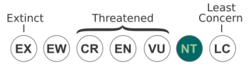
Lestoidea brevicauda, commonly known as the short-tipped bluestreak, is a species of Australian damselfly in the family Lestoideidae.[3][4]
It is endemic to north-east Queensland, where it inhabits rainforest streams.[5]
Lestoidea brevicauda is a medium-sized to large damselfly, dark brown to black in colour, with dull orange to greenish markings.[4]
Taxonomic history
In 1996, Günther Theischinger described Lestoidea brevicauda during a revision of the genus Lestoidea.[2]
Prior to this revision, specimens of Lestoidea brevicauda had generally been identified as Lestoidea conjuncta.[2]
Theischinger distinguished Lestoidea brevicauda from related species by differences in the shape of the male appendages and the structure of the female thorax behind the head.[2]
Description
Lestoidea brevicauda is a medium-sized to large damselfly, dark brown to black in colour, with dull orange to greenish markings.[4]
A pale spot is present at the base of each antenna.[4] Males have distinctive appendages at the tip of the abdomen, with the upper pair bent sharply downward and ending in a short rounded tip.[4][2]
Females can be identified by the broad rear margin of the section behind the head, with the sides strongly upturned.[4]
Distribution and habitat
Lestoidea brevicauda is endemic to north-east Queensland, where it inhabits rainforest streams.[5]
The species is associated mainly with lower-altitude rainforest streams in the northern part of the range of the genus.[2]
Etymology
The genus name Lestoidea is derived from Lestes and the Greek suffix -οειδής (oeidēs, "resembling" or "having the form of"), indicating resemblance to that genus.[6]
The species name brevicauda is derived from the Latin brevis ("short") and cauda ("tail"), referring to the short appendages at the tip of the male abdomen.[2][7]
Gallery
-
 Female wings
-
 Male wings


See also
- List of Odonata species of Australia
References
- ↑ Dow, R.A. (2017). "Lestoidea brevicauda". IUCN Red List of Threatened Species 2017. doi:10.2305/IUCN.UK.2017-1.RLTS.T87534518A87539964.en. https://www.iucnredlist.org/species/87534518/87539964. Retrieved 20 November 2021.
- ↑ 2.0 2.1 2.2 2.3 2.4 2.5 2.6 Theischinger, G. (1996). "The species of Lestoideinae Munz (Insecta: Odonata: Zygoptera: Lestoideidae)". Linzer Biologische Beiträge 28 (1): 315–324 [318]. http://www.zobodat.at/pdf/LBB_0028_1_0315-0324.pdf.
- ↑ "Species Lestoidea brevicauda Theischinger, 1996". Australian Biological Resources Study. 2012. https://biodiversity.org.au/afd/taxa/Lestoidea_brevicauda.
- ↑ 4.0 4.1 4.2 4.3 4.4 4.5 Theischinger, Günther; Hawking, John (2006). The Complete Field Guide to Dragonflies of Australia. Collingwood, Victoria, Australia: CSIRO Publishing. p. 40. ISBN 978-0-64309-073-6.
- ↑ 5.0 5.1 Theischinger, Gunther; Endersby, Ian (2009). Identification Guide to the Australian Odonata. Department of Environment, Climate Change and Water NSW. p. 223. ISBN 978-1-74232-475-3. http://www.environment.nsw.gov.au/resources/publications/09730AustOdonata.pdf.
- ↑ Endersby, Ian (2012). "Etymology of the Dragonflies (Insecta: Odonata) named by R.J. Tillyard, F.R.S.". Proceedings of the Linnean Society of New South Wales 134: 1-16. https://openjournals.library.sydney.edu.au/LIN/article/view/5941.
- ↑ Endersby, I. (2012). "Watson and Theischinger: the etymology of the dragonfly (Insecta: Odonata) names which they published". Journal and Proceedings of the Royal Society of New South Wales 145 (443 & 444): 34–53 [38]. doi:10.5962/p.146542. ISSN 0035-9173. https://www.biodiversitylibrary.org/page/46371079.
 |
Wikimedia Commons has media related to Lestoidea brevicauda. |
 |
Wikispecies has information related to Lestoidea brevicauda |
Wikidata ☰ Q2497367 entry
 |  |


