Biology:Little spotted kiwi
| Little spotted kiwi | |
|---|---|

| |
| Foraging at Zealandia EcoSanctuary, Wellington | |
Scientific classification 
| |
| Kingdom: | Animalia |
| Phylum: | Chordata |
| Class: | Aves |
| Infraclass: | Palaeognathae |
| Order: | Apterygiformes |
| Family: | Apterygidae |
| Genus: | Apteryx |
| Species: | A. owenii
|
| Binomial name | |
| Apteryx owenii | |
| Subspecies | |
| |

| |
| The distribution of little spotted kiwi.
Predator-free islands:
Mainland:
| |
| Synonyms | |
|
List
| |
The little spotted kiwi (Apteryx owenii), also known as little grey kiwi[2] or kiwi pukupuku, is a small flightless bird in the kiwi family, Apterygidae. It is the smallest of the five kiwi species, at about 0.9 to 1.9 kg (2–4 1⁄4 lb), about the size of a bantam. It is endemic to New Zealand, and in pre-European times occurred in both main islands, but is now mainly restricted to a number of small offshore islands and mainland reserves protected by pest-exclusion fences.
The little spotted kiwi was on the brink of extinction when a conservation effort took place 100 years ago. Five individuals were translocated from the South Island to Kapiti Island. Today, the Kapiti Island population has grown, with around 1200 birds.[4] They were considered extinct on the mainland, with no sightings since 1978, until their rediscovery in the wild in 2025.[5]
Taxonomy
The little spotted kiwi is a ratite and belongs to the Apterygiformes order, and the Apterygidae family. The genus name Apteryx means 'without wings' and the species is named owenii after Sir Richard Owen.[6] Only the nominate subspecies A. o. owenii survives.
The little spotted kiwi was first described in 1847 by John Gould from a specimen obtained by Frederick Strange and sent to England.[7] The locality is not recorded but it probably came from Nelson or Marlborough. In 1873, Henry Potts published an account of its habitats, and about this time specimens were collected in South Westland and sent to England.[2] A specimen described as Apteryx occidentalis in 1893 is often considered a junior synonym of this species, but a study in 2002 indicated this may be a hybrid between Apteryx australis and Apteryx owenii.[8]
There is a subspecies called Apteryx owenii iredalei, from the North Island, but its status as a subspecies is not universally accepted as valid.[9] More commonly known as the North Island little spotted kiwi, it is an extinct subspecies of the little spotted kiwi that was native to the North Island, New Zealand.[10] It was described by Gregory Mathews in 1935. Most subsequent authors do not recognise it or any other subspecies of Apteryx owenii.[11] The North Island little spotted kiwi went extinct sometime in the late 19th century[10][12] for unknown reasons; most likely from introduced invasive species such as stoats, feral cats, and other related species, or from human activity in the region. Two specimens were collected in the 1880s, being the only known remnants left.[13]
Description
The little spotted kiwi has a length of 35 to 45 cm (14–18 in) and the weight of the male is 0.88 to 1.36 kg (1 lb 15 oz–3 lb 0 oz) and the female weighs 1 to 1.95 kg (2 1⁄4–4 1⁄4 lb), making it the smallest species of kiwi.[9] Their feathers are pale-mottled grey, with fine white mottling, and are shaggy looking.[14] They lack aftershafts and barbules. They have large vibrissae feathers around the gape. They lack a tail, but have a small pygostyle.[2] Their bill is ivory-coloured and long and their legs are pale.[14] Albinism in this species has been recorded.[15]
-
 Illustration by J. G. Keulemans from a work by G. D. Rowley, 1870s
 -
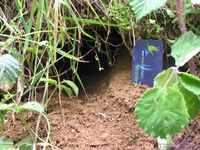 Burrow entrance, Zealandia


The little spotted kiwi had an obligate louse that parasitised on it, Rallicola pilgrimi. In an example of conservation-induced extinction, all lice were killed when the kiwi were translocated to Kapiti Island.[16][17]
This species is long-lived with a mean life expectancy of 45 years.[15]
Distribution and habitat
Studies on Kapiti Island show that they prefer flax, seral, and older forest habitats. Lower numbers are found in rough grassland and scrub, indicating that either they prefer other habitats or they simply need a larger territory to support themselves in these areas.[14]
Behaviour
Little spotted kiwis eat grubs and other small insects that are found underground, and occasionally eat berries. Earthworms, cockchafer beetle larvae, caterpillars, cranefly larvae, and spiders are their most common foods,[18] with annelids making up the largest percentage of the bird's diet;[18] fruit of the hinau tree is also commonly consumed.[18]
As they cannot fly and their eyesight is very poor, they depend on a keen sense of smell, long beak and talons for finding food. The birds use their sharp talons and long beak to dig into the ground and then probe its long beak through the softened ground.[2]
Little spotted kiwi are nocturnal, and will call occasionally each night to advertise its territory and maintain contact with partners; often pairs will duet. They are very territorial, and fight conspecifics with their sharp claws, resulting in many feathers on the ground.
Reproduction

They nest in an excavated burrow, dug by both birds and sometimes lined with plant material. Eggs are laid from July to January. The clutch size is one to two eggs (15% have 2), which are incubated by the male for 63–76 days. Chicks stay in the nest for 2–3 weeks after hatching and require feeding for 4 weeks.[2] The eggs, like in all kiwis, are very large for body size; representing around 25% of the female's body weight, being 10.5–11.3 cm (4.1–4.4 in) in length and 6.8–7.6 cm (2.7–3.0 in), with an average mass of 301 grams. [15]
Conservation
At the time it was described (in the 1840s), the species was common on the western side of the South Island and in Marlborough. A regular trade in skins sprang up and large numbers were collected for European museums. Further, with the advance of European settlement, birds were killed by prospectors and others for food, and their attendant dogs and cats took their toll.[citation needed]
The species was extinct on the North Island by 1938 when the last four South Island birds were moved from d'Urville Island to the population that had been established on Kapiti Island.[9] After they were released on Kapiti Island, they were also moved to Red Mercury Island, Hen Island, Tiritiri Matangi Island, Chalky Island, and Long Island in the Queen Charlotte Sound.[citation needed]
In 2000, about 20 little spotted kiwis were released into Zealandia. This was the first time since the 19th century that little spotted kiwis could be found on the mainland of the North Island.[14] In 2015, 20 kiwis were translocated from Kapiti Island to Anchor Island.[citation needed]
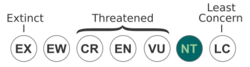
As the smallest species of kiwi, they would be very vulnerable to the main kiwi predators like cats, dogs, and stoats, if not mostly restricted to several off-shore island reserves (mainly Kapiti Island) which are mostly free of introduced predators. The little spotted kiwi's conservation status is listed as "range restricted" by Save the Kiwi, with a growing population. Formerly classified as "vulnerable" by the IUCN,[19] it was suspected to be more numerous than generally assumed. Following the evaluation of its population size, this was found to be correct, and it was consequently downlisted to "near threatened" status in 2008 as, although not rare, its small range puts it at risk. The lack of predators, apart from weka, is important to its increasing numbers. It has an occupancy range of 340 km2 (130 sq mi), and a population of 1,500 mature individuals was estimated in 2022.[1]
In May 2025, 40 birds (20 males and 20 females) were translocated from Kapiti Island to the Brook Waimārama Sanctuary in Nelson, the largest fenced sanctuary in the South Island. The last known population to have lived in the region disappeared nearly a century prior.[20]
In July, two little spotted kiwi were rediscovered on the mainland (outside of a fenced sanctuary) for the first time since 1978, following a tip-off from a hunter.[21] A female and male bird were found in the Adams Wilderness Area in the South Island's West Coast Region.[22]
A translocation of little spotted kiwi from Kapiti Island to Ao-ata-te-pō / Cooper Island is planned to take in 2028, where a trapping program has been carried out by tourist company RealNZ since 2015.[23]
| Location | Population | Date | Trend |
|---|---|---|---|
| Hen Island | 50 | 2012 | Increasing |
| Kapiti Island | c.1200 | 2012 | Stable |
| Red Mercury Island | 70 | 2012 | Increasing |
| Long Island | 50 | 2012 | Increasing |
| Tiritiri Matangi | 80 | 2012 | Increasing |
| Zealandia Wildlife Sanctuary | 120 | 2012 | Increasing |
| Motuihe Island | 30 | 2012 | Stable |
| Anchor Island | 20 | 2015 | Increasing |
| Chalky Island | 50 | 2012 | Stable |
| Total (New Zealand) | 1670 | 2012 | Increasing |
Citations
- ↑ 1.0 1.1 BirdLife International (2022). "Apteryx owenii". IUCN Red List of Threatened Species 2022. doi:10.2305/IUCN.UK.2022-2.RLTS.T22678129A214096691.en. https://www.iucnredlist.org/species/22678129/214096691.
- ↑ 2.0 2.1 2.2 2.3 2.4 2.5 Davies, S. J. J. F. (2003)
- ↑ Gould, John (1847). "On a new species of Apteryx". Proceedings of the Zoological Society of London 15 (1): 93–94. doi:10.1111/j.1469-7998.1847.tb00159.x. https://www.biodiversitylibrary.org/page/12862877.
- ↑ Ramstad (2013). "Genetic consequences of a century of protection: serial founder events and survival of the little spotted kiwi (Apteryx owenii)". Proceedings. Biological Sciences (PubMed Central) 280 (1762). doi:10.1098/rspb.2013.0576. PMID 23677342.
- ↑ Davies, Lisa (16 July 2025). "Endangered little spotted kiwi seen on mainland for first time in decades" (in en-nz). https://www.1news.co.nz/2025/07/16/endangered-little-spotted-kiwi-seen-on-mainland-for-first-time-in-decades/.
- ↑ Gotch, A. F. (1995)
- ↑ Whittell, H. M. (1947). "Frederick Strange". The Australian Zoologist 11: 96–114. https://www.biodiversitylibrary.org/page/39059740#page/132/mode/1up.
- ↑ Herbert, John; Daugherty, Charles H. (2002). "Genetic variation, systematics and management of kiwi (Apteryx spp.)". Some Early 1990s Studies in Kiwi. https://citeseerx.ist.psu.edu/document?repid=rep1&type=pdf&doi=8749d134b92b7063791b57637ef54203456cdfce. Retrieved 2 December 2024.
- ↑ 9.0 9.1 9.2 Folch, A.; Jutglar, F.; Garcia, E.F.J. (2018). del Hoyo, Josep; Elliott, Andrew; Sargatal, Jordi et al.. eds. "Little Spotted Kiwi (Apteryx owenii)". Handbook of the Birds of the World Alive (Barcelona, Spain: Lynx Edicions). doi:10.2173/bow.liskiw1.01. https://www.hbw.com/species/little-spotted-kiwi-apteryx-owenii. Retrieved 18 August 2018.
- ↑ 10.0 10.1 "Little Spotted kiwi" (in en-NZ). https://savethekiwi.nz/about-kiwi/kiwi-species/little-spotted-kiwi/.
- ↑ Herbert, John; Daugherty, Charles H. (2002). "Genetic variation, systematics and management of kiwi (Apteryx spp.)". in Overmars, Fred. Some Early 1990s Studies in Kiwi. New Zealand Department of Conservation. p. 31. ISBN 0-478-22194-0. https://www.doc.govt.nz/documents/science-and-technical/ir191a.pdf. Retrieved 20 May 2023.
- ↑ Hume, J. P.; Walters, M. (2012). Extinct Birds. London: A & C Black. pp. 23–24. ISBN 978-1-4081-5725-1.
- ↑ Jolly, J.N.; Colbourne, R.M. (June 1991). "Translocations of the little spotted kiwi (Apteryx owenii) between offshore islands of New Zealand" (in en). Journal of the Royal Society of New Zealand 21 (2): 143–149. doi:10.1080/03036758.1991.10431402. ISSN 0303-6758. Bibcode: 1991JRSNZ..21..143J.
- ↑ 14.0 14.1 14.2 14.3 14.4 BirdLife International (2008a)
- ↑ 15.0 15.1 15.2 Folch, Anna; Jutglar, Francesc; Garcia, Ernest (2020). "Little Spotted Kiwi (Apteryx owenii), version 1.0" (in en). Birds of the World. doi:10.2173/bow.liskiw1.01. ISSN 2771-3105. https://birdsoftheworld.org/bow/species/liskiw1/cur/introduction.
- ↑ Rózsa, Lajos; Vas, Zoltán (2014-08-22). "Co-extinct and critically co-endangered species of parasitic lice, and conservation-induced extinction: should lice be reintroduced to their hosts?". Oryx 49 (1): 107–110. doi:10.1017/s0030605313000628. https://real.mtak.hu/17477/1/oryx.pdf.
- ↑ "Rallicola (Aptericola) pilgrimi. NZTCS". https://nztcs.org.nz/assessments/20631.
- ↑ 18.0 18.1 18.2 "Apteryx owenii (Little spotted kiwi)". https://animaldiversity.org/accounts/Apteryx_owenii/.
- ↑ BirdLife International (2008b)
- ↑ Gee, Samantha (8 May 2025). "Little spotted kiwi return to Nelson 'turning clock back a century'" (in en-nz). https://www.rnz.co.nz/news/national/560286/little-spotted-kiwi-return-to-nelson-turning-clock-back-a-century.
- ↑ "Little spotted kiwi found on New Zealand's mainland for first time in 50 years" (in en-nz). 15 July 2025. https://www.rnz.co.nz/news/national/567038/little-spotted-kiwi-found-on-new-zealand-s-mainland-for-first-time-in-50-years.
- ↑ "Kiwi pukupuku/little spotted kiwi rediscovered on mainland Aotearoa after 50 years". 16 July 2025. https://www.stuff.co.nz/nz-news/360759060/kiwi-pukupukulittle-spotted-kiwi-rediscovered-mainland-aotearoa-after-50-years.
- ↑ "Why rare little spotted kiwi are heading to a new Fiordland home" (in en). Stuff. 2026-05-19. https://www.stuff.co.nz/nz-news/360980900/why-rare-little-spotted-kiwi-are-heading-new-fiordland-home.
General and cited references
- BirdLife International (2008a). "Little Spotted Kiwi – BirdLife Species Factsheet". Data Zone. http://www.birdlife.org/datazone/species/index.html?action=SpcHTMDetails.asp&sid=9&m=0.
- BirdLife International (2008b). "What's New (2008)". IUCN RedList. http://www.birdlife.org/action/science/species/global_species_programme/whats_new.html.
- Davies, S.J.J.F. (2003). "Kiwis". in Hutchins, Michael. Grzimek's Animal Life Encyclopedia. 8 Birds I: Tinamous and Ratites to Hoatzins (2nd ed.). Farmington Hills, MI: Gale Group. pp. 89–90, 92–93. ISBN 0-7876-5784-0.
- Gotch, A.F. (1995). "Kiwis". Latin Names Explained. A Guide to the Scientific Classifications of Reptiles, Birds & Mammals. London: Facts on File. p. 181. ISBN 0-8160-3377-3.
- "Little spotted kiwi". Save the Kiwi. https://savethekiwi.nz/about-kiwi/kiwi-species/little-spotted-kiwi/.
External links
- BirdLife International (2023). "Species factsheet: Apteryx owenii". Data Zone. http://datazone.birdlife.org/species/factsheet/little-spotted-kiwi-apteryx-owenii.
Template:Birds of New Zealand Wikidata ☰ Q244197 entry
 |  |


